Nonviolence as a strategy versus Nonviolence as a soul-force |
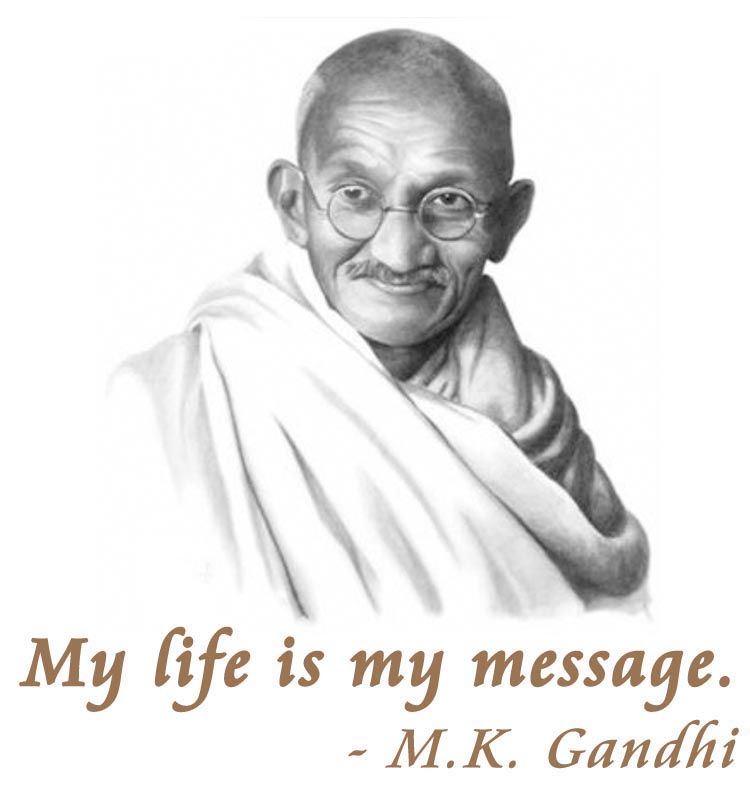
- By Dr. Krishnan Gopal Nandela*Nonviolence as a strategyThe concept of non-violence as propounded by Gandhi in the first half of the 20th century and as Buddha and Mahavir in ancient India (500 BCE) has travelled far and wide into the world. The concept of non-violence is a philosophy of human values. However, it cannot be a strategy but a soul-force as Gandhi himself wanted it to be. When you convert a philosophy into a strategy, the philosophy becomes diminished in essence for strategies are used in wars where they are used as preconceived and circumstantial ideas and discarded when circumstances are not relevant or when they change. Under different circumstances, different strategies are used and hence if non-violence is used as a strategy, even violence will be used as a strategy. Strategy is means-neutral and end-focused. If your enemy sees you failing in your strategy or becomes frustrated with your strategy, the enemy will have all the more reason to increase your frustration and provoke you to abandon the nonviolent strategy for a violent one. Using non-violence as a strategy will therefore lead you into being a plaything in the hands of your enemy. You are therefore sure to lose in the battle between non-violence and violence. Nonviolence as a Soul-forceIf non-violence is used as a soul-force, truth will triumph. Satyagraha is the vehicle and non-violence is the soul-force of Satyagraha. If non-violence is used as a strategy, it will be upheld if it wins and set aside if it loses. If non-violence is considered as the embodiment of the soul-force, it will become one with the Satyagrahi (the one who insists on Truth until he or she falls or until Truth triumphs), even if the Satyagraha fails in achieving its noble ends, the failure will be momentary because the non-violent fight continues as the struggle transfers from one person to the other person in an eternal chain of action called Non-violent struggle. Is there a conflict between nonviolence and violence?World over in the history of hitherto existing societies, violence has always found primacy over non-violence in the hands of kings and emperors, dictators and despots and even elected representatives of people in modern democracies and other forms of governments. Violence is politically expedient and violent nationalism is only an enlarged form of violent tribalism. If nationalism is violent then violent means will be employed and deployed to achieve political ends. The 20th and 21st centuries have and are seeing the accumulation of weapons of small, medium and large scale destruction. There is an ongoing race for the accumulation of weapons of destruction. Many times, the use of violence becomes economically or commercially expedient for the arms and ammunition manufacturing countries of the world. These countries fuel violence in the world by exporting weapons of destruction covertly and overtly to the countries in trouble and in mortal fear of possible violence that may be inflicted upon them. The 21st century world is following the policy of ‘an eye for an eye and a tooth for a tooth’ which promotes violence extensively amongst the countries of the world. We are in the age of moral decay where truth assumes a backseat and expediency assumes the front seat, where the accumulation of wealth is celebrated and advertised, where the accumulation of power is saluted by habitually obedient people across the class divide. In such a state of affairs, heads of States will only pay lip service to the concept and philosophy of non-violence. The concept of non-violence has the status of Swayumbhu (self-manifested or self-existent) because in Gandhian terms it is the soul-force and as it is in the nature of the soul that it self-manifests in the body of the human being and that it is eternal and everlasting and therefore it cannot be in conflict with the idea of violence which is unequivocally the weapon of the ignorant, the coward and the frightened. Hence, Walid Slaiby, a nonviolent thinker from the Arab world was right in saying that, “We are not in a world where violence has won; we are in a world where Non-Violence has not won enough yet.” He further wrote: “Non-Violence is two ‘No’s: No to self-violence, and No to the others’ violence, to injustice. The first No is individual ethical; and the second No is an efficacy both social and political. Therefore Non-Violence is four ‘Yeses’: Yes to love, yes to ethics, yes to justice, yes to efficacy”. Slaiby was right and there may be many other No’s beneficial to the welfare of human kind, hidden in the womb of Non-violence and remaining undiscovered. When more and more people dwell over the concept of Non-violence, more virtues will be discovered and hence as usual the onus of spreading the philosophy of non-violence is on the people who are now engaged with it and therefore a work in progress as Dr. Ogarit, the founder of AUNOHR, Lebanon says that, “the greatness of any human being and the greatness of any cause can only be completed for generations to come, by awareness, training, education and the transfer of ideas, experiences and lessons”. Dr. Ogarit rightly says that “Gandhian values will remain a perpetual traveler, a transient of time and place, needing no permission, no passport… They simply enter into minds and hearts as well as noble ends and effective means, bearing Non-Violence as a gift to “continue to nurturing - educating generations and liberating nations.” The words of Tolstoy, Thoreau, Martin and Bertrand have enduring relevance to humanity and hence they are reaffirmed: With Tolstoy: “Don’t resist evil by evil, violence by violence”. With Henry David Thoreau: “The conscience is the supreme law”. With Martin Luther King Jr.: “The choice is no longer between violence and nonviolence. It is either nonviolence or nonexistence.” With Bertrand Russell: “Remember your humanity and forget the rest”. Gandhi wanted people to follow their own truthsGandhi did not want Gandhians. Gandhi wanted people to follow their own truth. Gandhians may imitate the life of Gandhi externally not only by using khadi and sparse clothing but also by simple living which by itself is welcome and salubrious to the mental and physical health of the society but internalizing Gandhi and moving forward from where Gandhi left is what is required. When you regularly introspect and introspection becomes a way of life, the truth is gradually revealed. One may find one’s own truth and understand others’ truth and be able to attempt a comparison of multiple truths and understand the relative importance of each of the truths understood and identified. Truth evolves; it is not permanent. Truth is not permanent because the human being evolves and the horizons of information, knowledge and wisdom continuously evolve. Individuals who evolve and move ahead of their idols will take the society and humanity forward. Satyagraha is a dynamic process and not merely a strategyThe word strategy was borrowed by the science of Strategic Management from the military work books and now erroneously applied to the concept of Satyagraha. Satyagraha or Insisting on Truth may be a strategy for the politicians in particular and people from other walks of life but for Gandhi, Satyagraha was the soul force and the followers were expected to sacrifice their lives so that Truth alone triumphs in the ultimate analysis. Those who imitate Satyagraha or use the principle as a strategic tool may give up if they find that the tool is not yielding any result and may adopt some other strategy including violence. In that case, the Gandhian principle of non-violence will fail. In order to see that it succeeds, the principle of non-violence and Satyagraha needs to be internalized. Internalization requires spirituality. Spirituality is not religion because religion in the ordinary course of life is a set of rituals which may be practiced as a matter of habit or as a result of indoctrination. Spirituality is to understand the temporariness of matter which is body and that the soul is perennial and transmigrates endlessly. A spiritual person is fearless, understands the overpowering power of non-violence and hence insists on truth or Satyagraha. One may understand the concept of soul intellectually but what is required is permeation of the understanding in your body and soul so that you are willing to sacrifice your body at all times for a cause that is dear to your heart. Gandhi demonstrated through his choices that he was willing to sacrifice his body for a cause that was dear to his heart and a cause that was aimed at the spiritual, material and mental well-being of the people he led. Non-binary ways of thinkingLife is not either black or white. It is actually positioned on the black and white continuum with black at one end and white on the other. Actual life is always grey and there are many shades of grey. Life is holier when you are placed closer to the white and less holy as you are positioned away from the white and closer to the black. The black and white scale of life is not binary but a continuum. There is violence in nature because living involves killing and therefore non-violence. One life must kill another life for its sustenance and therefore violence and non-violence are the two sides of the same coin. What separates human being from the rest of the life on earth is his ability to be compassionate to others including other life forms. For example, a person consciously following vegetarianism can be said to be compassionate to animal life but not so compassionate to plant life. We do not know about the extent of cruelty inflicted upon plant life in the process of converting plant into food. We may appear to be innocuous in consuming plant life and barbarous in consuming animal life. Given the appearance of the two ways of food consumption, one may vote for vegetarianism because it is overtly non-barbaric and less energy/resource intensive and therefore environmentally more sustainable. Therefore the degree of non-violence or love that must be embodied in our lives and in our spirits becomes important. A less violent society is always a more humane society. Non-violence may appear to be the weapon of the weak because violence has the potential to subjugate non-violence but this subjugation is temporary as the body embodying the soul may perish with the soul living on endlessly. Matter is ephemeral and spirit and the soul are perennial. Ideas are non-material and they continue to exist and thrive in time and space and inspire and influence new generations of people. Buddha and Mahavir had left their bodies long ago and Gandhi too had left his body but the idea of non-violence, love and compassion are living on and they will continue to live to eternity. The world today is too afraid of the idea of non-violence and hence they attempt to dis-respect by inflicting violence on the hapless and sometimes others who are less capable of inflicting violence so that the more capable of inflicting violence may survive. This explains the violence that is tormenting people and nations in different parts of the world. There was a time when you did not exist and there will be a time when you will not exist and hence your life is placed between two time periods of non-existence. You are actually placed in the sphere of non-existence and hence your physical identity becomes non-existent in time and space. What is remembered is imagination and history is remembered in imagination and when life dies imagination also dies and there is thus nothingness in time and space. People who understand the nothingness of life will not chart a course of life that is violent and destructive. Instead, they will become creative, compassionate and forgiving and patient enough to bring about desirable changes in human life. I think Gandhi understood that life was imagination and even imagination is ephemeral. References:
* Dr. Krishnan Gopal Nandela is Principal, Swayam Siddhi Night Degree College, Thane 421 302 & International Fellow for Peace and Nonviolence. | Email: krishnannandela34@gmail.com |