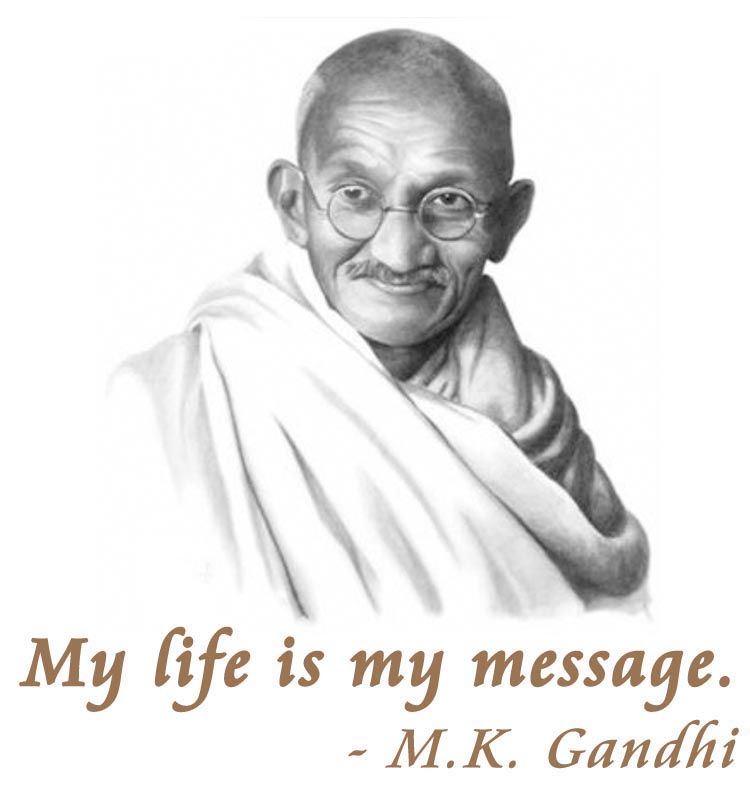
Gandhian Whirlwind and the Image of Mahatma Gandhi in Indo-English Fiction |
- By Rajeshwar Prasad*AbstractThe objective of this paper is to study the influence of Mahatma Gandhi on Indo-English fiction. He was a political leader, but the practice of Truth and Nonviolence for the freedom of India between the period of 1917 to 1947 was unique. He also played an instrumental role in the abolition of many social evils like drinking wine, untouchability, and the sense of high and low. As a result, he resided in the hearts and minds of the masses of India. There were a number of changes in each and every sphere of life and literature, and we find an overwhelming influence of Gandhi in Indo- English fiction. IntroductionMahatma Gandhi is known as the paragon of Truth and Nonviolence which he practiced throughout his life even dealing with the toughest problems faced by him in his personal life and also for securing the independence of the country. He worked in South Africa before leading the Indian freedom movement where he used to live to fight against injustice and class division, and he propagated the philosophy of Satyagraha there and fought against racial discrimination faced by Indians. There were several occasions when Mahatma Gandhi successfully led freedom movements in India. The period between 1920 and 1947 in Indian literature is designated as the Era of the Gandhian Revolution by a number of historians. In this period of India’s struggle for independence, Mahatma Gandhi led the Indian national scene, and his strategies, techniques, and approaches shaped the course of India’s destiny. His personality, image, socio-political philosophy influenced millions of Indians. Several contemporary poets, novelists, and other men of sensibility were widely influenced by him. They looked to him as their literary and spiritual mentor. Because of his magical impact, many Indian-English novelists were inspired to express, reflect, or probe his ideas and ideals in their literary arts directly and indirectly. J. N. Mundra and C. L. Sahni rightly write in Advanced Literary Essays: During those fateful years of India’s struggle for independence, Mahatma Gandhi dominated the Indian national scene, and Gandhian strategies, techniques and approaches shaped the course of India’s destiny. Gandhi's images and personality and his socio-political philosophy influenced millions of people in India, including a large number of poets, novelist and other men of sensibility who looked up to him as their literary spiritual mentor.1 Mahatma Gandhi established an entirely new direction for Indian literary artists in matters of both style and subject. His impact on Indian literature extends far beyond the fictional representation of his own image and philosophy. He was not deeply involved in the literary field, but he wrote frequently in Harijan, Indian Opinion, and Young India, which were famous English-language weeklies of the time and which presented the contemporary social, political, and, economic conditions of the country. These were the main sources to communicate his messages broadly. His style was simple, vivid, direct, and entirely free from any kind of flamboyant rhetorical features of many Indian-English writers of the time. He himself said that he wanted the art and literature that could speak to millions. He did not believe in the theory of art for art's sake practiced in the Victorian Age by a lot of literary artists. He also said that he rejected beautiful things if instead of expressing truth, they expressed untruth. J. N. Mundra and C. L. Sahni rightly write in Advanced Literary Essays: He himself was not a man of letters proper, in the strict sense of the term, but he wrote frequently in his English-language weeklies Indian Opinion, Young India, and Harijan to spread his message. His style was simple, clear and direct, free from the flamboyant rhetoric characteristic of many Indo-English writers of the time.2 The presentation of realism has been an important feature in many novels not only in India but also in different languages of the world. Gandhi gave a powerful impetus to realism in Indian-English fiction, and he insisted on truth in literature. With his insistence on truth in the novel, the prevalence of writing historical romances, adventure or mystery novels, and exotic religious cult novels came to an end. Novelists turned to realistic elements of the contemporary social and political scene for inspiration, and they wrote several novels dealing with realistic themes. In the meantime, the message of Gandhi was more powerful than the international impact of Freud and Marx, and his message of peace and nonviolence, his ethical realism, and the saintly austerity of his personal life counterbalanced their foreign influences in India. This awakened among Indian writers a new sense of national pride and purpose. J. N. Mundra and C. L. Sahni rightly observe in Advanced Literary Essays: Gandhi's insistence on truth in literature and his pragmatic approach thus provided a powerful impetus to realism in fiction. The vogue of writing historical romances, adventure or mystery novels, and novels dealing with exotic religious cults came to an end, and instead the novelists turned to the living reality of the contemporary socio-political scene for inspiration.3 Mahatma Gandhi played an instrumental role in India’s struggle for freedom. He is well-known for his policy of truth and non-violence. He was a supreme political and spiritual leader of India who led the country in the Noncooperation Movement in 1922 and the Salt March in 1930 and later in the Quit India Movement in 1942 during its struggle for freedom. He was also known as ‘Bapu’ and occupied a special place in the hearts and minds of Indians. He adopted the policy of mass disobedience, and non-violent resistance as weapons against British Rule in India and followed the principle of Nonviolence throughout his life. He also endured several hardships, was arrested and occasionally beaten in his journey in the way of nonviolence and Satyagraha and struggle for Justice and freedom. Gandhi started noncooperation, nonviolence, and peaceful resistance as the most effective weapons against British rule. During the Jallianwala Bagh massacre and the violence that followed, after which, Gandhi felt an immediate need for a self-controlled government and total control over all Indian government institutions. Later on, the concept of self-rule or complete individual, spiritual and political freedom evolved. He urged the people to boycott foreign-made goods, and clothes, to resign from government services, and to forsake British titles and honours— encouraging them to wear khadi (homemade) clothes. Gandhi himself wore a traditional (home-made) Indian dhoti and shawl, which was made with yarn he himself spun on a charkha which he felt the need of the time to defeat poverty. J. N. Mundra and C. L. Sahni rightly write in Advanced Literary Essays: Gandhi did not build an original system of thought, for many aspects of Gandhian philosophy were borrowed from popular Hinduism and Jainism. Further he kept on modifying, developing, or challenging his own concepts in the lights of his experience. Nevertheless, the core of his philosophy lies in a few central concepts: Satya (Truth), Ahimsa (Non-violence), Swadeshi (made in one’s own country), swaraj (self-rule), Satyagraha (truth-force), and Harijan uplift (removal of untouchability). These concepts, in varying degrees, found their way into the Indo-English novel of the Gandhian era and continued to inspire the novelists after independence.4 Mulk Raj Anand and Raja Rao are the best who presented the best treatment of the main concepts of Gandhian philosophy. Raja Rao’s Kanthapura and Mulk Raj Anand's works are quite different than those of others, and they stand out both for intrinsic artistic worth and for the elaborate presentation. In Untouchable, Mulk Raj Anand presents the problem of untouchability in Indian society, and in Kanthapura, Raja Rao presents the heart of the entire Gandhian movement by presenting the emergence of national consciousness in a typical village community of South India. These novels vividly show the influence of Mahatma Gandhi on the authors, and their novels vividly show the impact of Gandhian thoughts and philosophy. J. N. Mundra and C. L. Sahni rightly write in Advanced Literary Essays: Among Indo-English novels of the Gandhian era, Mulk Raj Anand’s Untouchable (1935) and Raja Rao’s Kanthapura (1938) stand out both for their intrinsic artistic worth and for the elaborate treatment of a few central concepts of Gandhian philosophy.5 Mulk Raj Anand was a great Gandhist, humanist, socialist, and sympathizer of the poor among all the Indian-English writers of the age. He was widely influenced by Gandhi. He is regarded as the Indian Charles Dickens. In his works, he presented pity and sympathy for the downtrodden class only because of the influence of Gandhi on him. Mahatma Gandhi attracted the attention of Anand when he launched a massive Satyagraha movement in protest against the repressive Rowlatt Act imposed by the British government on India. After this Satyagraha, Anand was too much impressed by Gandhi's ethics of the abolition of untouchability, ahimsa, and simple living. Anand also joined Gandhi's nonviolent movement and was arrested. Later on, he got himself interested in the Marxist doctrine modified by Mahatma Gandhi. J. N. Mundra and C. L. Sahni rightly write in Advanced Literary Essays: In Apology for Heroism Anand tells us that his initial interest in Gandhi's ideas began in 1919 when Gandhi launched a massive Satyagraha movement in protest against the repressive Rowlatt Act imposed by the British government on India.6 In Apology for Heroism Anand tells us that his initial interest in Gandhi's ideas began in 1919 when Gandhi launched a massive Satyagraha movement in protest against the repressive Rowlatt Act imposed by the British government on India. With the mission in mind in 1929, he went to live with Gandhi at his Sabarmati ashram. This was a necessary preparation for his novel untouchable. He took vow to clean latrines, to abstain from wine and women, and abide by the rigorous discipline of the ashram.7 In the Sabarmati ashram, Anand enriched his creative Gandhian vision in close contact with Gandhi. This contact also brought his heart to Buddhist compassion. This is the main reason that in his Untouchable, he is very compassionate, and sensitive, and realistically portrays humiliations and indignities. He presents the sufferings of untouchables and relentless exposure to the Hindu caste system. It also deals with the theme of the theory of karma, which perpetrates inhuman practices against marginalized people. The suffering of Bakha has been very beautifully portrayed in this novel. J. N. Mundra and C. L. Sahni rightly write in Advanced Literary Essays. Untouchable remains a very sensitive and compassionate, and realistic portrayal of the humiliations and indignities suffered by the untouchables and a relentless exposure of Hindu caste system and the theory of karma which perpetrate inhuman atrocities against the downtrodden people like Bakha.8 In Untouchable, Mahatma Gandhi has been introduced as a character toward the end of the fiction. In the novel, Anand very beautifully portrays an excellent and vivid pen portrait of the Mahatma seated, like a child, huddled up between two women, Kasturba Gandhi, and Miraben. Anand very powerfully portrays the impact of Mahatma Gandhi on the masses during the Indian Freedom Movement through Bakha, who is the central figure in the novel. Most people regarded Mahatma Gandhi as a saint-like Guru Nanak or an incarnation of the Gods Vishnu or Krishna. The speech of Mahatma Gandhi is his real and authentic presentation of untouchability which was the greatest evil in the then Hindu society. The central figure Bakha is both mystified and intrigued by the speech of Gandhi. J. N. Mundra and C. L. Sahni rightly observe in Advanced Literary Essays: Anand draws an excellent, vivid portrait of the Mahatma seated, like a child, huddled up between two women, Kasturba Gandhi and Miraben. He also powerfully demonstrates the electrifying impact of the Mahatma on the minds of the people through Bakha.9 The Sword and the Sickle is another great novel of the Gandhian Era, in which Anand demonstrates the conflict between the Marxist and the Gandhian ideologies in the soul of its central character, Lal Singh. Lal Singh, as portrayed in the novel, has returned from a German prison camp during World War I. Lalu finds himself involved in the peasant movement in Uttar Pradesh which was led by Kunwar Rampal Singh, an avowed communist, who frequently quotes Lenin and Marx. He used to celebrate the anniversary of the Russian Revolution with the peasants of Ramgarh. Lalu seeks an interview with Gandhi at Anand Bhawan when the peasant movement gets a setback. He expected that Mahatma Gandhi would help alleviate the hardships of the peasants. He is there astonished, knowing the talk of Gandhi about the spiritual significance of self-sacrifice, suffering, and non-violence. Lalu is also disillusioned to know that Gandhi was much preoccupied with the protection of the cow and the conservative Sanatani Hinduism. But Gandhi refuses to go to Rajgarh. So, Lalu and his party lose their faith in Gandhi and become critical of Gandhi‘s words and deeds in their later conversation. At the end of the story, Lalu realises the truth of Gandhi's faith. Thus, in The Sword and the Sickle, Anand very beautifully presents the influence of Gandhi in the Indian Freedom movement. J. N. Mundra and C. L. Sahni rightly observe in Advanced Literary Essays: The Gandhian image projected by the novel is neither romantic, nor eulogistic. Gandhi is mostly seen through the eyes of Lalu and other peasant workers who feel the magical pull of the Mahatma’s personality but fail to understand the meaning of his ideas and ideals.10 Anand, in The Big Heart challenges the attitude of Mahatma Gandhi toward machines and industrialization. In this novel, Anand shows the Gandhian view through Mahasha Hans Raj. He is an Arya Samajist leader who supports Gandhi. Satyapal is a student leader, and Prof. Majid spreads the gospel of Gandhi's swadeshi (home-made) and pleads with the jobless Coppersmiths to boycott machines. The Coppersmith society is persuaded that the machines are not only the cause of their massive unemployment, but they are also against the ideas of Gandhi. He thought that the machine in India was a symbol of the imposition of British civilization in India. The mechanisation led to exploitation of the poor by the rich. In The Big Heart, Ananta is the protagonist. He has a strong supporter in Puran Singh Bhagat, a Marxist poet who repudiates the Gandhian system of values. Thus, Anand challenges some Gandhian ideas and attitudes. But he never questions the underlying sincerity and humanism. So, we find that Anand shows images of Gandhi in his novels, and are ever authentic, objective, and free from emotional adoration for Mahatma Gandhi. J. N. Mundra and C. L. Sahni rightly observe in Advanced Literary Essays: Professor Majid, a powerful orator, sways the jobless thathiars against Anand and the factory owners by persuading them “that the real enemy is hidden here, the factory which is going to convert you from feudal slaves to wage slaves.11 Raja Rao is another great novelist who demonstrates the influence of Mahatma Gandhi on the Indian masses. His Kanthapura is one of the true interpretations of the image of Mahatma Gandhi. This novel captures the true age of Mahatma Gandhi. This living Gandhi novel is full of Gandhian references, thoughts, and imagery. The novel reveals the theme of Gandhian life and his philosophy. Raja Rao in this novel mythologized, eulogized, and romanticized Gandhi very wonderfully. The novel is a sthalapuran that reveals the myth, legend, religion, poetry, and politics in the village Kanthapura. Kanthapura is a village and whatever happens to this remote village, the same happens all over the country. There are direct and indirect actions revealed in the novel. All the major political and social activities associated with Gandhi during the thirties have been revealed in the novel. They are Dandi March, the Civil Disobedience Movement, Satyagraha, Harijan Uplift, Swadeshi, Swaraj, inebriation, spinning and fasting, police atrocities, the Gandhi-Irwin Pact, the Second Round Table Conference, and several other activities. Moorthy is the hero of this novel, who is the image of Mahatma Gandhi. He is known as a Gandhi-man, Moorthy is a small Gandhi and Mahatma is a big Gandhi. Moorthy is a true follower of Gandhi and a true Satyagrahi. J. N. Mundra and C. L. Sahni rightly observe in Advanced Literary Essays: The image of the Mahatma is projected through Moorthy, who is conceived as a “Gandhi man.” Moorthy is a true satyagrahi, dedicated to self-purification, self-sacrifice, non-violence, truth and the ideal of swaraj. He carries the true humanist who chooses to do the Pariah-work. He carries the dead body of the wife of Puttayya.12 Mahatma Gandhi remained the centre of all political and social actions during the period of the Indian Freedom Movement, and therefore he attracted almost all the writers of his age. In the writings of those writers, Gandhi has remained present in different manners. In Kanthapura, Mahatma Gandhi has been indirectly presented as the centre of all actions over the country and Moorthy as the centre of entire actions in the village Kanthapura. Raghukul Tilak comments: Despite some changes in Moorthy's views, they were all for the Mahatma. Then they heard that the Mahatma was going to the Red-man’s country, and they were sure he would bring swaraj for them.13 Raja Rao presents the influence of Mahatma Gandhi even in a remote village in south India. His influence was more than any other political leader in India at that time, and a mass of people were ready for anything after his declaration. He resided in the hearts and minds of the people of his time. Moorthy was a small Gandhi who led all movements in his village Kanthapura declared by Mahatma Gandhi. Raja Rao writes in Kanthapura: Ganga, Jamuna, Sarswathi, and rising up we dipped again and cried out ‘Mahatma Gandhi ki jai. And Priest Rangappa, coming up, says, ‘Oh, you are all earlier than ever today, hmm?’ and we say, ‘Today the Mahatma manufactures salt with his own hands...14 The spirit of Gandhi pervades the entire novel, and most of the village people continue to pledge their support for the Mahatma, Moorthy fulfils all the actions in his village Kanthapura under the vision of Gandhi. The personality of Mahatma has been very beautifully portrayed by Raja Rao in his Kanthapura. The people of Kanthapura said that they are soldiers of the Mahatma. India is of them and the soldiers are of them, but not the Englishmen. They believed that the day will come when there will be light everywhere. The flowers will be put on idols. Englishmen will go away. Mahatma will speak of love to all men. Raja Rao writes in his Kanthapura: Say Mahatma Gandhi ki jai - Inquilab Zindabad, Inquilab Zindabad- and the police lathis showered on us, and the procession throne fell, and the gods fell and the flowers fell and the candlebras fell, and yet the gods were in the air...15 India secured freedom but through blood and tears of partition, which left India heartbroken and frustrated. The freedom which came was not as was dreamed by Indian writers. It was indeed flawed freedom that took place in the hour of communal disturbances of unprecedented ferocity and unbelievable bestiality. Numerous people crossed the border. Several houses were ruined. A number of lives were wrecked and human values were crushed underfoot. Some people unnecessarily blamed Mahatma Gandhi for the partition of India. It also led to the assassination of Gandhi after some months, and there was the end of the Gandhian era. Surprisingly, after eight years of Mahatma Gandhi's assassination, R. K. Narayan's Waiting for the Mahatma was published. But before this novel, R. K. Narayan published a short story entitled Gandhi's Appeal, in which he deals with the irresistible appeal of Gandhi to the Indian people and shows how Gandhi's magical charm disarmed even those who wanted to be disloyal to him. In Narayan's Waiting for the Mahatma, we see that Gandhi in person is staying at Nallapa’s Grove in Malgudi and years later in Delhi on the fatal day of his assassination. The main story of Sriram and Bharti revolves around Gandhi. So, he occupies a pivotal place in the novel. The novel reveals the dominant personality of Gandhi, which is warm, loving, and good-humoured Bapu. Thus, Narayan's presentation about Gandhi is quite authentic. The novelist presents the main concepts of Gandhian philosophy, spinning on the charkha, his practice of truth, and Satyagraha, abolition of untouchability. He shows how Gandhi touches the hearts and minds of common people, as well as Sriram and Bharti. J.N. Mundra and C. L. Sahni rightly observe in Advanced Literary Essays: Through Gandhi's words and actions, he brings out the major concepts of Gandhian philosophy – spinning on the charkha, the practice of absolute Truth and nonviolence, the idea of purity, self-discipline, and self-reliance, and the removal of untouchability — and shows how Gandhi, through his personal example, touches and transforms the lives of the common people, including Sriram and Bharti.16 The Vendor of Sweets by R. K. Narayan also presents the ideals of Mahatma Gandhi. This novel shows the east-west encounter. In this novel, Jagan, the sweet-vendor is a Gandhian, who finds his son Mali lured away by the West. Mali returns from the U.S.A. With a half-American and half-Korean girl, although unmarried. Mali plans to devise a novel-writing machine, which frustrates Jagan and he renounces the world. It shows indeed the clash of generations and examines the efficacy of Gandhism in the modern world. M. K. Naik observes: Jagan, the sweet-vendor, who is a Gandhian, finds his only son, Mali lured away by the West. Mali returns from the U. S. A. With a half-American and half-Korean girl (to whom he is not married) and has plans for devising a novelwriting machine, making the frustrated Jagan renounce the world.17 Inquilab is another Indo-English novel by Khwaja Abbas, which deals with Mahatma Gandhi through the growing consciousness of the young hero Anwar. Mahatma has been portrayed in this novel as a leading national hero along with some others. It presents the political events of nearly two decades, beginning with the Jallianwala Bagh massacre. Anwar, the protagonist, first sees Gandhi first at Dr. Ansari’s house, where he saw him as a thin, spindly-legged man in a coarse dhoti and kurta, playing with a spinning wheel. J. N. Mundra and C. L. Sahni rightly observe in Advanced Literary Essays: Gandhi is seen here as a prominent national leader along with other leading political figures of the time. The novel coves the political events of nearly two decades, beginning with the Jallianwala Bagh massacre of 1919 to the year of the Gandhi-lrwin Pact, 1931.18 Train to Pakistan is also an important Gandhian novel. In this novel, Khushwant Singh portrays Mahatma Gandhi as a religious man. His novel presents a detailed account of the partition of India and later on communal riots which occurred in Pakistan against Hindus. J. N. Mundra and C. L. Sahni rightly observe in Advanced Literary Essays: Look at Gandhi! | hear he reads the Koran Sharifand the Unjeel along with his Vedas and Shashtras. People sing his praise in the four corners of the earth. Even the English respects a man of religion.19 Chaman Nahal, in his novel Azadi, portrays the same types of views. The people of Sialkot had full faith in Gandhi‘s determination to keep the country united. The central figure in this novel Lala Kanshi Ram cannot even imagine the partition of India. But the partition occurred suddenly for the people of Sialkot. Thus, the faith in Mahatma Gandhi is shattered. J. N. Mundra and C. L. Sahni rightly observe in Advanced Literary Essays: The Congress had a promise to keep with the people. For the last thirty years, since that wizard Gandhi appeared on the scene, it had taken the stand that India was a single nation, not two. And Gandhi was not only a politician, he was a saint.20 Manohar Malgonkar is another famous novelist who wrote a Gandhian novel. He uses a two-pronged approach to Gandhism. Malgonkar simultaneously presents the emptiness and hypocrisy of Gandhi's disciples like Gian in his novel A Bend in the Ganges. He probes the Gandhian philosophy of non-violence. He poses some questions. In his novel, Gandhi appears only briefly in the first chapter. On the other hand, the creed of nonviolence of Gandhi is seen throughout the novel. The novelist presents this from the viewpoint of a terrorist group called ‘the freedom fighters’. In fact, the group has no faith in Gandhi’s nonviolence, and it held Gandhi responsible for the violence committed during India’s partition. Singh, in A Bend in the Ganges, denounces Gandhi's philosophy of nonviolence as the philosophy of the sheep, a creed of cowards. The same idea is uttered by Basu in the novel. J. N. Mundra and C. L. Sahni rightly observe in Advanced Literary Essays: Nonviolence is merely a pious thought, a dream of the philosophers. I shudder to think what disillusion confronts them: what Gandhi will feel when he sees the holocaust that will engulf this country. He will die a thousand deaths. I tell you, he will suffer for each single man that suffers, Hindu or Moslem, but will he ever recognize that mankind is not prepared for true nonviolence - will never be prepared? No! No! He will go on living and preaching his dream.21 Actually, Mahatma Gandhi was ideal for the masses and maximum of the then-political leaders. So, after independence, they took a pledge to rule over the country according to the principles of Gandhi. But in the course of time, they encountered some political and diplomatic problems, they felt that the principles of Gandhi were not too helpful for them. Thus, Nayantara Sahgal's This Time of Morning presents a veteran Gandhian like Kailas Vrind who expresses doubts about non-violence. He also believes that Gandhian ideals like cow protection, sexual abstinence, prohibition, and aversion to science and industrialization had been irrelevant in the twentieth century. Kalyan Singh is his antagonist, who thinks that Gandhi emasculated them. The novel deals with the power politics of Nehru's prime minister-ship, the image of Gandhi is pervasively felt in the reflections Vrind. J. N. Mundra and C. L. Sahni rightly observe in Advanced Literary Essays: The question — Can a sovereign state which has to maintain armed forces for defense live up to the ideal of Gandhi's principle of nonviolence? — posed casually in This Time of Morning had actually become crucial during the Chinese invasion of India in 1962. Gandhian philosophy was found inadequate to meet the new challenges faced by the nation.22 The same type of ideas has been presented by Bhabani Bhattacharya. In his novel entitled Shadow from Ladakh, he shows social realism throughout. This novel is full of conflict between Gandhism and industrialization and technological development. Shadow from Ladakh revalidates the Gandhian philosophy in the context of new changes and challenges in free India. It presents the scenes set in Gandhigram, a replica of Gandhi's sevagram, an embodiment of the rural India of Gandhi's dream, and representing the Gandhian philosophy. Satyajit is a true Gandhist, and the novelist paints the picture of Gandhism through him. Satyajit demands the same rigid self-discipline from his wife Suruchi and his daughter Sumita like him. That was the time of Chinese invasion. He has also some other confrontations and he thinks that Gandhigram is seriously threatened by Lohapur or Steeltown run by an engineer named Bhaskar. J. N. Mundra and C. L. Sahni rightly observe in Advanced Literary Essays: He demands the same kind of rigid self-discipline from his wife Suruchi and his daughter Sumita as he has imposed on himself. He is faced with a great dilemma posed by the Chinese invasion: India was under invasion, and what could the answer be? Armed resistance. Violence against violence. Had he, Satyajit, a second answer? Had he a clear alternate to conflict? What would Gandhiji have done? This question is asked again and again.23 K. S. Venkataramani is also a Gandhian novelist. His Murugan, the Tiller, contrasts the careers of two South Indian friends - Kedari and Ramu. Kedari is a flashy materialist, while Ramu is an introvert. Murugan the Tilleris based on the economic deterioration in rural regions and the alienation of urban people due to urbanization, dealing with the principles of Gandhian ideals. Venkataramani interweaves the novel's central ideas while keeping in mind the ideals of Mahatma Gandhi which were self-sufficient, morally and economically integrated village communities as the elemental unit of Indian society’s superstructure. M. K. Naik observes: Murugan, the Tiller, contrasts the careers of two young south Indian friends — Kedari, a flashy materialist finally ruined by his own chicanery, and Ramu, an introvert, whose spirit of public service brings him spectacular rewards after an uncompromising beginning. The novel ends with Ramu’s founding of an ideal rural colony on Gandhain principles to which he retires with his repentant friend.24 Venkataramani's second novel entitled Kandan, the Patriot has more impression of Gandhism than in Murugan, the Tiller. This tells us the story of Kandan, an Oxford-educated youth. He was in Indian Civil Service but resigns to join the freedom movement, but finally, he succumbs to a police bullet. The story is indeed mainly taken from Gandhian ways of struggle like Satyagraha and ahimsa. The novel ends with the assassination of one of its heroes Kandan, when he was addressing a huge rally in Tranquebar against the British government trying to arouse the national sentiment of the people for the freedom of the country. M. K. Naik observes: The impress of Gandhism is even stronger on Venkataramani’s second novel, Kandan, the Patriot: A Novel of New India in the Making. Set against the background of the Civil Disobedience movement of the nineteen thirties, the novel tells the story of Kanda...25 Three Men of Destiny by A. S. P. Ayyar is another Gandhian novel. This is indeed a novel of impunity. This novel craves social reform. It reveals frequent homilies on the evils of the caste system, pseudo-religiosity, etc. The three men in the novel are Alexander the Great, Chandragupta Maurya, and Chanakya. It shows the invasion of Alexander in the fourth century B. C. M. K. Naik observes: Nothing is more appropriate in the present glorious renaissance period of India, when Eastern and Western ideas are string the people into various kinds of political, artistic and religious expression peculiarly their own than depicting the story of the time...26 Krishnaswamy Nagarajan is also a Gandhian novelist who wrote Athavar House. This novel deals with the theme of a Maharashtrian Vaishnav Brahmin family who was settled in the south for generations. This novel presents economic vicissitudes in the life of the joint family, which was the ferment of the Gandhian age. It shows a number of clashes between orthodoxy and new ideas, along with the stresses and strains of complex family relationships. It presents a true and realistic picture of the time, which is now completely vanishing. M. K. Naik observes: Athavar House (1937) is a Galsworthian family chronicle dealing with an old Maharashtrian Vaishnav Brahmin family settled in the south for generations. The action, spread over almost a generation, covers the economic vicissitudes in the life of the joint family, the ferment of the Gandhian age...27 Chronicles of Kedaram by Nagarajan reveals realism with a sharp sense of irony. It shows the picture of life in a Coromandel coast town during the nineteen thirties, drawn by an insider who tempers his knowledge to be expected of an outsider. It shows the manners and morals of the small town. M. K. Naik observes: The manners and morals of the small town set, its petty religious feuds (in one of which Gandhiji himself has to meditate), the little storms in its tiny social teacups, the flutter in its dovecotes caused by the Gandhian whirlwind...28 ConclusionThus, we can say that Mahatma Gandhi is regarded as one of the greatest leaders in the world and who practiced Satyagraha (truth), and ahimsa (Nonviolence) in the entire part of life. He said that Truth and Nonviolence was his God, while he is regarded as God by millions of people in the world. He started his career as a lawyer in Bombay and later on in South Africa but took part in several political and social movements there and gave a new direction to the country. When he arrived in India, he joined Indian freedom movement and became a national hero and entered the hearts and minds of millions of people in the country of all communities. He was the most regarded man of his time, and his ideals, philosophy, and personality also left an indelible sign in the history of Indo-English literature. Almost all the writers of his time in all the languages of India were largely influenced by his ideals, philosophy, and personality, and we find Gandhi's images in Indo-English fiction. Several Indo-English writers wrote several novels influenced by Mahatma Gandhi are Mulk Raj Anand, Raja Rao, R. K. Narayan, K. R. S. Venkataramani, Nayantara Sahgal, Khuswant Singh, Krishnaswamy Nagarajan, A. S. P. Ayyar, Bhabani Bhattacharya, Manohar Malgonkar, Khwaja Abbas, and Chaman Nahal who enriched Indo-English fiction. Notes and References:
Courtesy: Prasad, R. (2023), Critical Pedagogy Principles Gandhian Whirlwind and the image of Mahatma Gandhi in Indo-English Fiction, * Rajeshwar Prasad is a professor, literary titan, acclaimed poet, playwright, novelist, screenwriter, editor, columnist, thinker, philosopher, and academician who pioneered the Absurd Theatre in India, penning 14 thought-provoking books, 28 research articles and 18 other creations brimming with philosophical depth. His dedication to teaching and prolific writing is evidenced by numerous awards and publications. He has been honoured with 12 national and international awards in literature and education. Email: rajeshwarprasad1981@gmail.com |