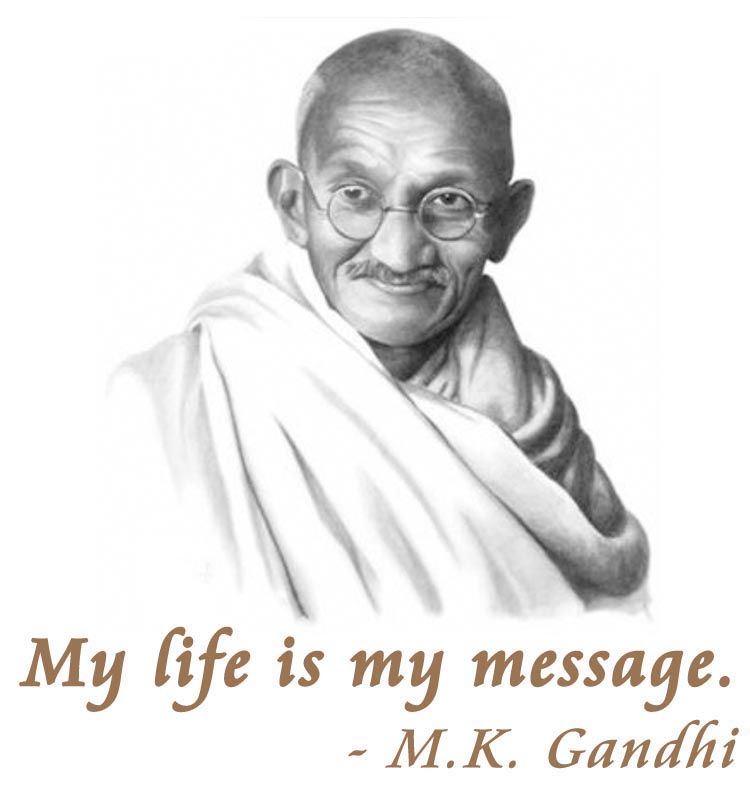
Mahatma Gandhi, Karl Marx, and their creative dialectical relations in 2025 and for the future |
- By Douglas Allen*IntroductionThis essay is significantly revised and greatly expanded and developed from a presentation that I gave as part of the Socialist and Marxist Studies Series at the University of Maine on November 21, 2024. Unlike my many books, book chapters, and journal articles, this essay, while intended to be lively, engaging, challenging, and creative, does not include the usual scholarly documentation, footnotes, and bibliography. Such documentation can be found in my many publications focusing on Gandhi and on Marx. Karl Marx was born in Trier, Germany in 1818 and died in London in 1883. Mohandas Karamchand (Mahatma) Gandhi was born in Porbandar, India in 1869, 14 years before Marx died. Marx was a significant influence in India during Gandhi's lifetime, continuing until the date when Gandhi was assassinated in New Delhi on January 30, 1948. Marx and Gandhi are two of the most significant contributors to our understanding of the modern world. This essay explores how they can be brought into dialectical relations providing new creative understandings and practices. While acknowledging that Gandhi and Marx are two of the most formative, influential, and insightful theorists and practitioners for us today, this essay is informed by a key question: What is living and what is dead in Gandhi and Gandhian perspectives and what is living and what is dead in Marx and Marxian perspectives in 2025? Decades of experiences, studies, and understandings have led me to the conclusion that M.K. Gandhi has often been worshipped and continues to be extolled as the larger-than-life Mahatma. His writings are often taken as dogmatic scriptures. Competing Gandhian and anti-Gandhian approaches and positions are factionalized and ossified. This is often deadly in destroying what is living in Gandhi and Gandhian orientations today. Similarly, my conclusion is that Karl Marx has often been dogmatically placed on a non-dialectical pedestal. His writings are often taken by diverse Marxists as the essential foundational texts with all of the needed answers and solutions. Competing Marxist and anti-Marxist approaches and positions are factionalized and ossified. Once again, this is often deadly in destroying what is living in Marx and Marxist orientations today. At first, one may question why we should even attempt to relate Gandhi and Marx, since they may seem to be diametrically and oppositionally unrelated. Those most informed by Marx and later diverse Marxist orientations usually know nothing about Gandhi or regard him with hostility as an uncritical, escapist, reactionary, religious figure. They claim, or simply assume, that Gandhi has little to offer about class exploitation and class struggle, caste and race and gender oppression, and the modern world. Often similarly, those most informed by Gandhi and later diverse Gandhian orientations usually know nothing about Marx or regard him with hostility as a narrow, reductionistic, secular, immoral, violent, anti-spiritual figure. They claim, or simply assume, that Marx has little to offer about nonviolence, truth, morality, and human and cosmic flourishing in the contemporary world. While acknowledging how Marx and Gandhi often sharply disagree and analyzing their respective strengths and weaknesses, this essay attempts, in selective and creative ways, to bring them into complementary, new, creative, dialectical relations of the greatest value for 2025 and the future. We'll begin by providing a little personal background information on my limited exposure and almost complete non-exposure to Marx and to Gandhi in my youth. Growing up in the United States in the 1950s, we were told that the atheist evil communist Karl Marx hated religion and was mainly committed to destroying religion. I later learned how this was misleading and presented a false picture of Marx. After 2ll. his most famous and most complete formulation of religion was written in his 20s. It consists of seven paragraphs, less than two pages long, and is entitled Introduction to the Contribution to Hegel's Philosophy of Right (Law). Except for the brief Introduction, published in 1844, the work remained unpublished in Marx's lifetime. Marx's concludes the seventh and final paragraph: Now that we understand the illusory imaginary construction, the inverted consciousness, the drug-like opium of religion, let's move on to deal with the real problems of which religion is at most a symptom. During my entire Ph.D. studies, we never read anything by Marx. What I first learned of the remarkable thinker Karl Marx came primarily from struggling along with others in 1960s, 1970s, and later to understand our hidden histories, how to better understand the Vietnam / Indochina war, imperialism, exploitation, oppression, and injustice and how to make better sense of ourselves and our world and then, in the words of the 11* and final thesis of Marx's Theses on Feuerbach, the point is not only to interpret our world, but the point now is to change it. Marx has been embraced by hundreds of millions and by so many diverse and often contradictory Marxist and Socialist groups and perspectives. This does not discount the fact that Marx is also often presented as the most hated and dangerous modern figure. For example, the quickly composed Communist Manifesto, intended by Marx and Engels as a rather brief manifesto and not a lengthy, rigorous, scholarly work, has been described as the most attacked modern political text, while at the same time serving globally as perhaps the most inspiring, glorified, and influential of all modern political writings. Turning to MK. Gandhi, my youthful impressions of him were very different from those of Marx. In my youth, although we never read or studied Gandhi, there were the famous images, slogans, and references to Mahatma Gandhi. These were usually positive, even reverential, although sometimes rather bizarre, as of the saintly figure in loin cloth. Indeed, Mahatma Gandhi was often presented as the most admired moral, political, and spiritual figure in India and even in the world. For example, Albert Einstein, who was a committed socialist, famously asserted of Gandhi that future generations would scare believe that anyone such as this ever walked the earth in flesh and blood. Einstein asserted that Gandhi's political views were the most enlightened and that we should act in Gandhi's spirit, not using violence and not participating in evil. Even in 2025, Gandhi is usually extolled as the world's greatest proponent of nonviolence. Gandhi's birthday, October 2nd, is fittingly recognized by the United Nations as the UN International Day of Nonviolence. Today Gandhi is still often presented as the most admired moral and spiritual figure for our future world. I was fortunate to be the recipient of a youthful yearlong Fulbright grant to India in 1963-1964, and I was even more fortunate to be based in Banaras, Varanasi, the sacred Hindu city, on the sacred Ganges River. Institutionally, I was based at Banaras Hindu University, where I taught and did Ph.D. studies in Indian Philosophy at the top department in India. I'll simply note a formative Gandhi-informed experience from that year that remains significant today. Gandhi's presence was ubiquitous. Politicians, administrators, and others would wear their Gandhi caps and homespun khadi vests. They would give endless speeches extolling Gandhi as Bapu, the martyred Father of the Nation, and Gandhi as the Mahatma, the Great Soul, who provides the exemplary model for India and for the world. This was inspiring, but the pervasive hypocrisy soon became apparent as Gandhi was used and misused for anti-Gandhian purposes. This use and misuse is certainly true in India, in the Indian diaspora, and throughout the world in 2025. We may acknowledge that M.K. Gandhi is so extolled, revered, even sometimes deified, by Gandhians and other admirers, as the larger-than-life Mahatma, too good for this world, who gave us the perfect blueprint with all of the needed solutions to our ethical, violent, political, social, economic, and other crises. Nevertheless, Gandhi was always controversial with strong anti-Gandhian critics during his lifetime, and this continues today. Critics include many diverse Marxists, anti-Gandhian socialists, Dalits (Untouchables, Outcastes), diverse feminists, traditional and conservative Hindus and other religionists, representatives of what Gandhi analyzes and critiques as "Modern Civilization" (capitalists and modern economists, modern representative of the military-industrial complex, modern political theorists, modern scientific, technological, medical, educational, and environmental experts). In what follows, I'll much too briefly and very selectively focus on some of these controversies, strengths, and weaknesses in relating Marx and Marxist perspectives and Gandhi and Gandhian perspectives. Gandhi's Greater Focus and Strength: Violence and NonviolenceM.K. Gandhi repeatedly asserts that his two major principles, values, and presuppositions are Satya (Truth, Being, What is Real) and Ahimsa (No Harm, No Injury, Nonviolence). Mahatma Gandhi is best known as the most influential modern proponent of nonviolence. Gandhi- informed approaches, interpretations, and applications of violence and nonviolence can broaden and deepen Marx-informed understandings and can bring Gandhi and Marx into insightful dialectical relations, sometimes revealing surprising similarities. Marx is often simplistically and misleadingly presented as extremely violent: as uncritically glorifying violence, violent revolution, and a centralized powerful violent communist state. Gandhi, by oppositional contrast, is presented as extremely nonviolent: as against all violence and as a decentralist viewing the state as invariably a violent, coercive, humanly constructed institution. Sometimes quoting Henry David Thoreau, Gandhi asserts that the best state is the least state. The truth is that Marx does not uncritically glorify violence. He views the socialist proletarian state as indeed violent and coercive, but this is necessarily so because the more violent capitalist ruling class will not voluntarily and peacefully relinquish its exploitation and domination, and it will not later desist from its violent attempts at counterrevolution. Indeed, in the gradual transition from post-capitalist socialism or lower communism to communism, Mark repeatedly proposes "the withering away of the state" and a higher and more developed communism that is largely nonviolent and closer to Gandhi's ideal vision. In providing a historical, materialist, contextualized, dialectical formulation, Marx submits that nonviolence is sometimes ineffective, and violence is sometimes necessary. Surprisingly, in hundreds of passages, the nonviolent Gandhi agrees that violence is sometimes necessary, even if it is tragic and should never be glorified. The relative difference is that Marx asserts that Gandhi minimizes the role and need for violence in understanding class, the asymmetrical dynamics of violent class relations, and the positive nature of class struggle. Gandhi, by way of contrast, while repeatedly rejecting class struggle as violent, agrees that violence is sometimes necessary and is sometimes our most nonviolent option available, but he asserts that Marx allows for too much violence and does not recognize our many nonviolent options in lessening violence. In my own view, Mahatma Gandhi, while far from perfect and sometimes revealing serious limitations and even major weaknesses that we should reject, has more of a focus and more of a developed analysis of violence and nonviolence than does Marx. In that regard, I'll rather briefly share some of my own understandings, interpretations, and applications of Gandhi on ahimsa, violence, and nonviolence. Most of us easily affirm that nonviolence is better than violence, peace is better than war, love and kindness are better than hatred and meanness, even if most then qualify this by sharing that we unfortunately live in a violent and unjust world in which violence and war are sometimes necessary. Gandhi then challenges us by claiming that most of us who affirm that we believe in the superiority of nonviolence are really quite violent; we are complicit with violence, sometimes actively support violence, and often profit from violence. How can Gandhi justify such a challenging interpretation? Mahatma Gandhi broadens and deepens our understanding of violence and nonviolence through two interconnected concepts or principles: the multidimensionality of violence (and nonviolence) and the structural violence (to be transformed into the structural nonviolence) of the status quo. When we easily affirm that we are against violence, we usually are thinking of examples of overt physical violence. We are against examples of the unjustified killing of innocent people, of torture and other blatant examples of violating basic human rights, of wartime "collateral damage" killing and injuring civilians, of rape and blatant examples of domestic violence, of lynchings and blatant examples of racist violence, of the terrorist 9/11 mass killings in New York in 2001 or the 26/11 terrorist mass killings in Mumbai in 2008, of the Oct. 7, 2023 slaughter of Jews in Israel and the revenge mass slaughter of Palestinians in Gaza, and more. Gandhi, of course, is against such overt physical violence, but he considers it a relatively small part of overall violence. Gandhi radically broadens and deepens our understanding, resistance, and transformation regarding violence and nonviolence by focusing on their multidimensionality. In addition to overt physical violence, we experience and express hatred and other dimensions of inner psychological violence; poverty, exploitation, and other dimensions of economic violence; linguistic, social, political, cultural, religious, educational, and environmental dimensions of violence. Gandhi also focuses on how the multidimensionality is interconnected with the structural violence of the dominant status quo, which we usually do not even recognize as extremely violent. The dominant, hierarchical, economic, structural systems, even when they seem to be functioning nonviolently without any resisting disruptions, are extremely violent. This is also the case of the dominant political, cultural, social, religious, media, educational, and environmental relational and structural systems expressing and usually hiding and deflecting our attention away from the exploitative, oppressive, unjust, violent status quo. In short, Marx and Marxists, who often have had a history of failing to recognize, too easily accepting, and even supporting all kinds of multidimensional and structural violence, can learn a lot from Gandhi. Marx's Greater Focus and Strength: Capitalism, Class Relations, and Class StruggleTurning to Marx and in which Marx is more developed than Gandhi, Karl Marx has more of a focus on and a more critical and rigorous understanding and analysis of the mode of production and how this constitutes and reveals exploitative and unjust class relations. He provides a more focused and deeper analysis of the nature of commodification, commodity fetishism, dehumanizing alienation, the extraction of surplus value with endless accumulation and expansion of capital. He insightfully contributes to our understanding of the many obstacles to overcoming and moving beyond capitalism and moving toward a classless flourishing society, based on the movement from each according to their means to each according to their needs, a society in which the good and well-being of each is dialectically related to the good and well-being of all. It will surprise many to learn that Gandhi really agrees with what was just expressed from Marx. Gandhi repeatedly asserts that capitalism is essentially and structurally exploitative, violent, and unjust and that he is a committed socialist. Indeed, in various passages, Gandhi expresses admiration for Marx's vision, even sometimes expressing approval for the Bolshevik ideal of communism. He claims that there is little difference between this Marxist communist ideal and his ideal of a post-capitalism beyond ego-driven greed and possessiveness, beyond private property relations and attachments, beyond hierarchical class relations of inequality and domination, and with the realization of a classless society with harmonious relations with other human beings, nature, and the cosmos. Where Marx is much more focused, rigorous, and developed is evident in the fact that Gandhi's formulations and practices are sometimes very uncritical, muddle-headed, and blatantly inadequate. For example, as expressive of his socialism, Gandhi repeatedly claims that capital needs labor, which is certainly true, but also that labor needs capital. He is not simply asserting that labor needs capital in a capitalist mode of production or in a transitional stage still partially defined by capital, as Marx insightfully analyzes. Rather, he bizarrely sometimes seems to be asserting that capital and capitalism are essential, non-historical, metaphysical concepts, that there have always been and there will always be capitalists, and that human nature requires this. This contradicts what Gandhi knows and expresses elsewhere, even if it appeases powerful capitalists in his lifetime. We can present a similar critique of Gandhi's weakness and Marx's strength in relating their approaches to the capitalist mode of production, class relations, and class struggle to our previous clarification of violence and nonviolence. With his focus on the need for nonviolence, Gandhi repeatedly asserts that his project is to use nonviolence to win over and convert to nonviolence the big capitalists, the high-caste Hindus, the males privileged by sexist patriarchy, and others with unjust, systemic, violent power. That is how to bring about permanent nonviolent transformation. Marx would insightfully regard this as at best completely naïve and at worst completely complicit with and supportive of the exploitative, violent, multidimensional and structural capitalist status quo, that Gandhi so often emphasizes elsewhere. For Marx, this greatly explains why the big capitalists so often support Gandhi in the Indian swaraj freedom and independence movement and view him as no threat, completely unlike how they view Marx as a revolutionary threat. Developing the open-ended, dynamic, Gandhi-Marx relations, we now leave time only to rather briefly note three of many other possible ways of bringing Karl Marx and M.K. Gandhi into dialectical relations: ethics, the ego and self, and an organic interconnected approach to truth and reality. These three topics are integrally interconnected with the two major topics previously presented: Gandhi's greater focus and more developed perspectives on violence and nonviolence and Marx's greater focus and more developed perspectives on capitalism, class relations, and class struggle. EthicsI regard Mahatma Gandhi primarily as an ethical thinker and activist practitioner, even if I have evaluated some of his positions as blatantly immoral, as in his advice to Jews facing genocide in Holocaust Germany and elsewhere in Europe. Gandhi is primarily concerned with how we can live moral lives, lives of moral character and virtue, with selfless love and compassion, dedicated to alleviating the suffering of other beings. For example, in the Gandhi-informed view of education, as contrasted with dominant modern views of education, we focus on whether our students through their courses, research, and activities become more virtuous human beings, living lives of greater moral character. In terms of Gandhi's major means-ends formulations, Gandhi-informed students are taught that they cannot use immoral, untruthful, violent, unjust, oppressive means in order to achieve their desired ends (even when those ends may appear to be very worthwhile). Means and ends are dialectically and integrally interconnected, and both our means and also our ends must be as pure, as ethical, and as spiritual as possible. In short, moral development, as transformed by moral education, is essential to human development with the greater self-realization of truth, nonviolence, and reality. Although Karl Marx, unlike Gandhi, is not primarily an ethical thinker and moral activist, his Economic and Philosophic Manuscripts of 1844 and several other works are profoundly significant expressions of a deep ethical humanism. This was recognized by the Marxist humanist philosophers in Yugoslavia ("Praxis Marxists"), by Eric Fromm (Marx's Concept of Man), and by other Marxists, especially in their critiques of what had become dogmatic Marxist-Leninist formulations. Such interpretations of Marx, as a humanist and as an ethical humanist, are very different from the dominant formulations of twentieth century Marxist thinkers, groups, and parties, who often dismiss ethics and morality as bourgeois concerns, completely subjective, unscientific, non-historical, and having no positive role in our modern world. We have witnessed and continue to witness the disastrous consequences of such undermining and dismissal of ethics by both capitalists and Marxists, including some who still use the term communist. By way of contrast, I propose that we cannot understand the passion and legacy of Marx without recognizing the ethical dimension of being human and relating morally to other beings. Although not as obvious, we have also witnessed how so many rigid dogmatic Gandhians, as well as anti-Gandhians, have undermined or completely ignored a Gandhi-informed focus on ethics with disastrous consequences with regard to gender equality and other relations. In this regard, Marx and Gandhi are often not so different with complementary different strengths when it comes to moral living. The Ego, Ego-Attachments, and the SelfMahatma Gandhi has thousands of passages in which he focuses on the nature, the construction, and the negative consequences of the traditional, violent, illusory, immoral, I-me, ego-self and its modern expressions as the ego-driven and ego-attached self, as evidenced in the capitalist self. Gandhi repeatedly proposes the imperative, admittedly difficult to achieve, of the need to reduce the ego-self to zero in order to experience deeper self-realization, often identified with nonviolent realization and truth-realization. This is a lesson that has often been ignored by many rigid, close-minded, reactionary Gandhians, who I've sometimes interpreted as Gandhian fundamentalists. They dogmatically attach their egos to Gandhi as some perfect cult leader and to Gandhi's writings as their perfect sacred scriptures. In addition, contemporary Marx-informed thinkers, parties, and states can learn a lot from Gandhi's greater focus on the ego-self and the need to deconstruct the ego in order to realize Marxist, socialist, and communist proposed goals. It is often forgotten or ignored by Marxists that Karl Marx also focuses on the historical, social, and contextualized nature, the construction, and the negative consequences of the ego-driven, greedy, violent, exploitative, and oppressive modern self, especially as constituted by relations and contradictions within capitalism. As Herbert Marcuse and others have insightfully shown, Marx creatively interprets and challenges us revealing how the rejection of the capitalist ego, with its ego-relations and ego-oriented ways of being, discloses and requires quantitative and especially qualitative breakthroughs on the biological, bodily, psychological, mental, material, historical, social, cultural, experiential levels of being human and of self-realization. We have seen the consequences of ignoring such lessons from Marx in modern societies, often self-labeled or labeled by others, as Marxist, socialist, or communist. Such societies are often driven by greed, possessiveness, inequality, violence, corruption, and injustice, with the accumulation of wealth and power in the hands of their elite ruling classes. In addition, Gandhi-informed thinkers, activists, ashrams, and organizations can learn a lot from Marx's greater focus and more rigorous analysis of key features of contemporary capitalist ego-orientations in order to realize their Gandhi-proposed socialist and even communist goals. Organic, Holistic, Interconnected Approaches to Truth and RealityWe'll consider only briefly the huge topic of Karl Marx and Mahatma Gandhi on their approaches to truth and reality. Without mentioning their many differences, we'll only note several key remarkable similarities. Both, in diverse ways, emphasize the need for an organic holistic approach, recognizing and developing the dynamic, open-ended, interconnectiveness of all life, nature, and reality. Both, in diverse ways, emphasize relational and structural interconnectedness, as revealed and constituted in the complex dynamic interconnected relations between wholes and parts. In complex contextualized ways, both Marx and Gandhi analyze, critique, and reject dominant modern philosophical, political, and capitalist views of the individual autonomous ego-defined self; of modern views of particular objective unconstituted and uninterpreted data, phenomena, or other givens; of claims of value-free particular technology and science, and more. For Marx and for Gandhi, we cannot understand and relate to such particulars without understanding how they are greatly constituted dialectically, both positively and negatively, violently and nonviolently, adequately and in diversionary and illusory ways, by the larger systemic and structural interconnected historical, economic, political, social, cultural, environmental wholes of which they are particular expressions. For example, Marx critiques the modern capitalist approach to and view of technology as some abstracted and essentialized instrument or thing. Instead, he situates, approaches, and views dominant modern technology as capitalist technology, as grounded in the capitalist mode of production, and as expressing interconnected capitalist relations of production. This is qualitatively different from how technology will be approached and constituted relationally in a post-capitalist mode of production and socialist and Marxist ways of living. Similarly, one notes Gandhi's approach to and view of the dominant perspectives on technology, as better understood, critiqued, and transformed as a contextually expressed orientation of Modern Civilization. Gandhi's often describes this as the reductionistic dehumanizing "machine craze," viewing and constituting technology as some end in itself, or usually as some means to realizing modern ends of dominating human beings and nature, accumulating wealth and power. Gandhi challenges us with a radically different approach to technology, as one of numerous ways expressing human related interconnectedness with others, nature, truth, and reality and qualitatively different ways that are relationally constituted and sustainable. For both Gandhi and for Marx, when we relate interconnected wholes with particular expressions, something quantitatively and especially qualitatively emerges that cannot be reduced to or be found in any of the particular parts or even in the sum of the parts. This is a key lesson for both Marxist and Gandhian perspectives in revealing weaknesses of their past and present approaches and interpretations. Interactions with Other RespondentsAfter the presentation part of my program on November 21, 2024, I received many questions and comments from some attending in person or by Zoom. I responded, and this resulted in a lively discussion period. Then, almost immediately after we had finished the program, I received excellent email questions and comments to which I sent immediate responses. What follows are three of those email questions and responses. First, a professor, who teaches peace and reconciliation courses and has deep Irish roots, wrote that he has previously never thought of linking Marx and Gandhi, so the presentation was a great revelation. He had been investigating a newly published edition of Marx's Capital and found that ten pages were devoted to the Irish Famine of 1846-1849. After reading them over, he saw Marx in a new light when he expressed his concern for Irish agriculture following the Famine. It was evident that Marx was a deeply compassionate thinker in his treatment of Irish poverty. Therefore, he proposed that "compassion" was another way to connect Gandhi and Marx. I responded that I agree that compassion is a great term for the kind of dialectical comparisons and relations I was suggesting. Compassion is prominent in Gandhi's writings and living, especially with deep formative influences from Hinduism, Buddhism, and Jainism. In fact, in his approach to Ahimsa, Gandhi often uses terms such as nonviolence, benevolent harmlessness, loving kindness, compassion, and selfless service interchangeably. He even uses Ahimsa and Satya (truth, being, what is real) interchangeably, so that one cannot realize Truth, the spiritual Self, etc., without compassion. Relating Marx with compassion may not seem so obvious. Interpreters often focus exclusively on an impassioned, angry, caustically sarcastic Karl Marx. Such a Marx is so outraged, so furious at class exploitation and injustice, so that "compassion" seems to be an inappropriate way of characterizing him. What is ignored are the thousands of passages in which Marx expresses great compassion for the downtrodden, the exploited, the impoverished, the marginalized, the oppressed; those with the least freedom and the greatest suffering. Second, a medical professional who also has a research position at a school of education, expressed appreciation for how much she learned from the lecture. She then wrote that she had the following question: How would Gandhi and Marx each set social standards that would encourage "each from their abilities" since most today see a good portion of their jobs that need to be done as not fully using their abilities? She asked this because currently there is the highest percentage of working young and middle-aged men out of the U.S. workforce not using their full or a significant part of their abilities, and also because of the current issue of who will do the jobs that undocumented immigrants and so-called "illegal aliens" have been doing and not fully using their abilities? I responded that this participant raised many good questions for Marx and for Gandhi. Marx's famous "from each according to their abilities to each according to their needs," with its best-known formulations in his Critique of the Gotha Program, is his dictum for some future post-capitalist and communist ideal of some classless society. He fully agrees and analyzes why most (almost all) do not see their jobs under capitalism (and other class societies) as fully using their abilities (under relations of domination, dehumanization, mechanization, objectification of humans as things to be exploited, etc.). Also, consistent with what this respondent wrote, Marx analyses the increasing expulsion of labor by capital that no longer needs such surplus labor to generate profit. Also consistent with what she wrote about jobs and "illegal aliens," Marx analyzes how based on the imperatives of maximizing the exploitation of labor power as integral to the accumulation of capital, capital will be increasingly directed at cheaper labor abroad (globalization, outsourcing) as well as the cheapest labor at home (undocumented farm workers, etc.). It is revealing that Gandhi agrees with all of this, but with his own Gandhi-informed perspectives. For Gandhi, class exploitation, caste oppression, racism and sexism, etc., all prevent human beings from using all or even a small part of their human abilities. Instead, as evidenced under capitalism and other forms of "Modern Civilization," the oppressed are used by those with economic, social, cultural, political, and other power as mere means to further their ends. In our modern "machine craze" orientation, humans are devalued, violently and immorally dehumanized, expelled from their lands and jobs, and denied their abilities and potentials to develop and flourish as self- empowering subjects. Of course, how one understands, applies, and transforms such Gandhi-informed and Marx-informed Gandhian and Marxist approaches in terms of our specific contextual situations in 2025 and the future is open to different perspectives, questions, debates, and practices. Third, a young scholar in India, who received his Ph.D. from an Indian Institute of Technology and now teaches in India, responded how the presentation had been very thought-provoking. He then shared many pages of excellent reactions, comments, and questions regarding Marx and primarily regarding Gandhi, and comparing them on a wide range of topics. To share only some of what this respondent wrote, he claimed that Marx, focusing on economic exploitation, class structure, mode of production, and capitalist relations of domination, was much more radical; he was far more revolutionary than Gandhi in his vision, theory, and proposed struggles and practices. Gandhi, by way of comparative contrast, was more of a morally motivated, self-empowering reformer with regard to production, class, caste, and other topics. Gandhi was for burning British clothes so that Indians could produce khadi and be more self-reliant in achieving swaraj. He accepted much of what existed in India, while then attempting to morally reform manual labor, scavenging, sanitation, health practices, and more. With his Hindu morality, Gandhi, unlike Marx, did not propose abolishing as unacceptable dominant Indian class and caste structures, relations, and oppressive practices, but rather to work for societal reforms. For example, on the topic of the Hindu caste system, the respondent offered clear-cut oppositional contrasts between the more radical and worthy Dr. B.R. Ambedkar, with his position on the Annihilation of Caste, and the limited Gandhi, who accepted the Hindu caste system and was then committed to transforming the perspectives, values, and practices of the dominant upper castes, who needed moral refinement, so that they will respond to the suffering of the oppressed lower castes. I responded that the respondent's thoughtful comments raise many open-ended dialogical issues for ongoing questions, debates, and new creative formulations and practices. His comments on khadi, the satyagraha burning of clothes made in Britain, various kinds of manual labor, etc. go beyond what I shared in my original presentation. I acknowledge that what Gandhi literally said about these and other topics and what he actually did are important topics for our reflections, interpretations, evaluations, and applications. But for me what is far more important is, say, how salt in the famous Salt Satyagraha (Dandi March Satyagraha) in 1930, the boycott of British goods with the burning of British clothes (1920 Satyagraha), etc., were constituted by Gandhi in larger symbolic ways, on deeper complex levels of meaning, such as expressing and realizing the struggles for freedom, independence, nonviolence, and truth, and how they can be reimagined in new creative ways today. I accept but give different interpretations to some of many key terms that the respondent kept repeating about collective production, caste and moral reform, social adjustments, other moral reforms, adopting manual labor, and more. All of that is in Gandhi's writing, speeches, and actions, and there, indeed, is often a sharp contrast with some of what one finds in Marx and in Ambedkar. I attempted to be selective in my approaches and interpretations, in recognizing strengths and weaknesses, in Gandhi and in Marx, and I proposed the potential for radical revolutionary Gandhi-inspired and radical revolutionary Marx-inspired formulations and practices. In my selective presentation, for example, Gandhi does not simply accept and attempt to reform what is contextually existing, but, instead, he often rejects old and reformulates new views of the collective, finally rejects and does not want to reform caste, rejects and does not adopt old views of manual labor, and instead reformulates this in new holistic, qualitatively different ways, and more. Since the respondent devoted much of his response to the important topic of the caste system in India, with the extreme oppositional contrast of the radical, more adequate Ambedkar and the more limited, inadequate, caste reformer Gandhi, I'll only allude to a few thought-provoking comments from my own work. Followers of Ambedkar, as well as supporters of Gandhi, typically focus on and present in static essentialized ways the true (or false) Ambedkar, the true (or false) Gandhi, and their specific contextualized disagreements and conflicts that then are presented as their real unchanging positions on caste and other topics. Such static rigid debates and perspectives are often oversimplified, lack nuance and complexity, and lead to dead ends that block our potential for new creative research and applications. I do not ignore these serious differing positions, but by focusing exclusively on these differences, what is ignored is how much Gandhi and Ambedkar share in relating to exploitation, oppression, violence, and other concerns. In addition, to reverse the common presentation of Gandhi and Ambedkar, one can propose for ongoing debate that M.K. Gandhi may be more radically anti-caste! While rejecting earlier unacceptable caste positions in Gandhi, one can submit that there was something radically anti-caste in Gandhi's personality and character, how he organized his ashrams, how he evolved and lived his daily life and moral and social values and relations with Dalits and others, and how, late in his life, he no longer wanted to debate issues of caste because he found caste to be completely indefensible. By contrast, and in larger terms, one can submit that Ambedkar was more of a liberal, bourgeois, modern, constitutional thinker and practitioner, whereas Gandhi radically critiqued this as expressing limited, violent, dehumanizing, immoral, untruthful, dominant "Modern Civilization." Gandhi proposed a far more revolutionary means-ends, radical, qualitative paradigm shift far beyond Ambedkar's position. My aim here is not to uphold Gandhi and reject Ambedkar, but rather to call for an open-ended, creative, dialogical process that will embrace the interactions of radical challenging Ambedkar-informed insights and contributions with radical challenging Gandhi-informed insights and contributions. As expressed throughout this essay, Karl Marx and selectively and creatively Marx-informed values, insights, perspectives, and practices will be central to such dialogical interactions. Concluding ReflectionsThis provides a nice transition to my brief ending on the topic of Mahatma Gandhi, Karl Marx, and their creative dialectical relations in 2025 and for the future. I've attempted to suggest numerous ways for relating Marx and Gandhi, recognizing their differences but also their complementary similarities. Each can provide insights to render more adequate the approaches, views, and practices of the other. In this dialectical relational way, the other, whether Gandhian or Marxist, is integrally related to the constituting self and serves as an invaluable catalyst pushing the self beyond its rigid presuppositions and concepts, its closed boundaries, and its normal comfort zones. This can provide insights and openings for new ways of thinking, acting, and being. I've also suggested numerous ways in which dialectically relating Marx and Gandhi, Marxist and Gandhian perspectives, can involve radical paradigm shifts, perspectival breakthroughs, revealing new ways of understanding and responding to the many existential, moral, economic, political, social, cultural, violent, environmental, and other crises that challenge us in 2025 and in the future. This expresses what is challenging and what also makes contemporary life hopeful, resilient, meaningful, and worth living. Courtesy: Gandhi Marg, Volume 47 Number 2, July-September 2025 * Douglas Allen is Professor Emeritus of Philosophy, Department of Philosophy, The University of Maine. 5776 The Maples, Orono, ME 04469-5776 USA. Email: dallen@maine.edu |