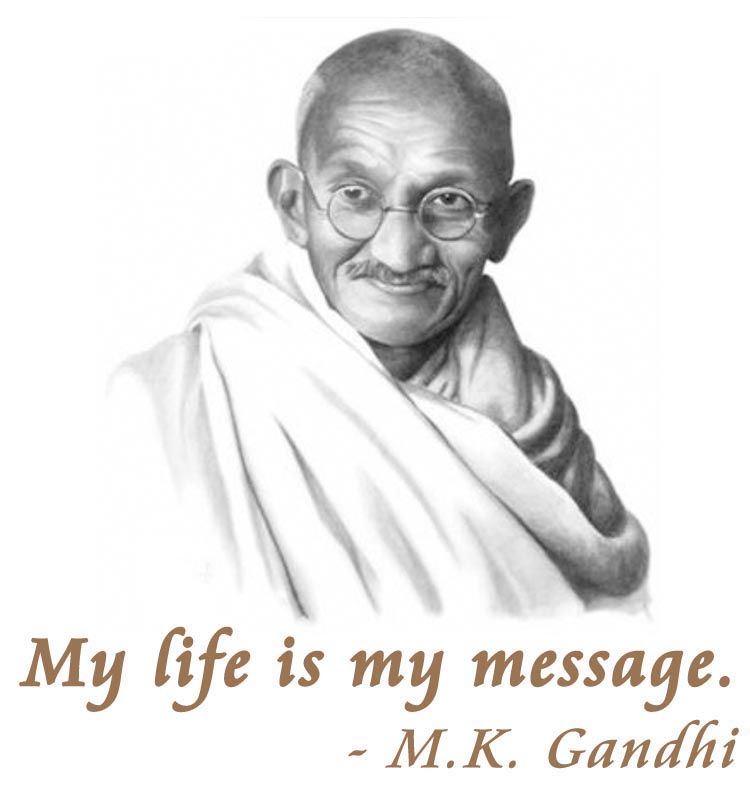
Mahatma Gandhi’s ‘Science of Satyagraha’ is More Powerful than Atomic Weapons: A Humanistic Vision for the Survival of Humanity |
- By Rajeshwar Prasad*AbstractThe twentieth century saw the emergence of two similarly strong and opposite forces that will forever change humanity: the development of the atom bomb and the philosophy of Mahatma Gandhi's Satyagraha. While the atom bomb is viewed as the most advanced scientific mode of destruction, Satyagraha is considered to be the greatest indication of the high moral/cultural/spiritual capacity humans possess. With the ability to wipe a city or a population off the face of this planet within an exceptionally short period of time, the atom bomb serves as an instrument of destruction. Gandhi's Satyagraha serves to awaken the consciences of people, connect hatred to compassion, and ultimately establish justice without using a single act of violence. This article examines why Gandhi's science of Satyagraha represents a moral, political, and humanistic force that is ultimately more enduring than nuclear weapons. IntroductionIn the contemporary world, there are many new inventions in science that are changing the ways we live; however, there are both positive ones that will benefit mankind and, on the other hand, there are also many new methods of destruction that are disturbing. Perhaps the most destructive invention in human history, the atomic bomb demonstrates how scientific advancement can become divorced from moral responsibility. The awful bombings at Hiroshima and Nagasaki underline how people, once they hold that power, can destroy entire cities within seconds. Whole towns were turned to ash, innocent people were killed without distinction, and after that, generations will keep paying the price – because they endured radiation, deep fear, and long-lasting trauma. The birth of the atomic age changed human society in so many ways, including adding not only technological superiority but also existential fear. Coincident with such historical occasions, there arose a different revolutionary force out of India, embodied in the life and thought of Mahatma Gandhi. While scientists dealt with the destructive aspects of matter, Gandhi delved into the remaking of the human spirit. Satyagraha was the method of resisting injustice based upon truth, nonviolence, self-suffering, compassion, and moral courage. Satyagraha was no meek submission; it was rather an active and courageous response to injustice, developed along ethical lines. Gandhi's view made political struggle a moral science steeped in human dignity. At first glance, it may appear unusual to make a contrast between the atomic bomb and Satyagraha, for one is military science and the other moral philosophy. But this contrast was recognised by Gandhi himself. He held that the power of nonviolence is infinitely more creative and alive than violence since violence destroys only the bodies of men while steadily transforming the mentality of a larger section of humanity. The atomic bomb gives terror and leaves room for faith; Satyagraha extends faith and creates faith where there is none. The bomb forces obedience through mere terror, whereas Satyagraha creates and inspires cooperation through the true spirit of humanity. Violence leads to revenge and still further violence, while nonviolence counters with an appeal to the inner conscience of the human population. The philosophy of Gandhi developed out of both practical political and deep spiritual traditions. Gandhi took inspiration from various major Indian religions, particularly those being Hindu and Jain, but he also drew upon ideas contained in Christian as well as Buddhist tradition; in addition to references from writers such as Leo Tolstoy and Henry Thoreau to create an ethical philosophy that transcended both cultural and religious boundaries. In Gandhi's eyes, because the principles of truth and non-violence must work closely throughout all aspects of life to make them relevant and meaningful, their commonality is not only visually represented but additionally extended throughout every aspect of life through action. If either principle is separated from the other, both lose their ethical coherence. If someone clings to truth alone, it can slowly drift into cruelty. And if someone only keeps non-violence, then it tends to turn into weakness. Gandhi therefore regarded them as inseparable ethical principles. As a result, Satyagraha was both an effective and moral method to achieve justice through disciplined action towards this end. Raghavan Iyer rightly observes in an ‘Introduction’ to ‘The Essential Writings of Mahatma Gandhi’: “Satyagraha and sarvodaya were Mahatma Gandhi’s most significant and revolutionary contributions to contemporary political thought. The fundamental concepts of satya and ahimsa, truth and nonviolence, can be found in all the world’s major religious and philosophical traditions. Gandhi’s originality lay in the way he fused them in both theory and practice.”1 The twenty-first century continues to be plagued by wars, terrorism, racism, nuclear standoff, economic exploitation, and extremist ideology, one knows, among other persistent global challenges. Even while countries spend billions of dollars on weapons, millions of people across the globe keep on living without food, schooling, health care or dignity. And the danger of a nuclear disaster continues to threaten all humanity. In a world like that, Gandhi's humanitarian approach seems to have an unmatched need, because his belief that love is stronger than hatred, and that moral bravery is larger than military force challenges the very foundations of civilisation that has been built on violence. This article considers Gandhi's science of Satyagraha as a force that is more powerful than atomic weapons, the philosophical underpinning of Satyagraha, its ethical supremacy over violence, its psychological and political effectiveness, and its ongoing relevance in the nuclear age. Mahatma Gandhi writes in ‘Young India’: “One form of direct action is adult suffrage. The second and more potent form is satyagraha. It can be easily be shown that whatever is needful and can gained by political power perhaps be more quickly and more certainly gained by satyagraha.”2 This article broadly investigates how Gandhi’s humanism offers an alternative paradigm for the survival of civilisation, and it argues – drawing upon historical and philosophical evidence – that even if nuclear weapons can wreck things through physical destruction, Satyagraha still possesses a profound spiritual force capable of sustaining human civilisation. The Concept of Mahatma Gandhi's Satyagraha“Satyagraha” was discovered, successfully practised and fostered by Mahatma Gandhi in his fight against discrimination tied to race and ethnicity in South Africa. The term comes from Sanskrit, and it is derived from two Sanskrit roots: “Satya”, meaning “truth”, and “Agraha”, meaning “firm adherence”, thus, together they suggest “holding firmly to truth”. Gandhi did not describe it as “passive resistance” because, for him, Satyagraha was not “passive” at all, and it was not “feeble” either. Rather, he treated it as an intensely active moral force, brimming with courage, and it requires a commitment to justice, discipline, sacrifice, and steady persistence. For Mahatma Gandhi, truth is not only about correct statements or tidy facts. It is the ultimate spiritual reality. God and truth, in his belief, are one. Thus, the pursuit of truth is simultaneously the pursuit of God. Because of this, Gandhi relied on the practical way of nonviolence, called Ahimsa, as a route to the lived realisation of truth. In Gandhi’s view, the science of Satyagraha is anchored in self-suffering rather than in making other people suffer. This point separates it fundamentally from violence and warfare. A Satyagrahi willingly accepts imprisonment, beatings, humiliation, and even death, yet does not repay those harms by retaliation of the same kind. Such self-sacrifice carries with it a great deal of ethical and psychological power because it brings to the forefront of society's conscience the injustice of the oppressor. Gandhi believed self-suffering purifies both the individual and the political struggle. The Salt March of 1930 stands as one of the greatest examples of Satyagraha in the history of the world. By challenging the unequal laws imposed upon the Empire by the British, Gandhi utilised the method of peaceful civil disobedience to lead thousands in opposing the unjust salt laws. This movement awakened global moral consciousness. Despite its military might, prisons, and weapons, the British administration found it increasingly difficult to suppress a movement founded upon truth and nonviolence. Gandhi was able to prove that moral authority could be more powerful in overthrowing an empire than military force. Louis Fischer rightly observes: “The entire night of 5 April, the ashramites prayed, and early in the morning they accompanied Gandhi to the sea. He dipped into the water, returned to the beach, and there picked up some salt left by the waves.”3 Satyagraha was therefore not only a method of political resistance, but it was also this full way of living, a comprehensive way of life. It asked for self-control, humility, compassion, courage, and faith in humanity. Mahatma Gandhi seemed to have this profound conviction that hatred, if somebody lets it keep growing, will ultimately destroy both the victim as well as the aggressor. The purpose of Satyagraha must not be about humiliating the opponent, or even more cruel, erasing them. Instead, it should be about morally transforming the other person. Meaning, people don't look at our opponent as an enemy one must defeat, more like a human being with the capacity for moral transformation, to change direction. Nuclear Weapons and the Crisis of CivilisationNuclear weapons are the terrible culmination of a violent civilisation. Nuclear bombs represent scientific knowledge without a moral code to govern them. The creation of nuclear technology during WWII has radically changed the nature of war forever. Mankind now has the ability to totally destroy itself. Unlike conventional weapons, nuclear weapons can cause not just the death of the soldier but also the death of entire populations, ecosystems and all future generations. Hiroshima and Nagasaki demonstrated how far technological violence could go. Hundreds of thousands of people died immediately or from the long-term effects of radiation following the atomic bombings of Hiroshima and Nagasaki. Beyond that, quite a number of children were later born with defects, or the survivors had to carry trauma for the rest of their lives because of those bombs. Nuclear warfare transformed human suffering into destruction on an unprecedented industrial scale. Therefore, we are now in a position where advancements in science might lead to mankind being completely wiped out. Rajmohan Gandhi writes: “…after atom bombs were dropped on Hiroshima and Nagasaki, Japan surrendered.”4 Gandhi expressed a great deal of moral agony over atomic weapons. He contended that the atomic bombardment was the final proof that modern civilisation is bankrupt. He stated that the appearance of temporary "victory" in violence is always followed by the end of the use of violence as a result of self-destruction. Gandhi believed that as long as people used fear to bring peace, there would never be true peace. Peace established on a foundation of panic will always be unstable and inhumane. The atomic arms race has increased the insecurity of the world instead of making it safer. Countries are amassing great amounts of destruction while distrust and fear increase. Gandhi believed that reliance on violence inevitably generates further violence. Each new weapon creates the perceived need for another, resulting in an endless cycle of militarisation. Thus, humanity is now in a state of constant anxiety. The use of atomic armament illustrates the stark contradiction between the religious and spiritual development of mankind and the growth of civilisation. The capability that has been given to mankind through science has not been matched by an equal level of moral development. Gandhi recognised that this disconnect was dangerous. He believed that if man were to continue to grow materially through advancements in science and technology without also progressing ethically and spiritually, then he would ultimately destroy himself through both. Although nuclear weapons can kill millions, the method can also leave many people without any physical evidence or proof of hatred, greed, injustice, or fear – the underlying reasons for conflict. Gandhi understood that the elimination of one person due to military superiority does not create peace; true peace will only be achieved through moral transformation. The Satyagraha concept is the method of addressing the issues behind the violence rather than simply the symptoms of that violence. The Humanistic Foundation of Gandhi’s PhilosophyGandhi's philosophy is based on a profound respect for each person's inherent dignity as an individual. For Gandhi, there was no distinction between one person and another based upon nationality, religion, race, or economic status. For him, every individual has inherent rights to exist as a person of worth. This commonality among all people forms the moral basis of Satyagraha. Gandhi refused every kind of injustice, including exploitation, discriminatory treatment and domination. He pushed back against the harms faced by the oppressed, because colonial rule, untouchability, intolerance, and economic inequality were widespread. His nonviolence was active, courageous, and transformative rather than passive. His humanism was not merely idealistic; it was fundamentally practical rather than merely theoretical. He kept close to the everyday people, and he even adopted a simple way of life. Mahatma Gandhi writes in his letter: “The prayer you will note, is not exclusive. it is not restricted to one’s own caste or community. It is all-inclusive. It comprehends the whole of humanity.”5 Gandhi also pointed out that there is no real distance between the means we select and the ends we are trying to reach. There can be no peaceful society achieved with violent methods of struggle for peace, as the means become the nature of the end product we create through that method. Therefore, using hatred to achieve a Just Society will mean that we will continue to live in a society that will be filled with hatred. So, Gandhi argued that our goals of nobility must also be attained through methods of nobility. Gandhi's teachings are diametrically opposed to the justifications used by the Nuclear Age. The inhumane justifications for the destruction of human life through nuclear weapons, because of security for the country or victory for a nation, are morally inappropriate because power is more important than humanity. Gandhi sees life as being of sacred value, beyond any political calculations. Regarding Satyagraha, Gandhi’s humanistic perspective also shows deep compassion and forgiveness by the person who practices Satyagraha, in that every human being, even the aggressor, has within him moral potential. Satyagraha is fundamentally concerned with reconciliation rather than vengeance. Forgiveness is indeed the result of the great power of the soul, and it needs incredible courage. Gandhi's Satyagraha has influenced many people throughout the world, and they have practised it very successfully. They stood as the changemakers of their country and society. Examples of Gandhi's influence include Martin Luther King Jr.'s use of nonviolent resistance during America's Civil Rights Movement, which the world witnessed. For him, nonviolent resistance was not just one tactic among many but a complete philosophy, a form of faith through which he hoped to help not only the oppressed but also the oppressor. In the same general direction, Nelson Mandela acknowledged Gandhi's influence on the struggle against apartheid, although the South African movement later adopted multiple strategies under different circumstances. It is evident that Satyagraha can matter on a global scale, because Satyagraha is able to confront racial discrimination, colonial rule, dictatorship, injustice and even social inequality without going back to the same repeating violence. It suggests that Satyagraha can work as a practical method to face those problems. Unlike other forces that simply tear things down, like nuclear weapons, Satyagraha tends to bring people together, and it fosters shared sense of purpose between sides that do disagree. Why Satyagraha is More Powerful than Atomic WeaponsSatyagraha's advantage compared to atomic bombs can be understood in four dimensions: morality, psychology, politics and spirituality. Using bombs is mostly grounded in fear; the whole idea is founded upon fear. Gandhi said that only those who want to use weapons have fear. Satyagraha arises from courage and truth rather than fear. Fear is detrimental to humanity, while courage promotes it. While force may produce temporary subjugation, it cannot produce authentic loyalty or moral consent. Empires based on military might ultimately will fall because oppression breeds resentment and rebellion. Satyagraha transforms the human spirit more profoundly than does any Imperial regime by appealing to conscience. Satyagraha seeks co-operation by choice, not by compulsion. Satyagraha not only preserves life by confronting injustice; it provides more powerful evidence of inner strength by demonstrating a willingness to endure suffering for the sake of truth than does a willingness to resort to killing. A soldier may be able to defeat an enemy using weaponry; however, a Satyagrahi conquers his fear with inner strength. This inner victory has lasting value. Mahatma Gandhi writes: “To embrace satyagraha amounts to taking a great vow. Having taken it, one must die rather than forsake it. Such is the profound import of satyagraha, and it is for this reason that satayagraha may be said to know no defeat.”6 Satyagraha is also powerful due to its constructive aspect. Violence produces destruction of infrastructure, economies, communities and relationships. Satyagraha produces solidarity, trust, and awareness of morality. Gandhi looked upon politics not merely as a struggle for power but rather as the establishment of an ethical society. This is indeed an example of Satyagraha building civilisation rather than destroying it, as demonstrated throughout history. Violence directly hurts the mind and the heart and leaves long-term psychological scars on both the victim and the persons who cause it. Studies have shown that exposure to war frequently produces long-term psychological trauma among both combatants and civilians. They often develop an increased sense of hatred toward their perpetrators, and the cultures from which they come become emotionally damaged as well. Satyagraha also leads to the development of self-discipline, compassion, and a clearer understanding of moral standards. The use of Satyagraha will increase the quality of character rather than degrade it. Spiritually, Gandhi viewed nonviolence as the highest manifestation of humanity's evolution; animals survive through the use of their bodies and physical might; humans utilise consciousness and rationality to exist, therefore reliance upon violence is a lack of moral evolution rather than progress; thus, Satyagraha is representative of mankind's highest spiritual evolution. The atomic bomb can kill millions but cannot forge love, justice, and reconciliation; however, Gandhi's philosophy has weathered the test of time and has become a legacy left to generations and across cultures and continents; its legacy lives well beyond the life cycle of political empires and military powers. Therefore, Satyagraha has the moral capacity to outlast all destructive technology. Relevance of Gandhi’s Satyagraha in the Contemporary WorldThe twenty-first century is facing many of the same crises as Gandhi's time: intolerance, violence, inequality, exploitation and confusion about right and wrong. There are serious nuclear tensions between powerful countries. There is a lot of fear in societies because terrorism keeps happening. At the same time, political discourse more and more includes hate-filled and extremely polarising words, even when people pretend it's normal. Economic systems usually lean toward profit, not human welfare. The environmental destruction threatening our planet is at a critical point, and this will affect our ability to stay alive on Earth. In times like these, Gandhi gave clear directions and guidelines on how to take care of ourselves and the planet; however, sometimes they are hard to follow initially. His idea of Satyagraha reminds humanity that peace built through domination and pressure or violence cannot endure. For humanity to get something truly enduring, we have to strengthen our capacity so we can join in dialogue, show empathy, and pursue justice instead of leaning on the tools of militarism. Gandhi also put forward a framework for living simply and with ethical responsibility, and this framework helps individuals face today’s problems like consumerism and environmental exploitation in a more straightforward way. Mahatma Gandhi says: “I cannot say either that I myself know all the laws. This I do assert that every worthy objects can be achieved through satyagraha.”7 Also, a number of modern protest movements are inspired by Gandhi’s principles of nonviolent resistance. They keep using approaches based on nonviolent resistance – peaceful protests, civil rights efforts, environmental justice, gender equality, and democracy – and they also push the idea that moral legitimacy matters, as a way to make social change work better than violent methods. Gandhi's thought also challenges the ethics of scientific progress. The pursuit of technological advancement without moral accountability poses a significant risk to the future of all people. As technology continues to advance, so does the global threat to humanity increase. He also reminds the modern world that the purpose of science is to help people rather than to harm them. In today's world, Gandhi's humanistic philosophy is needed more than ever because political structures cannot handle ethical dilemmas on their own; while laws are useful for controlling a person's behaviour, internal change must take place before true peace can exist. Satyagraha works to deal with personal ethics and, at the same time, the political institutions, especially when it comes to social justice. Gandhi's teachings extend beyond politics; they encompass education, religion, economics and even international relations too. What stays steady is his confidence in truth, in compassion and in non-violence, and that makes a universal moral framework which goes beyond cultural and ideological lines. In a world that is becoming increasingly fragmented, Gandhi’s message kindles hope for a shared humanity. ConclusionSatyagraha (the pursuit of truth through nonviolence), developed by Mahatma Gandhi, is one of history's greatest ethical accomplishments because the philosophy of Satyagraha offers a radically different view of the world from that which is offered by violence. In an age when the majority of our world is characterised by violent militarism and the use of technological weapons of mass destruction to accomplish domination over others, Gandhi's vision of a pervading force for good based upon truth, non-violence, love and dignity for human beings, stands in stark contrast to the world's reality today. While atomic weapons clearly show the force of humankind to undo itself, Satyagraha points to the possibility that we can shift into a more elevated moral state. Mahatma Gandhi firmly believed its potent force. Charles F. Andrews writes: “And my confidence is unshaken that, if a single satyagraha holds out to the end, victory is absolutely certain.”8 An atomic bomb may destroy a city, but it cannot conquer the human conscience. It may spark panic, yet panic has never managed to build lasting peace. Also, violence keeps summoning violence, and in the end, it deepens the spiral of hatred and fear. With an amazing understanding of the above-mentioned tragedy, Gandhi presented Satyagraha not as a position of weakness, but as a position of the utmost strength, and said that the basis of Satyagraha is the concept of self-sacrifice versus aggression, compassion versus vengeance, and truth versus oppression. The moral superiority of Satyagraha rests on the respect that it has for all forms of life. Gandhi insisted that political struggle cannot be separated from ethical responsibility. No noble ends can justify corrupt means because we cannot obtain justice through injustice. Satyagraha is still very relevant right now, as we step into a world that’s threatened by the possibility of nuclear terrorism and the pull of rigid ideology. Gandhi had a philosophy centred on humanity, which held that every single individual possesses worth, regardless of their race, faith, nation, or socioeconomic status; this philosophy held a great deal of significance to him. He also unwavering faith in nonviolence. It felt to him that Satyagraha was not formed to crush the other side, or to ruin our opponent, but to awaken them, so they become more alert to their own morality, for the sake of humanity and civilisation. Although this appears simple, it requires immense moral discipline. It asks for restraint even when everything else is pushing one forward. And this whole way of reaching one's aims is a sharp difference compared to people who spread their ideas using violence, rancour, or outright hatred. When people look at history, Gandhian nonviolence has actually held up, over time too, and nonviolent movements have reshaped a lot of nations across the planet, while not going into violent means. Thomas Jefferson and Franklin Delano Roosevelt were personalities who had great moral courage (to push history forward) that was not based solely on physical force, but on an entirely different form of persuasion. It appears at this time that our collective existence as a global community is attempting to manage all these burdens at once: nuclear threats; the destruction of the global environment; tremendous inequalities between social classes; and political oppression. The continuation of civilisation depends not only on what technology can build, but also on our moral understanding of how to live in a more sustainable way. Gandhi’s Satyagraha therefore remains profoundly relevant. And it remains urgently needed for the world we have today. It keeps reminding us that real strength is the ability to heal, to reconcile, and to steer change toward something better, instead of just pushing harder. Even if atomic bombs come with huge physical power, Gandhi’s satyagraha has far greater spiritual force. Such weapons may dominate temporarily yet truth and nonviolence ultimately liberate humanity, in the long run. Gandhi’s teaching still points us toward a more gentle, steadier and more humane world. And at the end, Satyagraha is stronger than atomic weapons because it guards more than just countries – it shields the very inner soul of humankind. Firmly, it can be said that if Satyagraha is practised by genuine people to solve the thousand-year-old Gaza-Israel conflict, the several-year-old Russia-Ukraine conflict and months America-Iran conflict, these issues will be solved very easily and without any loss. I hope the leaders of the world, along with the people related to these, will understand and practise Satyagraha for solving these. References:
* Rajeshwar Prasad is a professor, literary titan, acclaimed poet, playwright, novelist, screenwriter, editor, columnist, thinker, philosopher, and academician who pioneered the Absurd Theatre in India, penning 14 thought-provoking books, 28 research articles and 18 other creations brimming with philosophical depth. His dedication to teaching and prolific writing is evidenced by numerous awards and publications. He has been honoured with 12 national and international awards in literature and education. Email: rajeshwarprasad1981@gmail.com |