Gandhi and Peace in the Museums of the World |
- By Elisabetta Colagrossi*AbstractThe article is about Gandhi’s musealization as a pacifist leader in the world. Particular emphasis has always been placed on the figure of Gandhi as a symbol of peace, a concept that encompasses many aspects of his vision. Gandhi’s pacifism is not only a rejection of war, passive nonviolence, but it is an active force, which, in order to be realized through satya (Truth) and ahiṃsā (nonviolence), acts on two levels, spiritual and political. This includes a transformative dialogue between individuals and nations, the renunciation by the great powers of imperialist designs, nuclear disarmament, the ideal of the sarvodaya (universal uplift), and practicing voluntary poverty. To understand whether these aspects are evaluated, the author analyzes significant museums for peace in India and outside India, taking into account the particular historical and cultural contexts to which they belong. These institutions give audiences access to witnessing aspects of the universality of the Gandhian message, reflecting a communion between East and West. While recognizing that in the choices made by museums we sometimes witness the exploitation and trivialization of the Mahatma, for the purpose of commercialization, they have the capacity to restore, if not the entirety and complexity of the historical figure and his message, at least a part of it and an invitation to deepen and explore its meaning. Introductory ReflectionsWith these words Gandhi, in October 1939, warned his supporters: One warning I should like to issue to my admirers. Some would like to erect my statues in public places, some others would have portraits, yet others would proclaim my birthday as a public holiday. . . . Avoidance of such opportunity is a real service to the country and me. Statues, photographs and the like have no place today. The only praise I would like and treasure is promotion of the activities to which my life is dedicated.1 These recommendations were completely disregarded. For example, the anniversary of the Mahatma’s birth is celebrated as a public holiday (Gandhi Jayanti) and has also been declared by the United Nations, since 2007, as “International Day for Nonviolence,” and his image is visible everywhere, all around the world. It is impossible to count the statues and images that portray him, as a political leader, a saint, a champion of nonviolence, or an ambassador of some brand – from food, clothing, technology, and other industries – depicted on posters, t-shirts, magnets, toys, all kinds of objects, to the point of becoming the most successful brand that India has ever produced.2 The image of Gandhi has been so iconized, musealized, exploited, simplified, trivialized, and distorted that it is legitimate to wonder what happened to his real message and the complexity of his figure. The characteristic of trivialization is an objectifying representation, which does not refer to anything except the simplified and objectified message that is intended to convey. Of course, by its nature, the icon, whether in marble or pictorial form, is all the more profound the more it knows how to document life itself, its deep mystery, placing itself against any reduction of life to an object, to something that can be trivialized and manipulated for commercial purposes. Indeed, this range and different uses reflect how representations of Gandhi in museums sometimes are true and profound, other times used for propaganda – a range of ideological and political purposes. Particular emphasis has always been placed on the figure of Gandhi as a symbol of peace, a concept that encompasses many aspects of his vision. The idea of peace that Gandhi symbolically embodies has made him a very present and represented subject in museums for peace. But, from the start, it is necessary to point out that Gandhi was not a systematic thinker, and he considered his doctrine to be an ‘open’ thought, always in evolution. His philosophy of peace has many influences, including Jain, Buddhist, Hindu, Christian sources, the teachings of Jesus, Socrates, Tolstoy, Ruskin, and Thoreau, and all this is inextricably linked to the political struggle for national independence from the British colonial empire. The Gandhian position is much more complex than generic pacifism. It presents various aporias, and several open problems. For example, and contrary to popular depiction, Gandhian pacifism did not have an absolute prohibition on killing, since in some cases refraining from killing was considered by Gandhi a form of himsa (violence) or a lack of compassion.3 The imperative at the heart of this ethics, as Giuliano Pontara emphasizes, is rather: “Act in such a way that your action leads to the greatest possible reduction of long-term violence and in all its forms.”4 Furthermore, Gandhian peace is not only a rejection of war, passive nonviolence, but it is an active force, which, in order to be realized through satya (Truth) and ahiṃsā (nonviolence), acts on two levels, spiritual and political. This includes a transformative dialogue between individuals and nations, the renunciation by the great powers of imperialist designs, nuclear disarmament, and the ideal of the Sarvodaya – that is a type of economy that has as its objective not the accumulation of personal wealth but the well-being of all and practicing voluntary poverty. It is interesting to analyze whether these aspects are valued within the various museums around the world in which the Mahatma is depicted, and to what extent.5 Gandhi in Museums: Overview and Selection outside IndiaMy analysis stems from a selection made necessary by the impossibility of dealing with all museums depicting Gandhi. I therefore privileged the institutes that I have had the opportunity to contact or visit directly. The museum is a material support of cultural memory, which cannot be kept alive by itself; it is not capable of self-determination, but is based, as Aleida Assmann underlines in her influential studies on the subject, on certain policies of memory or oblivion.6 Gandhi’s memory was not kept alive automatically, but, like any memory, it was shaped, modified, and sometimes even distorted over time. There are therefore many different memories of Gandhi that require recognition and which reflect certain concepts of peace. In this sense, individual museums in this chapter are placed within their specific cultural contexts and goals. The “Wise Peace Hero.” Vienna Peace MuseumBelieving, like much of the Western tradition, in the universality and exportability of Gandhi’s message, the Vienna Peace Museum, founded in 2014, describes him as ‘our wise Peace Hero.’ His name even appears in the museum’s mission description: Peace Museum Vienna attempts to conduct peace education through the lives of its Peace Heroes. These heroes include historic as well as contemporary figures, who spent their lives either promoting peace through their profession, such as the sociologist Johan Galtung, or practiced nonviolence as their main strategy for a peaceful life, such as Mahatma Gandhi.7 The museum is located in Blutgasse, one of the oldest streets in Vienna. It hosts regular exhibitions, offers a space that serves as a meeting point for discussions on peace, an exhibition hall, a center for the presentation of films and documentaries, and a library. There is a space for the World Peace Kitchen, a culinary laboratory, where visitors from different countries gather to prepare food together from their countries of origin such as Afghanistan, India, and Pakistan, to stimulate conversation and share cultural diversity. A distinctive and impactful exhibit is ‘Windows for Peace,’ an open-air public exhibit available 24 hours a day, with no admission fee. Visitors can stroll from street to street, window to window, learning about the life and impact of the museum’s “heroes of peace.” Windows for Peace shares images, quotes, and biographies of many international peace heroes and encourages people to be inspired by the windows and support the cause: to “help change the world into a better, more peaceful place, one window at a time.” There was the Gandhi window, in 2014; the idea was to inspire visitors who looked at these windows, who read the quotes, the biography of the Mahatma, to then ask themselves “What can I do for peace?” The “Missing Winner.” Oslo Nobel Peace PrizeGandhi was nominated five times for the Nobel Peace Prize, but he never received it.8 This omission was taken seriously by the Nobel Peace Center, in Oslo, which opened in 2005. The museum designs exhibits each year in honor of the Nobel Peace Prize winners, as well as having information about all the past peace prize recipients. “Eye on Gandhi” was the exhibit created for the “missing winner,”9 and it was on view from September 21, 2012, to February 17, 2013.10 The exhibition set out to explain the reasons why Gandhi was not the winner of the prestigious prize, alongside exhibiting the Mahatma’s nominations from the Nobel Committee’s archive for the first time. The Norwegian committee never commented on the reasons why Gandhi did not receive the award, nor was the documentation available on this. He was nominated among the shortlist of 13 eligible candidates for the first time in 1937 and a number of times afterward. There were a series of factors such as critiques of the extent of Gandhi’s pacifism and political pressure and concern about awarding a pacifist the Prize during World War II and alienating the British and other Allies. Gandhi was assassinated in 1948, and that year no Nobel Prize was awarded, whether he would have been the recipient remains open to speculation. The documentation is embellished by pictures from the gallery of French photographer Henri Cartier-Bresson, one of the last people to have seen Gandhi alive, an hour before his killing. His photographs of this tragic moment, and how it was experienced by India, are famous all over the world. United States: Gandhi in the International Peace Museum, DaytonIn museums and memorials in the United States, forms of patriotic narration generally predominate, apologetic to homeland history. These tend to censor, for example, the reasons that led America to engage militarily in a series of conflicts, what is known as American exceptionalism, and that America dropped two atomic bombs toward the end of the Second World War.11 An apologetic reconstruction of homeland history benefits from a lack of historical conscience, and a desire to make certain narratives fall into oblivion and not to address those politically more controversial aspects of peace.12 On this, Gandhi had already expressed himself in 1947, before his own India embraced the nuclear option: Unless there is a complete transformation in our economy and our style of life, peace will elude us, however hard we may strive for it. Europe and America want peace and yet they use their intellectual, technical and scientific resources for production of nuclear weapons. Therefore, while they express the wish that peace should reign in the world, they are busy inventing ways to disturb the peace and to destroy the world. It does not occur to them to seek ways to restore peace and stop the possibility of wars.13 Compared to the many military and war museums, there are relatively few peace museums/centers in the United States. The Dayton International Peace Museum (now called the International Peace Museum), Ohio, sometimes described as the only “brick and mortar” peace museum in the United States, was founded in 2004 by Christine and Ralph Dull (Christine, a teacher, had the initial idea), J. Frederick Arment, and Lisa Wolters. The goal that characterizes the museum is to “inspire people to work for greater peace and compassion through education and collaboration.”14 Since its opening, the museum has honored the Mahatma’s nonviolent legacy through numerous performances, exhibitions, workshops, and other initiatives, recognizing him as a key figure of peace. The temporary exhibition “Life and Ideals of Mohandas Gandhi,” and the panel “Gandhian Ideals for Today,” where the curators of the museum took Gandhi’s nonviolent philosophy seriously had great resonance.15 The International Peace Museum currently hosts a “Gandhi Photo Collection & Lifestory Exhibit” where visitors can admire a series of rare Gandhi photos, accompanied by explanatory captions.16 The photos exhibited concern for a number of key stages of this “complex peacemaker,” always inspired by his principles. In order to ignite students’ interest in peace, Gandhi’s exhibition is now displayed in the classroom of the museum. Here students can use a screen that shows four video biographies of Gandhi, which can be selected according to their age and ability. Among the other initiatives the museum has organized is a series of four “Conversations with Gandhi”: “Can violence ever be justified?” Gandhi versus Marx; “Can the anger be true?” Gandhi versus Freud; “Is the power of love realistic?” Gandhi against Reinhold Niebuhr; “Was Gandhi always a Gandhian?” Mohandas against the Mahatma. Gandhi’s message of peace has also been challenged and questioned to reflect on contemporary issues. For example, in a recent (April, 2022) communication, Professor Jacob Bauer asked, “Nonviolence and the Ukraine: What Would Gandhi Do?”17 Experiments with Truth: International Red Cross and Red Crescent MuseumThe figure of Gandhi was the subject of attention at different times in the International Red Cross and Red Crescent Museum, located in Geneva. The museum is built mainly of glass and wood materials; the latter, as a living and timeless element, has the function of making visitors feel more engaged and connected with the eternal elements of the values exhibited. In its exhibitions, one central question of the museum is as follows: How does humanitarian action affect us all, here and now? The mission of the International Red Cross and Red Crescent Museum is, as stated in the programmatic manifesto, to promote understanding of the history, current events and challenges of humanitarian aid by a wide audience in Switzerland and throughout the world, by encouraging contemporary artistic creation and developing innovative content with public and private partners from very different backgrounds and cultures.18 Alongside its permanent exhibitions, the museum provides several temporary exhibitions each year, including, from April 15, 2015, to January 3, 2016, an exhibition dedicated to Gandhi entitled “Experiments with Truth: Gandhi and Images of Nonviolence.”19 Josef Helfenstein, the then director of the Menil Collection Museum in Houston, and the Indian artist Amar Kanwar, collaborated to produce this exhibition. According to Helfenstein and Menil, “nonviolence immediately calls to mind a face, a smile, an easily recognizable figure: Mahatma Gandhi.” They wondered what was the most effective method to represent his philosophy of nonviolence. The story of his life exemplifies nonviolence, and in fact, the title of the exhibition is inspired by Gandhi’s autobiography ̶ The Story of my Experiments with the Truth – in which he described himself as a “humble seeker of the Truth.”20 The Truth so often invoked by Gandhi, in Sanskrit satya, is the ontological principle of all Reality, and has a broader and more holistic meaning than our concept of truth: It includes all together what exists, what is good, what is true, God.21 For Gandhi, the instrument with which the Truth is reached can only be ahiṃsā, which we translate as nonviolence, a term coined by Gandhi himself,22 to indicate a universal ethical principle, which pervades all existence: “Truth is at the very root of all our aims and vows and the plant of truth will not grow and fructify if you do not water its roots with ahiṃsā.”23 Gandhi’s entire life was an experiment in nonviolence, and in this exhibition, this path was displayed through about 130 works, including paintings, drawings, photographs, prints, sculptures, books, political documents, and films from artists from all over the world.24 Gandhi’s nonviolent message is explored in its complex facets, and particular space is given to his ideal of religious inclusivism. To illustrate Gandhi’s spirituality, the curators present different religious artistic views that each refer to aspects of Gandhian religiosity, such as tolerance, asceticism, compassion, and inclusion. For example, the painting of Vishvarupa, which is the universal form of Krishna, recalls the Gandhian conception of a religion that expands to become universal and host all the names of God: O God, in Your body The Byzantine icon of Saint Onofrio recalls Gandhi’s angular physique and his asceticism – a set of practices that include self-control of the senses, renunciation, self-sacrifice, and self-realization – which constitutes an essential part of his philosophy of peace.26 Rembrandt’s paintings “The Preaching of Christ” and “Christ Healing the Sick,” as well as the anonymous sculpture of St. Martin and the beggar, refer to the compassion preached by Gandhi. Also, there is the image of the Green Tara, considered in Buddhism the bodhisattva of universal compassion. In fact, Gandhi incorporates the concepts of karman, saṃsāra, and mokṣa from the Hindu tradition but, partly departing from Hinduism, he often used a language very close to that of Mahayana Buddhism.27 In line with this Buddhist current, Gandhi argued that there could be no peace, individual liberation, without the liberation of all living beings. Peace through Posters in Italy: International Peace Poster Documentation CenterIn Italy, there are posters with themes and images of Gandhi, together with archival material (books, magazines, various documents, videos, and photos) housed within the pacifist poster collection of the Casa per la Pace “La Filanda” in Casalecchio di Reno (Bologna). The collection is managed by the Centro di Documentazione del Manifesto Pacifista Internazionale, CDMPI.28 Vittorio Pallotti, a peace activist and co-founder of the CDMPI (1993), began collecting posters in the 1980s. The collection has grown to almost 7,000 posters; selections have been displayed in over 300 exhibitions in various locations in Italy and Europe and also, through collaboration with other initiatives, in other parts of the world. A wide range of activities and initiatives for peace revolve around the posters, such as thematic exhibitions, educational courses, and workshops in schools. The CDMPI philosophy about the figure of Gandhi emphasizes two aspects: reflecting on the human cost of violence in the world, and above all the need to promote cultures of peace. This corresponds to the double face of Gandhian ahiṃsā. Just as peace is not only the absence of war, ahiṃsā also has a concretely active face: “without a direct active expression of it, nonviolence to my mind is meaningless,” said Gandhi.29 The posters are divided into sections, based on different topics, including marches for peace, women and peace, religions and peace, art and peace, disarmament, ecopacifism, anti-racism, and many others.30 Monthly, since 2017, the newsletter of the municipality of Casalecchio has included an illustration of a poster, accompanied by comments and related articles to guide readers.31 The posters for CDMPI are a strong instrument of peace education, an effective means of communication, reaching people directly. Like all essential symbolic messages, the images have significant communicative effectiveness because they are immediate, and give a sense of urgency to the message of nonviolence and peace. As Vittorio Pallotti expressed in a 2016 interview: The urgent message of nonviolence today is primarily addressed to the United Nations and to the powerful men of the earth. Its main content must be aimed at the prevention of war. Prevention that, if not implemented, can lead, even in a short time, to a conflict on a global scale with the probable use of nuclear weapons.32 With similar words, the Mahatma communicated the same urgency: If the recognized leaders of mankind who have control over the engines of destruction were wholly to renounce their use, with full knowledge of its implications, permanent peace can be obtained. This is clearly impossible without the Great Powers of the earth renouncing their imperialistic design.33 Gandhi in Iran: Tehran Peace MuseumThe Tehran Peace Museum, open to the public since 2011, is funded by the municipality of Tehran and the SCWVS (Society for Chemical Weapons Victims Support, Iran). The aim of the founders is to “promote a culture of peace through raising awareness about the devastating consequences of war with focus on health and environmental impacts of chemical weapons.”34 Documents, war artifacts, and testimonies are exhibited on conflicts in general and especially on the devastating consequences of chemical weapons in the context of the two world wars and the Iran–Iraq war (1980–88). These focus attention on how much the Iranian people have suffered and the human cost of war. The exhibition is balanced by a series of activities such as workshops and initiatives aimed at raising awareness on the issues of peace, tolerance, and disarmament. A number of volunteer guides are men wounded in the Iran–Iraq war by chemical weapons. Seminars, study groups, and oral history projects highlight the experiences and testimonies of veterans and war victims who are still suffering the consequences of those attacks. Significantly, the museum closes with a caption describing the story of Gandhi’s life and nonviolence, and a poster with the famous motto attributed to the Mahatma: “Be the change you want to see in the world.” Museums in the Indian Cultural ContextIn Indian museums, representations of Gandhi are more markedly celebratory in tone than in other countries. However, these are not only memorials and places of celebration, but places that aim to actively spread the message. A further difference from the museums already examined is that in India there are numerous museums that place marked emphasis on the concept of peace as an inner state, in keeping with Indian tradition. The etymological Latin root of the English term “peace,” that is pax/paciscor, refers to the idea of a pact that binds two contractors, in terms of their external interactions; the corresponding Indian term, śāntī, from the Sanskrit root śam, alludes to an interior state of rest, pacification, absence of passions, quietism, calmness, suppression of one’s own negative emotions.35 From Inner Peace to World Peace. Vishva Niketan Peace MuseumOne of the most interesting locations is the Vishva Niketan Center, which houses a peace museum and was built in 1999 by the Sarvodaya Shramadana Movement. This museum is located in Moratuwa, Sri Lanka, but shares the underlying principles and philosophy of Indian museums. The environment in which the center is located makes us understand its vision: Every aesthetic aspect is carefully studied to promote the care of the mind. The goal of the center is in fact based on the belief that: enduring peace can only be attained when individuals achieve inner peace –cessation of conflict within themselves. In creating an atmosphere of tranquility and serenity close to nature, it aims to awaken people to their inner spirituality so that they may return to the world beyond to create constructive change.36 The principle that moves the curators of the museum is that taking care of one’s inner peace is the first step to be able to contribute to peace in the world: It starts from the care for the peace of the individual, and it will reach the family, society and finally the whole universe. “Outward peace is useless without inner peace,”37 Gandhi similarly stated on several occasions, arguing that “nonviolence is as much as a means of achieving ‘oneness with the other’ as the fruit of the inner unity already achieved.”38 In addition to promoting study activities, thanks to the presence of a library of peace that houses 4,000 volumes, there are a series of initiatives such as days of meditation, and spiritual retreats. Other programs are open to all people who feel stressed, who cannot manage their emotions, and who need to restore their inner balance. Finally, specific programs are designed for certain categories of people such as future mothers, prisoners, abused children, and children who have problems with the law. The Training for Gandhian Peace: Gandhi Memorial MuseumAnother museum that gives space to the Gandhian idea of peace achieved through spiritual practice, is the Gandhi Memorial Museum in Madurai.39 In 1921, in Madurai during his struggle to boycott foreign clothes (emphasizing that under British rule cotton grown in India was then sent to the UK, made into clothing, and then shipped back to India to sell), Gandhi decided to adopt traditional Indian clothing. This simple white cloth, made by hand in India, became associated with Gandhi: Photos were taken at the spinning wheel and in traditional attire. This became part of his identity worldwide heightened after Winston Churchill’s dismissive reference to Gandhi as a half-naked “fakir.” The museum, inaugurated in 1959, was built and organized by Gandhi Smarak Nidhi. His declared mission is to “propagate the Gandhian message of Truth and Nonviolence and give specific training with upgrading skills for relevant individuals, groups and communities,”40 in the conviction, reaffirmed by the words of the Mahatma, that “Ahiṃsā is the highest duty. Even if we cannot practice it in full, we must try to understand its spirit and refrain as far as is humanly possible from violence.”41 Peace is therefore a value that cannot be simply learned, it requires training and active programs that involve the individual in the entirety of peace. Inside the museum we find, divided into sections, photos, paintings, sculptures, manuscripts, original articles, and relics, including in particular a blood-stained cloth worn by Gandhi the day he was assassinated. There are also special exhibitions, celebrations, study activities, summer camps, as well as practices aimed at caring for one’s interior life, such as yoga, prānāyāma, meditation, and holistic health training courses to promote a healthy nonviolent lifestyle. Active Ahiṃsā. Gandhi Research Foundation MuseumAnother noteworthy museum is located within the Gandhi Research Foundation (GRF), at Gandhi Teerth, Jalgaon. This international center promotes the philosophy of nonviolence and peace through Gandhi on various levels, in the full belief that the Gandhian message is universal and also exportable to other cultures. Bhagwan Mahavir, Buddha, Jesus Christ all have propagated nonviolence or ahiṃsā. However, it was only for the purpose of improvement of an individual’s conduct. Gandhiji was the first living legend who used nonviolence for a larger purpose, These words were said by the founder of the center, Shri Bhavarlal Jain on the occasion of the inauguration of the GRF in 2012. The mission of the center is, therefore, to “strive to help establish a world founded on Truth, Ahiṃsā, Peaceful Co-existence, Conservation and Love for Labour – values cherished and practiced by Gandhiji.”42 The museum is housed in a beautiful structure built with sustainable material from Jodhpur and harmonizes well with the vast surrounding garden. Inside, Gandhi’s teachings, with particular attention to the most significant phases of his life, are represented in 30 sections through digital installations that include interactive touch screens, bioscopes, 3D maps, murals, animations, videos, and audio. For those wishing to deepen their understanding of peace themes, near the museum there is a large library that houses about 9,000 books, collections, archives, and videos, and there are a series of educational and research programs, with particular attention to younger generations. In fact, various educational and research activities are inspired by the museum. These include courses on nonviolence and peace, competitions, and events promoted every month by Prof. Gita Dharampal, Dr. D John Chelladurai, and Ashwin Zala. In my opinion, one of the most noteworthy, unusual aspects of the GRF is the degree to which it enhances the active side of the Gandhian concept of ahiṃsā. Nonviolence in Gandhi occurs in two states. One state we can define, according to the words of Gandhi himself, as “negative,” namely Nonviolence is the greatest force at the disposal of mankind. It is mightier than the mightiest weapon of destruction devised by the ingenuity of man. Destruction is not the law of the humans. Man lives freely only by his readiness to die, if need be, at the hands of his brother, never by killing him. Every murder or other injury, no matter for what cause, committed or inflicted on another is a crime against humanity.43 Ahimsā in Gandhi’s philosophy is not however to be understood only as a passive nonviolence, that is to say as an abstention from causing harm physically or psychically to any living being. Consequently, for the Mahatma peace is not simply a particular example of nonviolence, the absence of pain, the absence of abuse, the absence of war, a passive avoidance of violence, but it includes the active sense of ahimsā,44 that is to say “Ahiṃsā is not merely a negative state of harmlessness, but it is a positive state of love, of doing good even to the evil-doer.”45 Gandhi viewed simple abstention from violence negatively: Nonviolence requires a constructive program.46 In this sense, the GRF also promotes rural development projects that aim to transform villages into autonomous and productive communities in line with Gandhian guidelines. An Immersive Experience of Peace: Mahatma Gandhi Digital MuseumsA very engaging experience is offered by the Mahatma Gandhi Digital Museums (MGDM), a series of museums which are located in India, Australia, and South Africa, and which organize traveling installations around the world.47 The first permanent digital museum on Peace Truth Ahimsa opened in 2012 in Hyderabad and is located in the place where part of the Mahatma’s ashes were scattered. According to Birad Rajaram Yajnik,48 photographer, writer, and curator of these museums, “the desperate need of the hour is not to turn everyone into a Gandhian, but to find the next Gandhi. The world needs multiple Gandhis. The future of the world depends on it.”49 It is then a question of understanding how to amplify the Gandhian message as much as possible. Most striking, in Hyderabad’s museum, is the “Ahimsa Wall,” an interactive wall over 23 meters long, which represents the message of nonviolence through over 400 images of Gandhi (See Figure 5.1). 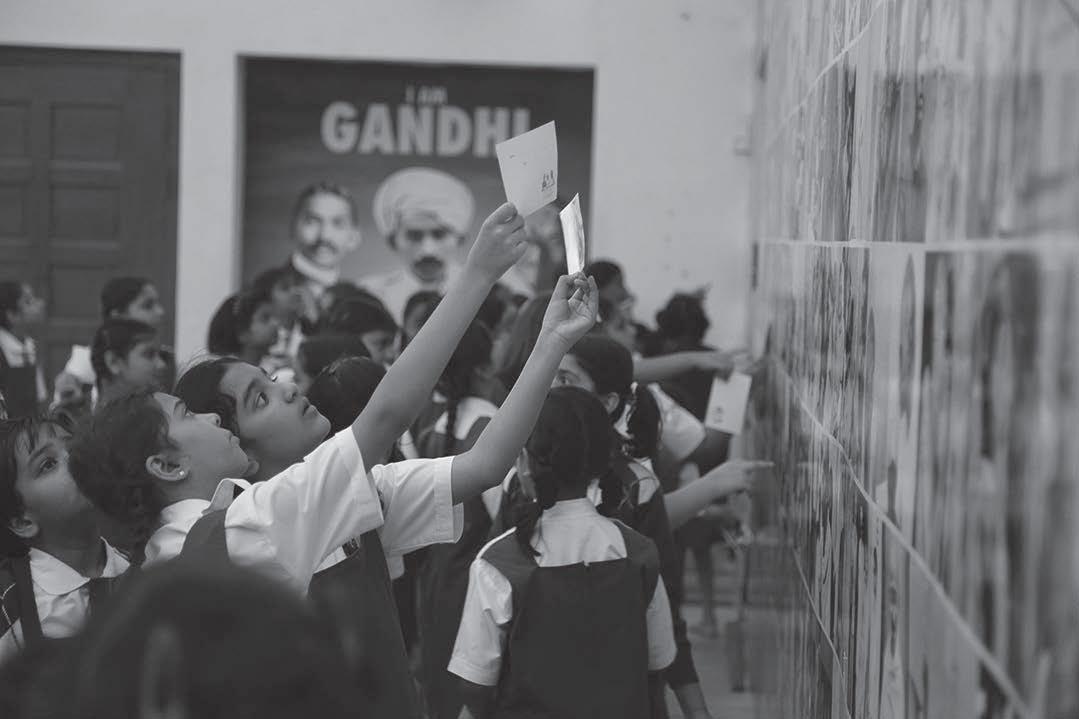
Figure 5.1 Students engaging on the Mahatma Gandhi Interactive wall at Bapughat, Gandhi Digital Museum, Hyderabad, India. The basic idea of these museums is that the best language to make Gandhi’s message of peace understood is the language of technology, through a series of modern digital installations, including interactive screens, videos, and audio through which Gandhi can be seen and heard directly. The visitor has a participatory experience, with quizzes, infotainment, and even collaborative and culinary art practices. There are numerous traveling installations and activities promoted by the Gandhi Digital Museums, and it is not possible to mention them all.50 Among the most relevant installations, I want to highlight the “King-Gandhi Wall” (2013), promoted at Howard University, Washington, DC. This large interactive wall hosts two of the greatest pacifist minds, who are often remembered together in the same space: Gandhi and Martin Luther King, Jr. A similar juxtaposition project was also made in Abu Dhabi, when in 2019, coinciding with the Year of Tolerance in the United Arab Emirates and the 150th anniversary of the birth of the Mahatma, the Gandhi Digital Museums in collaboration with the Ministry of Culture and of Knowledge Development organized the Zayed-Gandhi digital museum at the Manarat Al Saadiyat headquarters. The aim of the museum curators was to celebrate these two important figures by emphasizing their commonalities, in particular their insistence on the power of peace and the changes they have inspired.51 It is also worth mentioning the Ahimsa Harley event (2012), held in Hyderabad, where the curator of the museums placed a real Harley Davidson motorcycle at the center with the inscription: “Peace, Truth and Ahimsa,” involving 900 students from ten different countries. In this display, the Harley Davidson becomes a symbol to convey the Gandhian revolution, transcending boundaries of all kinds. Students were asked to sign the Ahimsa Harley to symbolize their promise of future action in line with Gandhian ideals of peace (See Figure 5.2). 
Figure 5.2 A collaborative art installation on a Harley Davidson motorcycle; 900 students sign their name and comments on the Mahatma at Harvard Model United Nations India, Hyderabad, 2012. Another unusual idea was the creation of a “mobile” museum shop, the Mahatma Gandhi Digital Museum Store. This bus offers interested people a wide range of Gandhi-inspired merchandising. The purported goal is to convey the museum’s values and to try to involve as many people as possible, and the profits made from the shop go directly to the museum. The Mahatma’s Power. Dandi Kutir MuseumOne of the largest museums dedicated to the figure of Gandhi is located in Gandhinagar, about 25 km from the Ahmedabad ashram, Dandi Kutir (See Figure 5.3). The word “dandi” is the name of the town where the salt march sometimes called ”Dandi March” ended. The particular architecture of this museum is striking: It takes the form of a mound of salt, symbolically referring to the famous Gandhi salt march of 1930 to protest against the British monopoly of this product. The museum was built and is managed by the State government of Gujarat; it was inaugurated in 2015 by the current prime minister of India, Narendra Modi.52 On the one hand, there is popular and government support for Gandhi’s opposition to British rule and support and leadership for Indian independence. On the other hand, the history of Indian sectarianism and of the nationalist Bharatiya Janata Party (BJP) presently in power under Modi’s leadership supports Hindu nationalism and other policies very much at odds with Gandhi’s universalist, nonviolent beliefs. The museum “represents Gandhi’s powerful idea of people across lines of class, gender, age, and community asserting their common right to salt itself: a symbol to inspire a pluralistic society to march toward independence – Purna Swaraj.”53 The curators of the Dandi Kutir state they want to highlight the leadership qualities of the “Father of the Nation,” who was able to realize the idea of pacification between people who have a common goal, purna swaraj, complete independence. The museum traces the story of Gandhi’s life, from the beginnings of his campaigns in South Africa to his activity in India, independence, and up to his murder. 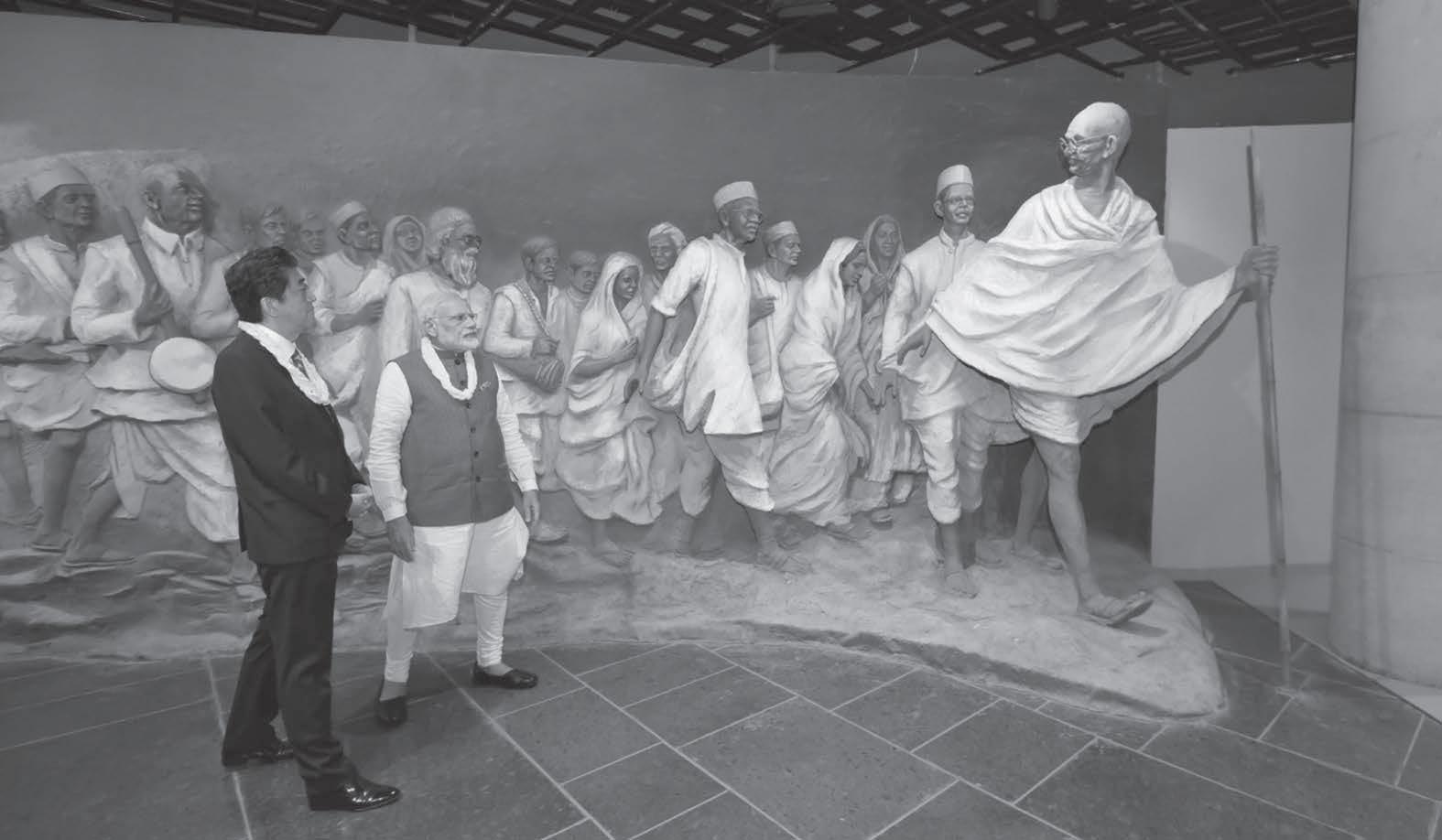
Figure 5.3 The Prime Minister of India, Shri Narendra Modi, and the Prime Minister of Japan, Mr. Shinzo Abe visit Dandi Kutir, Gandhinagar, Gujarat, on September 14, 2017.54 Modern digital installations include 4D virtual reality, 3D holography, floors and digital walls, laser, video and audio shows that accompany the entire duration of the visit. Through the use of this advanced immersive technology, Gandhi’s transformation is traced. There are a series of statues, and he is depicted from being a shy ordinary lawyer to becoming one of the strongest representations of nonviolence. Gandhi is represented as a victim of English racism, lying on the ground with his personal belongings scattered after being thrown off a train, to becoming the Mahatma who led Indian independence by liberating an entire people. ConclusionsTo conclude, I will also briefly mention those who reject the image of Gandhi as a symbol of peace. In June 2010, a bronze sculpture of Gandhi was placed at the entrance of the Canadian Museum for Human Rights in Winnipeg, as a donation from the Indian government. The presence of this monument has sparked protests and petitions. This includes suggestions that the museum removes the statue because, as we read in the words of one protester: Gandhi was a racist who considered blacks as sub-human, often calling them kaffirs (a pejorative term for black people), uncivilised, and believed whites should be the predominant race in South Africa. . . . Even though the West lauds him for nonviolence, in actuality he used it as a weapon against Colonialism only. We petition the Canadian Museum for Human Rights to replace the Statue of MK Gandhi with an indigenous or black hero from this land.55 Not infrequently, during the Black Lives Matter demonstrations, the authorities were forced to cover and protect many monuments around the world, including some that portrayed the figure of the Mahatma. In various locations, especially in America and England, some statues of Gandhi were demolished, damaged, and smeared with words such as “racist” and “rapist.” This was the case, for example, of statues placed outside the Indian embassy in Washington, DC and in Parliament Square in London. Some of Gandhi’s youthful remarks toward South Africans were certainly close to racism, but labeling Gandhi as a racist is a short-sighted view that amounts to obscuring the historicity of his thinking. There is an evolution of the concept of nonviolence that becomes increasingly clear in his biography and the innumerable writings of the Indian leader. Also, Gandhi recognized several times that he had committed Himalayan errors, corrected his theses on race, to the point of becoming a source of inspiration for famous African and African American leaders and activists.56 “I am a staunch believer in absolute equality between man and man,”Gandhi tirelessly reiterates.57 “I believe in absolute oneness of God and therefore also of humanity. What though we have many bodies? We have but one soul. The rays of the sun are many through refraction. But they have the same source.”58 Gandhi’s presence in museums dedicated to peace worldwide is a colorful mosaic. It gives audiences access to witnessing aspects of the universality of the Gandhian message. As such, this reflects a communion between East and West. This effect is enough, in my opinion, to give a positive judgment to this presence in spreading the Mahatma’s message of peace and nonviolence throughout the world. In fact, while recognizing that in museum choices we sometimes witness the exploitation and trivialization of Gandhi, for commercial as well as political purposes, the image of Gandhi in museums has the capacity to restore, in the best cases, if not the entirety and complexity of the historical figure and his message, at least a part of it, with an invitation to explore its meaning more deeply. The figure of Gandhi is of such depth and so multifaceted that it cannot be enclosed in a single image or document that reflects but one perspective: the one that the institution wants to illuminate. After all, what happens in museums is what happens in historical research, when we are confronted with something that cannot be understood in its fullness; we therefore refer back to the variety and plurality of viewpoints that Gandhi always defended on the cultural and religious levels. Notes:
References:
Courtesy: This article has been adapted from Taylor & Francis Group |