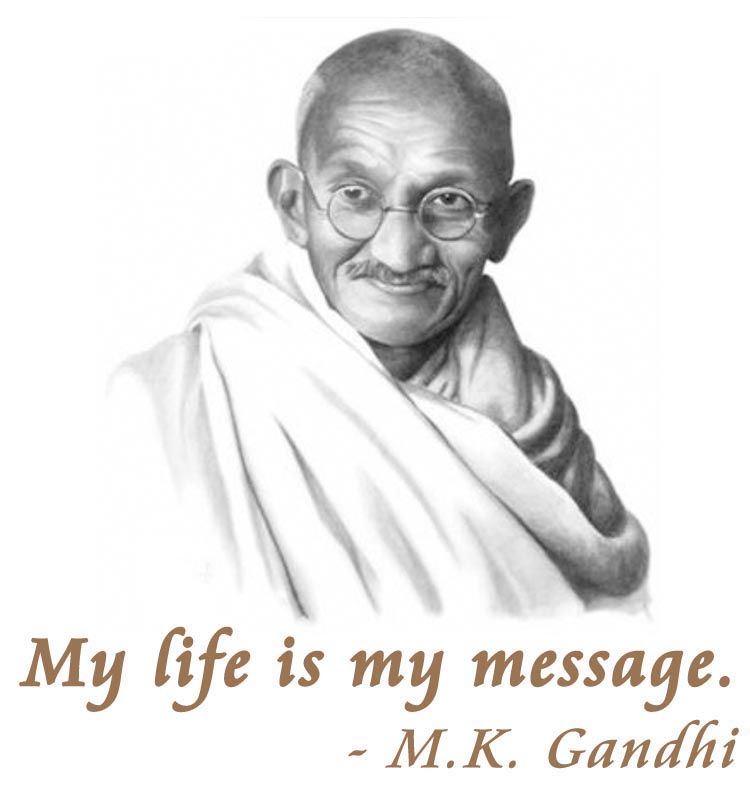
Gandhi and the Paradox of Modern Democratic Freedom |
- By Megha Kapoor*AbstractThis paper examines the paradox of modern democratic freedom through the critical lens of M.K. Gandhi's political and ethical philosophy. While liberal democracies claim to secure individual liberty and autonomy, they increasingly rely on institutional, technological and consumerist mechanisms that undermine genuine self-rule. Gandhi foresaw this contradiction, warning that modern civilisation, despite its promises of freedom, fosters dependency, moral disorientation and alienation from oneself. Drawing on his principles of Satya (truth), ahimsa (non-violence) and swabhava (inner nature), this paper argues that freedom, when divorced from ethical discipline and responsibility, becomes reduced to choice without conscience and autonomy without restraint. Through close engagement with Gandhi's writings and relevant philosophical critiques, the paper examines consumerism and state apparatuses that manipulate fear and desire, creating conditions of subtle domination. IntroductionModern Democratic Thought rests on a powerful assumption that freedom expands with choice. The more options we have, the more products we can buy, the more lifestyles we can pursue, the freer we must be. Yet, this link between choice and freedom produces a ‘tension’. While democratic societies formally protect liberty, the everyday lives of individuals are often shaped by anxiety, comparison, and competition that unsettle individuals’ sense of control over their lives. This paper approaches the tension as a paradox of modern democratic freedom and aims to analyse it through M.K. Gandhi's philosophical lens. It specifically asks: how do institutional, technological, and consumerist mechanisms in liberal democracies undermine genuine self-rule while claiming to secure individual liberty? As the paper progresses in its analyses of the contradictions of modern democratic freedom, it reflects on Gandhi's identification of this predicament long before the rise of social media and consumer capitalism. To further analyse this, the paper asks two questions: In what ways does Gandhi's critique expose the deficiencies of modern democratic freedom? And how can Gandhi's philosophy offer a morally grounded conception of freedom that counters the paradoxes inherent in contemporary democratic life? To address these questions, the paper proceeds as follows: The first section, ‘The Paradox of Modern Democratic Freedom’, elaborates on the inherent contradictions within contemporary liberal democracies, drawing on Gandhi's foresight and supported by other philosophical critiques. The subsequent section, ‘Where Does Modern Democratic Freedom Go Wrong?’, delves into the specific ethical deficiencies by examining the detachment of modern democratic freedom from Gandhi's triad of Satya, ahimsa, and swabhava. Finally, ‘Morally Grounded Ideals of Democratic Freedom’ posits Gandhi's philosophy as a powerful counterpoint, reimagining freedom as rooted in ethical self-limitation and shared life, thereby offering a path to a more meaningful democratic existence. 1. The Paradox of Modern Democratic FreedomThe ideal of freedom within modern democratic thought is often regarded as a normative achievement, grounded in the ‘belief’ that individuals are autonomous agents capable of shaping their own lives through choice, rights and participation in collective self-rule. This section argues that this ‘belief’, when analysed within social and economic conditions of modernity, often narrows the space for self-direction and well-thought-out action. The following three sub-sections, titled ‘Contradictions of Modern Democratic Freedom’, ‘Philosophical Lineage of Scepticism’, and ‘Fear, Consumerism, and the Erosion of swabhava’, explore Gandhi's engagement with the ideas of modern democratic freedom. 1.1. Contradictions of Modern Democratic FreedomDespite promises of autonomy, equality, and self-governance, modern democratic freedom contains deep contradictions that undermine its own ideals. Liberal democracy presents itself as empowering individuals through rights, participation, and representation, offering freedoms to speak, vote, consume, and dissent. Yet these freedoms are increasingly shaped and constrained by the very systems that claim to protect them. Bureaucratic governance, capitalist markets, media structures, and technological infrastructures often mediate and manipulate individual agency rather than liberate it. This contradiction forms what may be called the paradox of modern democratic freedom — where the promise of liberation conceals subtle domination. Even seemingly empowering developments such as technological access, civil rights, and free expression become complicit in this paradox. The digital sphere, often celebrated as democratic, increasingly fosters surveillance, algorithmic control, and echo chambers, subjecting citizens to invisible constraints. Economic freedom, similarly, operates within neoliberal rationality, demanding continuous productivity and consumption, producing anxiety and insecurity rather than emancipation. Wendy Brown argues that neoliberalism transforms democratic citizenship into economic entrepreneurship, reducing individuals to human capital valued primarily through market participation (Brown 2015). In this context, freedom becomes synonymous with market choice rather than moral or civic agency. Gandhi's critique anticipates these tensions with remarkable clarity. Although modern democracies claim to uphold self-rule, Gandhi warned that they cultivate dependency on impersonal institutions and external authorities. His critique was moral and existential rather than merely political. He wrote, “This civilisation is such that one has only to be patient and it will be self-destroyed... Parliaments are really emblems of slavery.” (Gandhi 1909, p. 34). While his language appears severe, it reflects ethical concern rather than contempt for individuals. Gandhi distinguished between people and the civilisational form organized around endless wants. Even while calling modern civilisation a “Satanic Civilisation,” he insisted that “civilisation is not an incurable disease” and described the English as enterprising and “not inherently immoral.” (Gandhi 1909, p. 34). His central concern was the cultivation of habits and desires that alienate individuals from their ethical capacities. As Bilgrami notes, this alienation lies at the core of Gandhi's anti-modernism (Bilgrami 2018, p. 7). Within modern systems, Gandhi argued, swaraj — ethical self-rule rooted in self-restraint and communal responsibility — is replaced by individualism and consumption. Nigam highlights Gandhi's concern that industrial modernity, symbolised by railways and machines, uproots individuals culturally and materially, creating profound existential dislocation (Nigam 2009). This dislocation intensifies the paradox of freedom: outward liberties coexist with an inward loss of moral grounding, or swabhava. Consequently, political freedom is reduced to procedural participation, while genuine economic and moral autonomy erodes under global markets and technological dependence. Gandhi thus observed, “Civilisation seeks to increase bodily comforts and it fails miserably even in doing so.” (Gandhi 1909, p. 25). This raises an important question: was Gandhi's scepticism unique, or part of a broader tradition questioning democracy’s promises? The following section situates his critique within a wider lineage of democratic scepticism. 1.2. Philosophical Lineage of ScepticismGandhi's scepticism toward modern democracy belongs to a broader tradition of doubt extending from classical philosophy to contemporary critiques of neoliberal modernity. By engaging Gandhi alongside Plato, J.J. Rousseau, Maurice Merleau-Ponty, and Zygmunt Bauman, this section reframes freedom as an ethical rather than merely institutional problem. In Republic, Plato criticises democracy for allowing “various passions... to have free play,” producing “weakness and dissipation” instead of true liberty (Plato c. 380 BCE, p. 452). He warns that unchecked freedom leads to lawlessness and ultimately tyranny, as private desires overshadow the common good (Plato c. 380 BCE, p. 17, 185-189). Gandhi's critique in Hind Swaraj echoes this concern, arguing that modern civilisation confuses license with liberty (Gandhi 1909). While Plato sees harmony secured through reason ruling the soul, Gandhi identifies the danger within modern civilisation itself, where endless comforts and desires erode moral clarity. His concepts of swabhava and ahimsa may be read as a democratised form of Platonic discipline — not imposed by philosopher-kings but cultivated through ethical self-restraint. The comparison suggests that democracy cannot endure if freedom is governed solely by appetite. Plato resolves this through elite guardianship, whereas Gandhi relocates discipline inward, insisting that self-rule through truth and nonviolence sustains political freedom. Thus, the crisis of democracy is fundamentally ethical rather than merely institutional. A similar scepticism appears in Jean-Jacques Rousseau, who declares that “genuine democracy never has existed and never will” (Rousseau 2012, p. 200). Rousseau argues that private interests and the impracticality of constant participation undermine democratic freedom, requiring civic virtue grounded in the General Will (Rousseau 2012, p. 169). Gandhi shares Rousseau’s concern about private interests but shifts focus toward inner moral transformation. For Gandhi, the problem becomes a ‘problem of spirit,’ where freedom collapses when detached from self-discipline. Whereas Rousseau seeks solutions through civic virtue within smaller political communities, Gandhi insists that democracy’s survival ultimately depends on ethical self-rule. In this way, he intensifies Rousseau’s argument by relocating the foundation of political freedom within the moral transformation of individuals. Twentieth-century thought continues this sceptical trajectory. Maurice Merleau-Ponty exposes tensions within liberal democracy, arguing that claims to universal freedom often conceal domination maintained through law, violence, and propaganda. In Humanism and Terror, he notes that liberal regimes present themselves as defenders of liberty while selectively applying rights and delegitimising dissent (Merleau-Ponty 2022, p. 63). Violence within liberalism becomes invisible because it is framed as lawful necessity (Merleau-Ponty 2022, p- 68). Gandhi's Hind Swaraj resonates with this critique. His assertion that “modern civilisation is a disease” (CWMG 10:243) parallels Merleau-Ponty’s claim that liberal progress can mask domination. Gandhi similarly viewed institutions such as parliaments and railways as deepening dependency while weakening moral responsibility. Yet he extends the critique by proposing satya and ahimsa as ethical disciplines that resist domination through self-mastery rather than institutional reform alone. Later, social theory shifts its focus from political institutions to the conditions of modern life itself. Zygmunt Bauman’s Liquid Times describes a world marked by uncertainty, individualisation, and weakened communal bonds, where power increasingly escapes politics and resides in global markets (Bauman 2007, p. 31). Freedom is celebrated as choice, yet the multiplication of choices generates anxiety and disorientation, leaving individuals formally free but substantively powerless (Bauman 2013, p. 5). Gandhi identifies a similar paradox: modern civilisation mistakes license for liberty, creating individuals enslaved by desire and dependent on impersonal systems (CWMG 10:248). While Bauman diagnoses the uncertainty of liquid modernity, Gandhi prescribes swaraj — ethical self-rule grounded in truth and nonviolence — as the discipline necessary for sustaining freedom. Both reveal that liberty without moral restraint produces new forms of bondage rather than empowerment. Across these thinkers emerges a shared insight: freedom cannot endure where moral formation is weakened. This recognition shifts the discussion from abstract theory to lived experience, where the erosion of ethical grounding manifests through fear, consumerism, and insecurity. The following subsection explores these lived conditions, focusing on fear, consumption, and the erosion of swabhava. 1.3. Fear, Consumerism, and the Erosion of SwabhavaThe paradox reaches its peak when democracy promises freedom from fear, yet simultaneously amplifies the very dangers that generate fear. This cycle fuels consumer demand as individuals seek security through the very structures and products marketed to guarantee their freedom. In this way, fear becomes both produced and exploited, used as a tool to drive consumption and deepen dependence on political and economic systems that claim to offer liberation. Gandhi critiques modern civilisation for creating restless, unhappy and unsatisfied individuals who are slaves of their own desires rather than masters of themselves. “Formerly, men were made slaves under physical compulsion. Now they are enslaved by the temptation of money and of the luxuries that money can buy.” (Gandhi 1909, p. 33) While analysing the restlessness, one can reflect on the profound alienation in which individuals lose touch with their swabhava and become dominated by external influences that shape their fears. Yet, in the modern world, fear becomes a defining feature, driving people to seek security through possessions and status rather than moral strength. This dynamic is especially visible in modern consumerism, which Gandhi viewed as a trap of endless desire rather than genuine freedom. He warned that unregulated consumption does not fulfil the self but entraps it. Rohmetra, while analysing Gandhi, said: A certain degree of physical harmony and comfort is necessary but above a certain level, it becomes a hindrance instead of help. Therefore, the idea of creating an unlimited number of wants and satisfying them seems to be a delusion and a snare. The satisfaction of one’s narrow self must meet at a certain point, a dead stop before it degenerates into physical and intellectual voluptuousness (Rohmetra 2011, p. 629). Furthermore, Gandhi's remark in Young India writings, calling himself a “farmer and weaver” (CWMG 23:85), stands as a stance against Western culture and civilisation (as the text of Young India mentions) and also acts as a caution against the tyranny of ‘want’. Gandhi saw that in Western culture (as driven by the idea of consumption), people are conditioned to believe that happiness lies in accumulation. Such craving, he argued, leads not to contentment but to perpetual dissatisfaction, fostering fear—fear of losing what one has, fear of not having enough and fear of social marginalisation. The pursuit of material goods becomes a substitute for inner peace, yet it deepens the sense of insecurity because it externalises the source of freedom. This paper reads Gandhi's analysis as more than a moral warning about desire. It suggests that when the pursuit of material goods replaces inner ethical grounding, freedom itself becomes externalised. The individual comes to depend on possessions, status, and recognition for a sense of security. As a result, the search for comfort intensifies insecurity, turning freedom into a fragile condition sustained by acquisition. Furthermore, individualism, as celebrated in modern democracies, similarly exacerbates this alienation by fracturing the communal bonds that sustain ethical living. Gandhi believed that the modern focus on the autonomous individual, disconnected from shared values and collective purpose, leads to isolation and existential fear. His thoughts reflect an erosion of social cohesion in favour of individual rights, and warn that modernity often invites moral decay and social fragmentation (Diop, Bhushan and Nikalje 2020). This isolation fuels vulnerability, making individuals more susceptible to fear, which consumerism then exploits by offering false remedies in the form of goods and status. Thus, the paradox of freedom that Gandhi helps identify is that the modern pursuit of freedom through consumerism and radical individualism generates new forms of bondage, in the form of chains forged by fear, insecurity, and moral disconnection. It is profoundly helpful in establishing the argument that the freedom promised by these forces is illusory, as it divorces autonomy from ethical self-mastery and communal solidarity. The pursuit of modern democratic freedom is evident in many aspects of contemporary society. It enshrines individual civil liberties while fostering deep psychological distress, anxiety and social isolation due to fear of the other. It promises personal fulfilment and progress, but results in widespread burnout and the erosion of shared moral life. In celebrating autonomy, it often forgets responsibility; in protecting rights, it neglects relationships. In other words, modernity causes a loss of swaraj as self-mastery is replaced by dependence on systems that manufacture desires and insecurities. From the discussion so far, fear may be understood not merely as a political emotion but as a deeper moral and spiritual condition. By locating fear at the heart of the modern democratic condition of freedom, Gandhi's lens further helps in uncovering liberalism’s promise of liberation, which often conceals deeper forms of psychological and moral servitude. Reflecting on the question, ‘How do institutional, technological, and consumerist mechanisms in liberal democracies undermine genuine self-rule despite claiming to secure individual liberty?” This section argues that the answer lies in the subtle reshaping of freedom itself. Democratic institutions remain procedurally intact, yet large-scale administrative and economic systems organise conduct indirectly. At the same time, consumer culture redirects desire toward acquisition, sustaining cycles of fear and comparison that weaken inner stability. The philosophical scepticism traced here shows that when freedom loses its ethical grounding, it persists in form but thins in substance, leaving self-rule fragile even where rights are formally guaranteed. Together with Gandhi's perspectives, the section adds a crucial layer to the critique: that freedom, divorced from restraint, relationality and inner discipline, becomes indistinguishable from the conditions that undermine it. To further map this, in the following section I argue that the pursuit of modern freedom in democracies is evident in its detachment from Satya (truth), ahimsa (non-violence), and swabhava (innate nature). 2. Where Does Modern Democratic Freedom Go Wrong?Having established the inherent contradictions and the subtle forms of domination within modern democratic freedom, as anticipated by Gandhi and echoed by other critical thinkers, this section now shifts its focus to the specific ethical foundations that, in Gandhi's view, are compromised. The following subsections will explore how the pursuit of modern democratic freedom, when detached from Satya (truth), ahimsa (non-violence), and swabhava (innate nature), leading to profound moral disorientation that this paper terms ‘social ruin’. 2.1. The Compromise of Satya (Truth)Modern democratic freedom often treats truth as negotiable because of its profit-seeking nature. Truth here is subjected to manipulation, spin and personal convenience. Referring specifically to public discourse, particularly within media and politics, the proliferation of misinformation, post-truth narratives and performative speech detaches expression from ethical responsibility. Gandhi, by contrast, rooted freedom of speech in a spiritual and ethical commitment to truth. In his words: “Young India [the newspaper] will be stale when Truth becomes stale. I want to see God face to face. God I know is Truth. For me the only certain means of knowing God is nonviolence—ahimsa—love. I live for India’s freedom and would die for it, because it is part of Truth.” (CWMG 23:340). For Gandhi, then, freedom was inseparable from a relentless striving towards Satya. He insisted that even when the press harshly criticises or errs in judgment, its freedom is meaningful only when it serves truth rather than ego or power. He says, “liberty of the press can be said to be truly respected when the press can comment in the severest terms upon and even misrepresent matters.” (CWMG 23:340) But this liberty, he emphasised, must not be a camouflage for self-interest or latent violence; “our thought and word must accord with our practice.” (CWMG 23:341). Reflecting on the above analysis, in today’s democracies, public debate is shaped less by careful thinking and more by quick reactions, social media trends and emotional outrage. Information spreads fast, but truth often becomes secondary to what is dramatic or attention-grabbing. When a shared commitment to truth does not guide freedom of expression, people begin to doubt everything, including institutions, leaders and even each other. This points to two significant issues. First, this trajectory reflects a direction in which the internal logic of modern democracies appears to erode the depth of freedom. Second, over time, such distrust weakens public life, making cooperation more difficult and democratic participation feel meaningless, even though people formally remain free to speak, vote and express their opinions. The latter is a significant concern. 2.2. The Neglect of Ahimsa (Non-Violence)Gandhi understood ahimsa not as a passive ideal but as the ethical foundation of political life, and a strategy for resisting injustice. In modern democratic structures, one can perceive a conventional detachment between them. While political systems today claim to safeguard freedom through legal rights, such protections frequently mask structural violence. Economic inequality, cultural domination and environmental degradation are tolerated in the name of growth and choice, even though they inflict lasting harm. What presents itself as freedom, therefore, often thrives on practices that contradict the discipline of nonviolence. Consumerism is perhaps the clearest instance of this inversion. Far from cultivating the humility and self-restraint essential to ahimsa, it fosters competition. Moreover, in Hind Swaraj, it is observed that modern civilisation equates worldly enjoyment with progress. Gandhi said, “In this civilisation, the more you have of worldly enjoyment, the better off you are.” (Gandhi 1909, p. 39) It is suggested that ‘enjoyment’ is signalled as coming at a great human cost: it divides people, displaces moral consideration and naturalises harm. Violence persists not just in war, but in consumption patterns that exploit labour, in technologies that alienate and in policies that fragment communities. Seen from Gandhi's standpoint, such a civilisation misunderstands freedom. True freedom cannot coexist with practices that corrode ethical selfhood and perpetuate harm (see section 1 of the paper). To recover ahimsa as political ground is therefore to expose these contradictions and to envision freedom as inseparable from responsibility, restraint, and justice. 2.3. Alienation from Swabhava (Innate Nature)For this research paper, the idea of swabhava serves a critical function, exposing how modern democratic life alienates individuals from this inner nature, making swabhava a diagnostic tool as much as a philosophical ideal. Modern democratic life encourages self-formation not through introspection or moral development, but through choice, performance and consumption, individuals are urged to ‘be themselves” by constructing identities in response to trends, markets and images, rather than through ethical cultivation. This leads to a loss of inner direction. Gandhi deeply feared this disorientation, and in his writings, speeches, etc., he aimed to preserve India from it. To mention a closely related perspective, he said, “They want India’s billions and they want India’s man-power for their imperialistic greed. If we refuse to supply them with men and money, we achieve our goal, namely, Swaraj, equality, manliness.” (Gandhi 1922, p. 551) Conversely, the modern subject becomes overburdened with choices, but underdeveloped in conscience. Alienated from their swabhava, individuals feel the pull of artificial needs and external validation rather than inner harmony. This misalignment creates a fragile freedom, where autonomy exists without grounding and liberty becomes license. Another aspect that deeply hinders the moral dimension of swabhava is Modernity’s emphasis on rationality. Bhikhu Parekh elaborates on this in his book: [Modern civilisation], although it had many achievements to its credit, it was fundamentally flawed, as was evident in the fact that it was aggressive, imperialist, violent, exploitative, brutal, unhappy, restless and devoid of a sense of direction and purpose. Gandhi thought that this was because modern civilisation neglected the soul, privileged the body, misunderstood the nature and limits of reason and had no appreciation of the individual swabhava (Parekh 1997, p. 79). Parekh’s insight into Gandhi opens a critical fissure in the very architecture of modern democratic freedom. It reveals that rational freedom, when detached from swabhava, becomes a tool of evasion rather than transformation. Unlike classical liberalism, which casts freedom as the expansion of choice and autonomy, Gandhi's conception demands a confrontation with the meaning of life. This contrast is not merely ethical but ontological as well. Rational freedom assumes the self as sovereign and self-transparent, capable of calculating its desires and charting its goals. Gandhi, in contrast, sees the self as opaque, fragmented and in need of moral cultivation. Here, swabhava is not an essence to be expressed but a discipline to be discovered. It is a process of self-suffering and self-limitation, through which the individual de-habituates from modernity’s compulsions. This points to a deeper philosophical provocation, that the modern ideal of freedom assumes the stability and sufficiency of the ‘will’, while Gandhian freedom presupposes its inadequacy. Gandhi does not reject reason but decentres it, placing it in the service of the conscience (antaryami—the inner guide awakened through suffering, labour and self-rule). In doing so, he anticipates critiques of the autonomous subject that would only later emerge in existentialist, psychoanalytic and post-structuralist thought.* Thus, Gandhi's swabhava is not simply an inward turn; it is a rupture in the liberal paradigm, a refusal of the idea that freedom can be engineered through external arrangements without a metaphysical revolution of the self. So, in what ways does Gandhi's critique expose the deficiencies of modern democratic freedom? From the above account, it can be asserted that the pursuit of modern democratic freedom detached from Satya (truth), ahimsa (non-violence) and swabhava (innate nature) leads to ‘social ruin’. This social ruin is problematic because it undermines the very conditions that make genuine freedom possible. When modern democratic freedom is pursued in abstraction from Satya, ahimsa and swabhava, it breeds a culture of moral relativism, hyper-competitive individualism and spiritual emptiness. The result is not only personal alienation but the breakdown of the ethical structures that hold communities together. Without Satya embedded in moral honesty, it becomes instrumentalised for power; without ahimsa, conflict is normalised and justified in the name of interests; without having an understanding of swabhava, individuals become estranged from their deeper purpose and get dominated by the ‘tyranny of want’. Gandhi feared that such a society, driven by desire rather than discipline, by rights rather than responsibilities, would collapse under the weight of its own contradictions. It will produce not liberation, but dependency, anxiety and violence masked as progress. This is why the ‘social ruin’ Gandhi helped in uncovering is not merely material or political, but civilisational (a loss of the inner and communal capacities needed to live freely). 3. Morally Grounded Ideals of Democratic FreedomGiven the analysis of modern democratic freedom’s ethical shortcomings and its detachment from Gandhi's core principles, the crucial question then arises, what alternative vision does Gandhi offer for a truly meaningful and ethically grounded freedom? This section argues that Gandhi's philosophy provides a powerful counterpoint, not by rejecting freedom, but by reimagining it as inseparable from the project of building the self and the community, rooted in moral self-limitation and shared life. 3.1. Countering Accumulation as an Ethical PracticeAs already discussed in this paper, the promise of liberation in modern democracies conceals a reality of subtle domination, producing a profound sense of existential dislocation. Outward liberties mask an inner loss of moral and spiritual grounding, intensifying the paradox of freedom. Gandhi's critique of modern civilisation exposed this contradiction, arguing that a society that generates restless and unsatisfied individuals, enslaved not by physical compulsion but by the temptation of money and the luxuries it can buy. In this context, Gandhi's idea of Aparigraha (non-possession) can be read as a deliberate resistance to the psychological and ecological violence of capitalist desire. His critique of consumerism is post-materialist. It challenges the equation of human value with purchasing power and the replacement of ethical life with transactional logic. In his vow of non-possession, he says, “It is not enough not to possess and keep much, but it is necessary not to keep anything which may not be absolutely necessary for our bodily wants. Thus, if one can do without chairs, one should do so. The follower of this vow will, therefore, by constantly thinking thereover, simplify his life.” (Gandhi 1922, p. 6) Moreover, the ethical problems of consumerism can be recounted in his vow of non-stealing, “It is not enough not to steal what is commonly considered as another person's property. It is theft if we use articles which we do not really need. Nature provides from day to day just enough and no more for our daily needs.” (Gandhi 1922, p. 6) Gandhi's ethical economics offers a sharp rebuke to the commodification of freedom in liberal democracies. When desire is manufactured, and consumption is mistaken for autonomy, human beings are estranged from their moral capacities and social obligations. For Gandhi, true freedom meant ‘self-restraint’, not ‘indulgence’, ‘interdependence’, not ‘individual accumulation’. 3.2. Reimagining Freedom: Swaraj Beyond the Consumer SelfMoving to the idea of ‘self’ that modernity produces, the paper has discussed the surging focus on individualism in the idea of freedom. What Gandhi sees here is a deeply irresponsible individual. As Mahesh Gavaskar explains, “The modern man, Gandhi thought, has become deeply irresponsible. He overeats, gets indigestion, goes to the doctor, takes a pill and gets on with his life.” (Gavaskar 2009, p. 45). In Gandhi's view, the modern world allows people to externalise the consequences of their choices onto medical, legal, or bureaucratic systems. But real freedom, he urges, is something that cannot coexist with this evasion. It demands that one confront and transform the self, rather than delegate its burdens to external institutions. If modern democratic freedom prioritises external autonomy such as freedom from constraints and the pursuit of individual interests, Gandhi offers a radically different conception rooted in internal mastery and ethical responsibility. It is in this context that the idea of swaraj must be considered as one of the counters to the paradox of modern democratic freedom. At its heart, swaraj is not the freedom of the atomised individual, but the freedom of a person who governs themselves through truth, non-violence and alignment with innate nature. Such a conception of freedom is realised not by eliminating restraint but by embracing it. This paper reads Gandhi's model of freedom as centred on restraint, where liberty depends on the cultivated ability to limit desire, regulate consumption, and live in ways that reduce harm to others and to the natural world. From this perspective, ahimsa is not confined to the refusal of physical violence but extends to the ethical organisation of everyday life. It becomes a principle for withdrawing complicity from structures of domination and exploitation. This analysis suggests that while liberal democracies often define harm in legal or bodily terms, Gandhi's framework pushes us to recognise harm as moral and structural, embedded in systems that estrange individuals from ethical self-rule. Furthermore, the argument here aims to suggest that such a reconceptualisation reshapes how we understand the idea of ‘political community’. Gandhi's account of freedom, as interpreted here, cannot be realised through abstract individual rights alone or through centralised state authority. Instead, freedom must be nurtured within local, interdependent communities sustained by mutual responsibility and ethical care. From this perspective, Gram Swaraj is read not as nostalgia for a pre-modern past but as a radical rethinking of political life. It presents freedom as a shared moral condition, emerging through relationships and collective responsibility rather than existing as an individual possession secured solely by institutions. This is why Gandhi's emphasis on self-government becomes especially significant and even prophetic in an age where politics is increasingly delegated to experts and economic actors, while ethical self-governance is neglected. He reinforces this principle again years later, writing, “Just as good government is no substitute for self-government, good justice, if foreign, is no substitute for home-made justice.” (CWMG 31:285) This ethos also explains Gandhi's insistence on tapasya, which is understood by Gandhi as ‘ethical suffering’. 'Ethical suffering’ is considered as essential to political transformation. He asserts, “Now we might have to die so that they [the villagers] may live... If now we die knowingly and willingly, our sacrifice will enable us and the whole nation. Let us not flinch from the necessary sacrifice, if we will live as an independent, self-respecting nation.” (CWMG 23:454) In a culture of comfort and speed, such an understanding of freedom may appear alien, yet it discloses the ethical depth of democratic life. He says, “Organisations die always for want of men, i.e. honesty, efficiency and self-sacrifice.” (CWMG 30:520) This is what gives democracy its moral force—not procedure, but praxis; not rights, but responsibility. In his view, “The highest form of freedom carries with it the greatest measure of discipline and humility. Freedom that comes from discipline and humility cannot be denied.” (CWMG 30:520) This, being at the heart of his understanding for freedom, highlights it as a moral foundation for democratic freedom. 3.3. Gandhi Against Institutionalised InjusticeGandhi focused on ‘situated ethics’, where right action depends not on abstract rules, but on one’s context, duties and nature. Freedom, then, becomes an ongoing discipline, shaped by tradition, spiritual insight and the demands of the moment. This positions Gandhi's thought as a middle path, resisting both the homogenising tendencies of liberal universalism and the moral relativism of cultural pluralism. Furthermore, his suspicion toward liberalism’s faith in codified rights and legal abstractions further illustrates this perspective.’ He writes in Young India: “We are not much enamoured of the Declaration of Rights business... The Declaration will be of little avail if we have not the strength to have it well administered... Unless we become manly [Humanly] and fearless, no number of rights showered upon us can secure us our liberties.” (CWMG 20:482-483). Since rights by themselves remain inert without ethical strength, legal frameworks alone cannot constitute freedom. It must be engraved on the heart through discipline, courage and self-rule. Gandhi saw this clearly during the Rowlatt Act, where the suspension of civil liberties revealed the limits of legal guarantees when they are not supported by moral autonomy. “To fatten the statute book... without removing the poison in his system,” he warned, “would mean to nourish a man without removing the poison in his system.” (CWMG 20:482-483) This deep ethical orientation also shapes Gandhi's response to political violence and injustice. Reflecting on the proposed memorial for the Jallianwala Bagh massacre, he insisted that even in remembering atrocity, the aim must be ethical transformation rather than revenge. “To err is human,” he wrote, “and it must be held to be equally human to forgive... Nor does this mean that we may not ask for General Dyers dismissal... But just as we do not bear ill-will towards a lunatic, so too may we not bear ill-will even towards General Dyer.” (CWMG 17:38) In this framing, political memory becomes a site not of resentment but of moral awakening, open to all. “I would invite Englishmen to appreciate our feeling... to make common cause with us in our endeavour to regain consciousness... and to realise the same freedom that they enjoy under the same constitution.” (CWMG 17:38) Gandhi's philosophy, therefore, offers a profound alternative to the dominant ideals of modern democratic freedom. 3.4. Rethinking Freedom: The Three D’sA serious question arises here. Can Gandhi's call for internal mastery and ethical responsibility be so easily realised? To frame freedom primarily as a matter of moral reform risks overlooking the intractable burdens of pain, poverty, and injustice that shape people’s lives. If suffering is recast merely as an occasion for ethical discipline, does this not risk normalising it as something inevitable, thereby silencing subjective experiences of sorrow that demand political redress rather than moral acceptance? Moreover, the emphasis on tapasya and restraint, while ethically powerful, may also conceal the danger of deteriorating living conditions in the name of self-purification. This tension points to why Gandhi often cannot be read as offering ready-made solutions for contemporary democracies. His critique of modernity, even though it is strong, the solutions, if one aims to adopt them, need thorough analysis. I follow the approach articulated by Behera and Nayak in Gandhi in the Twenty-First Century, where they emphasise that the relevance of Gandhi today lies not in the literal adoption of his institutional proposals, but in a deep engagement with the moral and philosophical concerns that shaped his thought. Just as we read Plato not to recreate his ideal ‘Republic’, or Rousseau not to rebuild his ‘General Will,” we read Gandhi not to replicate the village republics he envisioned, but to understand what he was trying to accomplish in terms of justice, community and ethical selfhood. I, here, suggest that re-reading Gandhi for the conditions of freedom in modern democratic life requires what I call the ‘Three Ds’. These categories are not those that Gandhi himself explicitly formulated, but they serve as a lens for reinterpreting his thought to illuminate the ethical and political dimensions of freedom today. The first, ‘Discipline’, frames freedom as grounded in self-mastery rather than mere indulgence. In an era where freedom is often equated with consumption or the exercise of personal choice, Gandhi's vision can help in highlighting that autonomy attains meaning only when coupled with restraint and ethical responsibility. The second, ‘Dissent’, derives from Gandhi's practice of satyagraha yet, is extended here toward a democratic ethic of resistance. As a sustained ethical practice that interrogates power structures, the category of dissent calls attention to systemic inequities and exposes forms of domination that are often normalised or invisible. Importantly, this dissent does not replicate the mechanisms of oppression it opposes. It seeks transformation rather than domination. In this sense, dissent functions as a mode of collective truth-telling since it demands accountability, amplifies marginalized voices and encourages public deliberation grounded in justice rather than coercion. Such an approach positions resistance as both a reaction to injustice and a proactive cultivation of ethical and political awareness within a democratic society. It also fosters spaces where freedom is both practised and made tangible. The third, ‘Democratisation’, interprets Gandhi's notion of swaraj as a principle that extends freedom beyond the narrow confines of legal rights or elite control. So, how does Gandhi's philosophy offer a morally grounded conception of freedom that counters the paradoxes inherent in contemporary democratic life? Reimagined for the present, his philosophy suggests a deeper engagement with shared responsibility and collective agency, dimensions often obscured in neoliberal democracies. Approached in this manner, his thought for navigating within the ‘Paradox of Modern Democratic Freedom’ provides not straightforward answers but conceptual resources for understanding freedom as a disciplined, resistant, and collective undertaking. ConclusionThis paper identifies a central paradox of modern democratic freedom: while liberal democracies promise individual autonomy, freedom is often shaped and constrained by institutional, technological, and consumerist mechanisms that subtly limit genuine self-rule. The crisis, therefore, does not arise from the absence of liberty but from the conditions under which liberty operates. Importantly, this paradox is not inevitable or permanent; it reflects a particular moral and structural configuration of modern democratic life. The study was organised into three interconnected sections. First, it examined how modern democratic systems formally secure rights and representation while simultaneously structuring agency through bureaucratic governance, market dependence, and technological mediation. Neoliberal rationality recasts citizens as economic actors, reducing freedom to participation in markets. Through engagement with thinkers such as Plato, Jean-Jacques Rousseau, Maurice Merleau-Ponty, and Zygmunt Bauman, alongside Gandhi, the paper demonstrated that democratic freedom becomes fragile when detached from ethical formation. Gandhi's critique of the multiplication of wants highlights how consumer modernity produces fear and insecurity, distancing individuals from swabhava and anchoring freedom in acquisition rather than self-governance. Second, the paper analysed the ethical distortions emerging when freedom is separated from Satya, ahimsa, and swabhava. Truth loses its binding power, non-violence is weakened by structurally sanctioned harm, and individuals become estranged from their moral orientation. The result is not juridical unfreedom but a form of liberty emptied of ethical substance, leading to wider social consequences described as social ruin. Finally, the paper argued that Gandhi offers not a rejection but a reconfiguration of democratic freedom. Practices such as aparigraha and the ethical ideal of swaraj reconnect personal restraint with collective responsibility. Building on this, the proposed framework of Discipline, Dissent, and Democratisation reimagines freedom beyond procedural liberalism. Addressing the paradox of modern democratic freedom ultimately requires a “metaphysical revolution of the self,” in which liberty is inseparable from moral honesty, self-limitation, and ethical commitment to others. Notes
References
Courtesy: Gandhi Marg, Volume 47, Number 4, January-March 2026. * Megha Kapoor is Lecturer, School of Arts and Sciences. Sai University. Chennai. +91 9560207234. megha.k@saiuniversity.edu.in |