The Collected Works of Mahatma Gandhi: A Brief History |
- By Thomas Weber*Abstract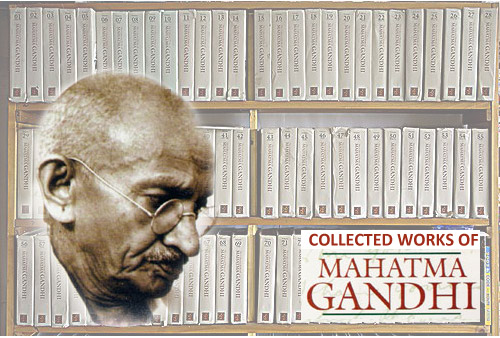
The Collected Works of Mahatma Gandhi is a remarkable world-class resource for those with an interest in Gandhi, especially Gandhi scholars. However, very few know the history of this series and that lack of knowledge may be diminishing its value. In 1999 a digital electronically searchable version, one that scholars had long waited for, was published. A "revised" print version was published in 2001. The new versions however had fundamental flaws and were withdrawn from circulation in 2005. A searchable e-version of the original "standard" edition was finally released in 2015. Unfortunately, many Gandhi-related web sites and Gandhi scholars' libraries still carry the corrupted "revised" editions. The CWMG will reach its full potential when all the complementary volumes of the Letters to Gandhi are eventually published. Founded in 1941, the Publications Division of the Government of India was subsumed into the Ministry of Information and Broadcasting with the attainment of Indian independence on 15 August 1947. Since then, the Publications Division has become a major publishing arm of the government, functioning as a vehicle for national integration and cultural preservation. The Collected Works of Mahatma Gandhi has become its flagship publication. Whatever Gandhi may have thought about the project, or problems that manifested themselves in the production of the series, the CWMG has become the major research tool for Gandhi scholars and one of the most ambitious undertakings of its kind anywhere in the world. Gandhi and His WorksMahatma Gandhi suggested that his writings should be burnt on his death: "As a matter of fact my writings should be cremated with my body. What I have done will endure, not what I have said or written..." ("Weekly Letter", Harijan, 1 May 1937). However, given whom he was, not only in Indian terms but also as a major world figure of the 20th Century, this was never going to happen. And now, we have 100 published volumes of his writing. And the story of the journey of this seemingly not Gandhi endorsed but nevertheless necessary undertaking is a fascinating one. With the collaboration of Gandhi's Sabarmati Ashram in Ahmedabad, after Gandhi's assassination, in 1949 the Working Committee of the Congress Party set up a National Memorial Fund, the Gandhi Smarak Nidhi. Part of the Fund's remit was to "collect, preserve and publish all of his writings and teachings in various languages, and to maintain a museum where articles connected with Gandhi may be preserved," The results were the Gandhi Museum at Rajghat in Delhi, across the road from where he was cremated, and the massive Collected Works of Mahatma Gandhi. The Birth of the CWMGThe Nidhi began collecting Gandhi's scattered English, Hindi and Gujarati writings from India, England and South Africa (Guha, 2021, 2005; Patel 2019). The veteran Gandhian and Bombay politician, Morarji Desai recommended that the Indian Civil Service member P.M. Lad be appointed as Secretary to the Centre's Information and Broadcasting Ministry. Lad prepared a plan for the collection of Gandhi's writings, speeches and letters and publishing them. An Advisory Committee with Desai as Chairman was constituted. It included a representative of the Navajivan Press, which held the copyright to Gandhi's writings, and Gandhi's newspaper editor youngest son, Devadas. By 1956 it had enough material to start bringing out the material in book form. In 1974, Desai noted that Gandhiji's works were to be collected and edited in the first instance in English, Hindi and Gujarati and the project has been carried on since that time. The collection has been far greater in volume than had been estimated. We found that Mahatma Gandhi had written and spoken much more than any other individual in the past. When we started the collection of material for this work we had estimated that there would be about fifty volumes. We found later on that the number would go beyond eighty. We had hoped to complete this work by the end of the birth centenary celebrations of Mahatma Gandhi in 1969 but we have not been able to do this on account of the magnitude of the task and the inherent difficulties involved in it (Desai, 1974, pp.34-35). The process entailed the collection of Gandhi's writings from around the world, authentication of the material, and then translating it into the three languages (English, Hindi, and Gujarati) that the series would be published in. The work was guided by an Advisory Board of veteran Gandhians and carried out "by a specially equipped team of editors with a perspective of English literature, world classics, history and modern systems of law" ("The Making of", 2023). The work took 38 years and totalled over 55,000 pages. The first appointee as Chief Editor of the CWMG was the English and Scottish educated well-known writer and Gandhi colleague, Bharatan Kumarappa. After the first volume went to press, he died of a heart attack in 1957. It was published the following year by the government's Publications Division. The next Chief Editor was Jairamdas Doulatram, who resigned after two years to take up a seat in India's upper house, the Rajya Sabha. Finally, on the recommendation of Gandhi's close associate and follower, Vinoba Bhave, the Editorial Board coalesced into the team that would complete the task under the general editorship of the English teacher, scholar and newspaper editor K.Swaminathan (Bhatt, 2019; Guha, 2016). Swaminathan (1896-1994) moved to Delhi from his home town of Madras in 1960 to take up the post. He was to oversee the publication of the ninety substantive volumes before, with failing health and eyesight, retiring in 1985. He continued to collaborate on the publication of the seven supplementary volumes. The Gujarati English scholar, C.N.Patel served as Deputy Chief Editor (John, 2019). The Hindi poet and author Bhawani Prasad Mishra took charge of the Hindi edition, and M.K.Desai and Ratilal Mehta the Gujarati edition. The Rationale for the SeriesIn his "Homage" to Mahatma Gandhi in the first published volume of the CWMG, the Indian President, Rajendra Prasad, noted that the project, which would encompass over fifty volumes, was important For the proper appreciation of such a man [as Mahatma Gandhi] it is essential to take a comprehensive and collective view of his teachings and the events of his life. Any sketchy or piecemeal study of his life's story might prove misleading, doing as little justice to this great man as to the reader. This is the primary reason why a compilation of Gandhiji's writings on such a vast scale had to be undertaken (Gandhi, 1958, pp.v-vi). In his "Foreword" to the first volume, penned in 1957, Indian Prime Minister Jawaharlal Nehru said: I am glad that the Government of India are bringing out a complete edition of his writings and speeches. It is most necessary that a full and authentic record of what he has written and said should be prepared. Because of his innumerable activities and voluminous writings, the preparation of this record is itself a colossal undertaking and may take many years to complete. But this is a duty we owe to ourselves and to future generations. Nehru added that, In a collection like this there is bound to be a mixture of what might be called the important and the unimportant or the casual. Yet, sometimes it is the casual word that throws more light on a person's thinking than a more studied writing or utterance. In any event, who are we to pick and choose? Let him speak for himself. To him life was an integrated whole, a closely-woven garment of many colours. A word to a child, a touch of healing to a sufferer, was as important as a resolution of challenge to the British Empire. Finally he advised that "In all reverence of spirit, let us undertake this task, so that succeeding generations may have some glimpses of this beloved leader of ours who illumined our generation with his light and not only brought national freedom to us but also gave us an insight into the deeper qualities which have ennobled man" (Gandhi, 1958, pp.ix-x). In the unsigned "General Preface" to the first volume, the reader is informed that the "Government of India have undertaken this project of publishing the Collected Works of Mahatma Gandhi not merely from a sense of requiting a nation's debt to the architect of its freedom, but from the conviction that all the writings, speeches and letters of the Mahatma need to be collected and recorded in one place for the benefit of posterity" (Gandhi, 1958, p.xi). However, some issues that would later cause problems for the series were also noted: In the nature of the work itself no claim of completeness or finality can be made for this collection. Later research may lead to the discovery of documents not now obtainable. It would have been inadvisable to wait indefinitely to achieve perfection. The task of improving of this work must be left to the future. For the present, however, every effort is being made to collect and verify all material that can be had, and to publish it with brief notes to aid the reader in understanding the text. If material is secured too late to go into a volume, it is proposed to publish it separately (Gandhi, 1958, p.xii). The CWMG: A Brief HistoryThe first English language volume appeared in 1958. A second revised edition of the first volume appeared in 1969, the second volume was published in 1960 with a revised second edition in 1976, the third volume was published in 1960, with a second revised edition in 1979. The revised second editions of the first three volumes brought them into line, with regard to size (the original versions were smaller), format and style, with the subsequent volumes in the series. The rest of the volumes, from volume 4, published in 1960, came out steadily until the last substantive volume, number 90, was published in 1984. These ninety volumes, comprising 48,000 pages, were followed by seven volumes of supplementary material that came to light after the appropriate volume had already been published (1989-1994). Finally, two index volumes (subjects and persons) and a collection of the prefaces to all the published volumes completed the series as volume 100. The 97 volumes containing 33,000 letters written by Gandhi were published in three languages: English, Gujarati and Hindi. The Hindi edition was completed in 1998, the Gujarati edition (overseen by the three Ahmedabad Gandhian organisations: Navajivan, the Gandhi-founded nationalist university - the Gujarat Vidyapith - and the Sabarmati Ashram) ceased publication in 2012 with volume eighty-two, requiring eighteen further volumes to complete the series.1 Gandhi biographer Ramachandra Guha notes that, “There was, however, a slight hiccup during the Emergency of 1975-77, by which time more than 50 volumes had appeared. The minions of Prime Minister Indira Gandhi wanted to get rid of Swaminathan on the grounds that he was sending the Gandhi volumes one by one, to the chairman of his advisory board, Morarji Desai, who happened to be in detention.” He adds that fortunately “wiser counsel prevailed, and the chief editor stayed on for several years thereafter, retiring only in 1985 after the original 90-volume set of Gandhi's chronological writings was completed” (Guha, 2005). The series was finally completed with the 100th volume on Gandhi's birthday, 2 October, 1994, twenty-five years after the original planned completion date. Reviews Following the Publication of the Early VolumesFollowing the publication of the first nine volumes of the CWMG, the well-known Gandhian philosophy of conflict theorist Joan V. Bondurant declared that the project warranted "the highest praise" and that In no instance have the editors intruded themselves; yet they have managed to answer the repeated questions which even the best informed of readers need to ask of the material. In the verification of sources, authentication of authorship, identification of little-known persons in letters, and addition of valuable background and appendix materials they have met the highest standards of scholarship (Bondurant, 1964 p.323). Generally, reviews of the early available volumes of the CWMG in English language academic journals were very positive (Weiner, 1965 Harcourt, 1962) Paul Power, of the University of Cincinnati, note that Gandhi would have admired the "conscientious work of the editors," and that "based on the quality of these volumes, the finished set promises to be a landmark in Asian Studies and beyond" (Power 1967, pp.311-312). Donald W. Smith, of the University of Pennsylvania added that from the nine volumes then published, "the editors were not inclined to omit anything that could conceivably be of even the slightest significance. The historian certainly cannot object to this policy, at least so long as he is not required to purchase the entire series" (Smith, 1964, pp.174-175). Margaret W. Fisher of the University of California, Berkley, echoing Nehru's sentiments, summed up the value of the CWMG thus: "In a collection like this there is bound to be a mixture of what might be called the important and the unimportant or the casual. Yet, sometimes it is the casual word that throws more light on a person's thinking than a more studied writing or reference In any event, who are we to pick and choose? Let him speak for himself" (Fisher, 1960, pp.123-124). Following the publication of vol.6 in 1963, the India scholar W.H. Morris-Jones added that "This collection will be near one hundred volumes before completion, but it is necessity for any library seriously concerned with world politics (Morris-Jones, 1963, p.213). Ramachandra Guha notes that "These standards were scrupulously maintained in the years to come" (Guha, 2005). At least as far as the "Standard" or "Original" edition" was concerned. Later Assessments of the CWMGVed Mehta is the writer of a very popular, but rather disparaging, book about Mahatma Gandhi and his followers. One of his jumping off points was the Collected Works of Mahatma Gandhi. He informs his readers that in 1956 the Indian government established a special department of the Information and Broadcasting Ministry to publish the CWMG. It was estimated that the collection would eventually run to around eighty volumes. He quotes the general preface which sets out the purpose of the undertaking: The series proposes to bring together all that Gandhiji said and wrote, day after day, year after year... Those who knew him in the body as he trod this earth, striving every moment to practice what he believed, owe it to those who cannot have the privilege of learning from his presence and example, that they should hand over to the coming generations the rich heritage of his teachings in its purity and, as far as possible, in its entirety (Mehta, 1977, p.33). Mehta conducted an interview with C.N. Patel, one of the main editors of the CWMG and the person with probably more hands on knowledge of what went into the volumes than anyone. However, Mehta seems more interested in Gandhi's "apostles", as he calls them -and then generally in ways that make them seem somewhat ridiculous rather than look seriously at their work. In his chapter concerning "Editors, Biographers, and Bibliographers", following his usual description of his interviewee, he focuses on Patel's stomach problems rather than the contents of, or issues concerning, the production of the fifty-nine volumes that had by then been published (Mehta, 1977). Thankfully he does a little more than discuss health issues with Swaminathan, who was still chief editor. Mehta asks, "How is the project coming along?" Swaminathan concedes that there have been problems with cost overruns such as having to pay Pyarelal, Gandhi's later secretary and chief biographer, for an assistant to secure his cooperation. Swaminathan points out that Gandhi wrote and spoke in Hindu, Gujarati and English, meaning translations were necessary, that the authentication of documents was a cumbersome process, and that material that turned up after the dated volume had been published meant that there would have to be supplementary volumes. Mehta commented on the fact that there would be a great deal of repetition and, probably correctly, that the Mahatma would not have approved of the project. As a final note to this section of his book, Mehta asks Swaminathan whether he thought that some parts of the CWMG read better than others, to be informed that "I am so busy supervising the whole project that I'm not able to read very much that goes into it. I have to look after fifty researchers and editors and thirty clerks just here in Delhi, and there are many others in Ahmedabad working on our great project" (Mehta, 1977, p.37). Here he gives us a whinging chief editor. In a 1990 article on anthologies of Gandhi's writings, speeches, letters and recorded conversations, Stephen Hay of the University of California, Santa Barbara, notes that a time might come when the CWMG may yet be copied onto computer disks, supplemented with previously omitted materials, and thoroughly indexed by subject. Given sufficient funds and demand for all these projects, a single index volume or set volumes with extensive headings, subheadings and ample cross references would greatly ease the task of researchers. Scholars and compilers could then quickly find and connect different selections, indicating their exact locations (Hay, 1990, pp.675-676). At the time Hay was writing this article, the 90 substantive volumes of the CWMG had been published and the Supplementary volumes and index volumes were being compiled. Given this, some of Hay's desires seemed quite reasonable as additions, and indeed some of them materialised as index volumes. Others had to wait until the electronic revised edition was released almost a decade after Hay’s article, and would lead to serious troubles down the track. Bhikhu Parekh takes note of mistranslations in various language editions of Gandhi's writings, including issues in the Collected Works (Parekh, 1986). This was probably inevitable given that a large portion of the content of the English language series is translated from Hindi and Gujarati, a large portion of the content of the Hindi language series is translated from English and Gujarati, and a large portion of the content of the Gujarati language series is translated from English and Hindi. Parekh observes that the "Collected Works leave a good deal more to be desired. They miss out important phrases and sentences, distort Gandhi's meaning, overlook crucial distinctions and inaccurately interpret some of his basic ideas. They also fail to give a full flavour of Gandhi's distinctive style of writing" (Parekh, 1986, p.169). As Gandhi scholar Tridip Suhrud points out, the CWMG can “be seen as an exercise in translation from Gujarati and Hindi into English”, and notes that this has resulted, as Parekh has also pointed out, in various problems (Suhrud, 2012, 2008, 2018). However, as seen by the issues surrounding the "revised" edition and the halt in taking the project further, the problems surrounding the 100 volume series go deeper than inevitable issues of translation. The Revised and Electronic VersionIn 1997, as part of the celebration of the 50th anniversary of Indian independence, the government proposed the production of a multimedia CD-ROM that included a digital version of the CWMG. The following year, the BJP government started the process of re-editing the CWMG to establish a searchable, updated electronic version of the series, with the material from the supplementary volumes integrated into the main collection in chronological order. The stated aim was to provide the series with "uniformity, strict chronology and authenticity" (Mahurkar, 2004). Many Gandhi scholars had long awaited such a searchable e-book. It seemed that at long last their wishes had been granted. The revised edition was published in a CD-ROM version in 1999 and in print in 2001. The "Publisher's Note" in the digital version foreshadowed future problems. The public was informed that the Publications Division brings to the user an electronic book based on Collected Works of Mahatma Gandhi running into 100 volumes with about 50,000 pages. This e-book has Gandhiji's writings, speeches and letters covering the period 1884-1948 almost sixty years of his very active public life. The arrangement of the material in the series is in chronological order. The writings are placed as per date of publication, except where the date of writing is there or is ascertainable. Where an item had no date in the source, the inferred date has been indicated in square brackets with reasons. There is a comprehensive integrative search facility based on personalities, contemporary events, Gandhian concepts, places and other key words used by Gandhiji in his writings. Appendices refer to background material relevant to the text. Further, it was noted that, In the earlier series Gandhiji's works were divided in 90 volumes, while volumes 91-97, known as supplementary volumes, carried the matter received later. Volumes 98-100 were indices. The objective of the series is to reproduce Gandhiji's actual words as far as possible; reports of his speeches, interviews, conversations which did not seem to be authentic have been avoided, as also reports of his statements in indirect form. In the case of speeches, however, reports in indirect narration of proven authenticity have been included as they give additional information not otherwise available. Every endeavour has been made to adhere strictly to original. Variant spellings of names have, however, been retained as in the original. Words in square brackets in the text are explanatory in nature. Quoted passages are in small type and printed with an indent. Indirect reports of speeches and interviews have been set up in small type and slight changes have also been made where absolutely necessary. Though the best efforts have been made to include all that Gandhiji wrote and spoke in these volumes, however, there may be some material that might have been left out. As and when new matter comes to the notice of Publications Division, it will be included in subsequent reprints. It soon became clear that several entries, mostly Gandhi's letters, had been omitted from the revised electronic version. This lead the champions of the original version to undertake a careful stock take of the new version to find that 97 items had gone missing from only the seven supplementary volumes. This included eight letters to Gandhi's South African friend and backer Herman Kallenbach. One could only guess how many letters or other entries were missing from the ninety substantive volumes. Tridip Suhrud, the former director of the Sabarmati Ashram in Ahmedabad, where the Gandhi archive is housed, thought that there were about 500 entries missing from the new CD-ROM version of which about 215 have been added back in to the revised print version – leaving about 300 entries missing (Suhrud, 2004, pp.4967-4969). And this raised questions about whether there was some form of deliberate meddling with the historical record or whether the omissions resulted from general incompetence. It appears that the preparation of the digital version was entrusted to a computer company without any Gandhian editorial oversight. Looking at the omitted entries, no obvious nefarious undertaking becomes readily observable. Incompetence and sloppiness seems to be the more likely cause of the disorder. In this new version, entries were, in Guha's words, "remixed" according to the "new specifications." The prefaces of the original volumes were dropped, as were the maps and illustrations. And the cross-references "so carefully prepared and so indispensable to scholars have been rendered meaningless", and the "new Subject and Person indexes" were rendered unusable (Guha, 2005). Guha noted that scholars who had worked on the original edition were "appalled", proclaiming that the new series was "an utterly rudderless conglomeration" that mauled the memory of Gandhi, with the "vast edifice of Gandhian thought... undone in a shocking orgy of twisting 'treating' and truncating, all in the name of 'revision." This means that "with the great work redone and undone, both scholars and readers have been put into confusion." Why this was done is unknown. Guha sums up the controversy thus: Speculation is rife as to why this new edition was commissioned. There could be a pecuniary motive at work; namely, kickbacks from the new contracts for typesetting and printing. Or the impulse could be ideological; the "editing" done with a view to excising entries embarrassing to the beliefs of those then in power. Or it could be personal vanity; the desire to illegitimately insert one's own, otherwise unknown name, as the "editor" of the works of Mahatma Gandhi (Guha, 2005). Those who undertook the project or assisted in it remain unidentified. "The Publisher's Note" does not mention who the editor or members of any advisory board may have been. No one has come forward to accept responsibility. In 2005 a committee headed by senior Gandhian Narayan Desai was set up by the Ministry of Information and Broadcasting to ascertain whether the revised version "should be scrapped and the original version published or whether the new version is capable of being revised." The Committee talked to several Gandhi scholars and activists and in June wrote to Jaipal Reddy, the Minister for Information and Broadcasting, informing him that After going through the records and personal hearings, the Committee would like to express its anguish on the manner in which the revised edition was brought out without expert editorial supervision or consultation. This was in stark contrast to the painstaking research, meticulous editing and dedication of Editors and other staff members of the office of Collected Works of Mahatma Gandhi (N. Desai, A. Mishra, B.R. Nanda, E.S. Reddy, J.P. Unival and P.K. Tripathi to S.J. Reddy et al, 2005). The Committee had unanimously agreed that "in view of the large number and gravity of errors in the revised edition, it was not possible to remedy the situation by a few corrections." It recommended that the sale of the revised edition be stopped and that a corrected CD-ROM version, based on the original edition, should be prepared as soon as possible (Reddy, 2005). Following much controversy and public anger, later in the year, the series was withdrawn from circulation by the Government. Following lengthy campaigning by Dina Patel, a student of Gandhian literature and the daughter of C.N. Patel, the original standard edition was published in a searchable digital form in 2015. The task had taken 200 people eight years to complete ("Collected Works Rededicated", 2017). The Future of the CWMGGandhi's writings are here to stay. However, there are still some issues to contend with. For the ease of research access, many scholars waited eagerly for a digital edition to materialize. Unfortunately the digital revised version was a disaster; however it is still the version on several Gandhi information web sites and still the version in the possession of many Gandhi scholars who did not have the shelf space to house 100 large volumes or the funds to purchase them. Fortunately, the standard edition is now back in its place as the "official" Collected Works, in hard copy and as an electronic version.3 After the completion of the 100 volumes, and particularly the seven volumes of supplementary material that came to light after the volumes covering the given dates had already been published, the question is raised as to how even newer unearthed material will be presented. And then there is the issue of making sense of Gandhi's many replies to correspondence he received, correspondence that cannot be viewed without a visit to the National Archives or the archives of the Sabarmati Ashram. This is being rectified with the publication of the 8,500 letters that were received and preserved by Gandhi. Ramachandra Guha, in his "Foreword" to the first volume of Tridip Suhrud, Megha Todi and Kinnari Bhatt's, Letters to Gandhi (published in 2017), notes that Although the CWMG is both impressive and indispensible, the series does have one limitation. It gathers together the letters, articles, speeches written or made by Gandhi, it occasionally refers to a letter written to Gandhi in the footnotes, and sometimes reproduces a few such letters in the volumes' appendices. By and large, though, the CWMG presents a portrait of the world from the point of view of Gandhi himself (Guha, 2017, p.iii). This new series, published by Navajivan (not only the holder of the rights to Gandhi's writings but also a major publisher of his works and works about him) saw a second volume come out in 2020 and a third in 2024. This is to be warmly welcomed as in a very real sense it will complete the CWMG. However, it appears that editorship of the volumes, carried out by various combinations of the staff of the Sabarmati Ashram, has come to a halt after these first volumes (covering Gandhi's time in South Africa from 1889-1900, 1901-1910 and 1911-1914 respectively) became available. This is a major pity and hopefully only a temporary pause. As valuable as the CWMG is, the complementary Letters to Gandhi would make it even more so, but perhaps the history of such publications tells us that we cannot necessarily assume that more volumes will materialise any time in the near future. There is precedent for unfinished series of Gandhi material. Besides the Letters, there are other key texts of Gandhiania that are incomplete. For example, in 1948 Navajivan published Delhi Diary, a collection of Gandhi's peace-pleading prayer speeches delivered in Delhi from September 1947 until his death at the end of January 1948. A publisher's note informed readers that these historical speeches fell into three parts: those delivered in Gandhi's Noakhali tour, those delivered in Calcutta and those delivered in Delhi and that "We intend to collect the others in separate volumes as early as possible." They were never published. By this time it was becoming clear that a bigger project, collecting all of Gandhi's writings and speeches, was going to subsume this more restricted endeavour (Gandhi, 1948). Still, under the title of The Diary of Mahadev Desai, a single volume chronicling Gandhi's time in Yeravda Jail with Sardar Patel between 10 March and 4 September 1932 was published in 1953. No other volumes appeared. However, there were other detailed accounts of Gandhi's life by his secretary. Nine volumes of Gandhi's secretary Mahadev Desai's Day-to-Day-With-Gandhi [Secretary's Diary] have been translated from Gujarati into English and published, covering the period between November 1917 and March 1927. They appeared in print between 1968 and 1974. Probably a further ten volumes would be needed to complete the series but, given the time that has elapsed since the ninth volume came off the press, it seems very unlikely that further volumes will ever appear. Fortunately, much of the material in these diaries is also available in the pages of the CWMG. However, if, at a time when Gandhi was still in the living memory of the majority of Indians, and he seemed more relevant than he appears to be today, these series could not be completed, it is unlikely that they ever will be. Serious Gandhi scholars will have to make the trip, perhaps with translators, into the archives to view original documents rather than into a library or to a computer screen to view reproductions of items that were envisaged to go into various series of Gandhi material that were not completed or simply did not make it in to them. Thankfully, with all its tribulations, most of them, the Letters to Gandhi being the obvious exception, did make it into the pages of that remarkable resource which is the standard version of the CWMG one that will be an even more remarkable resource once the counterpart volumes of the Letters are all published. Notes
References
Courtesy: Gandhi Marg, Volume 47, Number 2, July-September, 2025. * Thomas Weber, Honorary Associate in the School of Humanities and Social Sciences, La Trobe University, Melbourne. | email: t.weber@latrobe.edu.au |