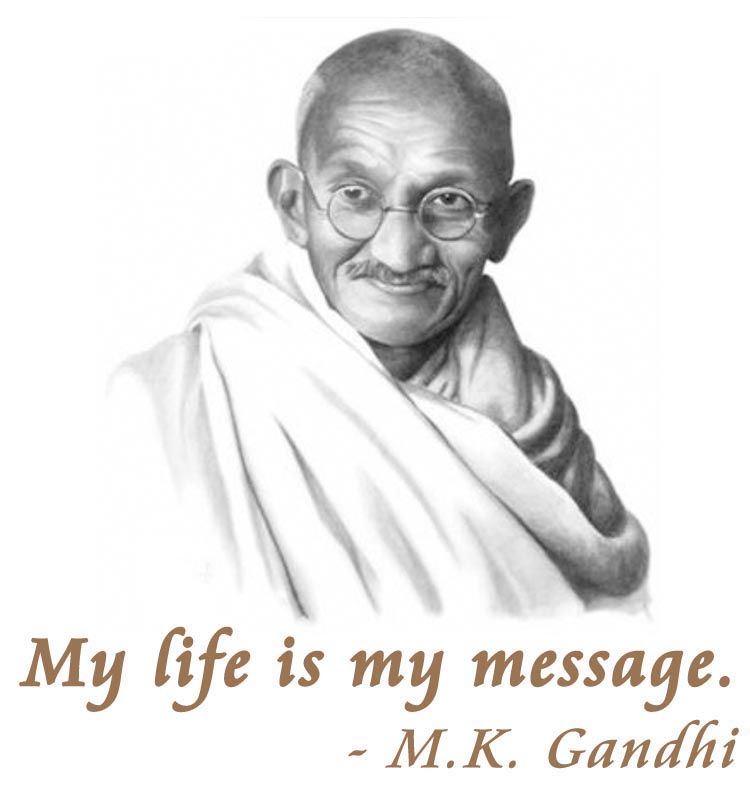
Gandhi and Art |
- By Shyam PakhareAbstractMahatma Gandhi's image is of an ascetic man among art critics and in the public mind. But Gandhi sincerely felt that there was enough Art in his life. He was well-connected with the world of Art. He had cordial relations with contemporary creative figures such as Leo Tolstoy, Romain Rolland, Rabindranath Tagore, Nandalal Bose, Anand Coomaraswamy, and Dilip Kumar Roy. He had his own stand on various debates related to Art. It will be interesting to explore Gandhi's views on Art in the context of colonialism and the struggle for independence. It will shed new light on an unexplored aspect of his multifaceted personality. A contemporary of Gandhi, noted art critic Ananda Coomaraswamy once said that Gandhi was a moral saint but not an aesthetic one (Naravane 1977). Partha Mitter, in his landmark work, Art and Nationalism, writes that, in Gandhi's programme, there was no room for art (Mitter, 1994, p. 379). Even today, not only among art critics but also in the public mind, Gandhi's image is that of an ascetic man. From his appearance, dress, and lifestyle, one would not think that he had anything to do with Art. But Gandhi sincerely felt that there was enough artistry in his life. Gandhi confessed to Nandlal Bose, the principal of the Kala Bhavana in Santiniketan, that the fine arts, and especially music, were very close to his heart. He said that, had he not been involved in the national movement, he would have dedicated his entire life to the Art of music. Signs of interest in Art are evident in the articles published in Indian Opinion, the newspaper Gandhi edited in South Africa. He read Anand Coomaraswamy’s Essays on National Idealism immediately after its publication and was quite impressed by the chapters on Indian Music. He also recommended this book to his friends in South Africa and India. He read Tolstoy's What is Art? which had a lasting impact on his views on Art. He even had this book translated into Gujarati (Parel 2018). Nandlal Bose wrote an article on Gandhi titled Bapuji in 1940. In it, he expresses the following thoughts about Gandhi and Art: From Mahatmaji’s life-style artists may find inspiration and develop their own character. Mahatmaji is indeed an artist and his creativity finds expression in the building up of his own self, in his attempt to transform himself from a man into a divine being, as also guide others in that direction. It is common knowledge that through his contact a large number of people have reached divinity. His thoughts have definiteness and clarity, his heart is pure, and he is ready to boldly sacrifice his life for the love of others. Thus, he has conquered death. To dismiss his ideal is difficult because he first practices himself what he preaches to others. Here is a rare human being whose clear heart is open for all to look into. He has absolutely nothing to hide. Like clear sunlight, his words reflect his mind. Indian artists, if they want, may transform themselves by following the model of his character. Without having a strong character an artist produces work that lacks force or foundation (Bose, 1983-84, p.164). Leading contemporary artists and writers such as Leo Tolstoy, Romain Rolland, Rabindranath Tagore, Nandalal Bose, Anand Coomaraswamy, and Dilip Kumar Roy, had cordial relations with Gandhi. Gandhi used to engage in dialogue with them on Art. One objective of this article is to understand Gandhi's views on Art in the context of those of these stalwarts. Art for LifeIn the 19th century, the idea of Art for Art's sake, or Art for life, was debated in the art world. The French philosopher Victor Cousin said that art should be judged on its purely aesthetic merits, not on its relationship to political, social, or moral values. At the end of the nineteenth century, a movement called Decadent began in the world of literature and Art in Western Europe. It also supported the ideology of Art for Art's sake. ‘Art is against nature’ was the main argument of that movement. It was against the accepted social values about morality and sexuality. The Yellow Book, published in London, was a mouthpiece of the Decadent movement. Aubrey Beardsley was its first art editor. This periodical challenged prevailing Victorian moral values. Oscar Wilde used to write for this magazine. Wilde was later sentenced to prison for homosexuality. While studying law in London, Gandhi may have come across these developments in the field of Art. Wilde was a leading literary figure in England and an ideologue of "art for art's sake". His famous novel, The Picture of Dorian Gray, and a book on literary criticism, Critic as Artist, were published during Gandhi's stay in London. In The Critic as Artist, Wilde says that all Art is immoral because it does not fit into what society defines as moral (Wilde, 1997, p.98). He elaborates that emotion for the sake of emotion is the aim of art, and emotion for the sake of action is the aim of the practical organization of life called society. He further writes, 'Art is out of the reach of morals, for her eyes are fixed upon things beautiful and immortal and ever-changing. To morals belong the lower and less intellectual spheres' (Wilde, 1997, p.127). Wilde gives aesthetics precedence over ethics. In the debate between Art for Art's sake and Art for life, Gandhi expresses his commitment to the latter. Gandhi comments that, "Oscar Wilde saw beauty only in external form and successfully embellished immorality" (Tendulkar, 1951, p.209). Gandhi writes to Devi Prasad, a student at Santiniketan, that bread comes first, then embellishment (CWMG 79, p. 23). Gandhi says that life should be more beautiful than the beauty created by combining all the arts. Gandhi's contemporary musicologist, Dilip Kumar Roy, has stated that he is the Manasputra (a son born not of one's flesh but of one's spirit) of Tolstoy in this regard (Roy, 1945, p. 23). Interestingly, in the Appendix of Hind Swaraj, Gandhi recommends What Is Art? for further reading. Tolstoy was one of the chief advocates of the party of Art for life. In the book What is Art?, Tolstoy writes that Art, like language, is a means of communication and thus aids in the human journey towards perfection. He considers human emotions ever-evolving, as does Art as its medium. He writes that universal Art is created when an intense urge to convey one's feelings to others arises in the artist's mind. He criticizes that the Art of the elite does not arise from such instincts, but only from the desire to seek pleasure. They are ready to pay a good amount to artists for that. Therefore, Tolstoy expresses his views in harsh terms, calling art a prostitute in the modern age (Tolstoy, 1899, p. 190). Tolstoy writes: The destiny of Art in our time is to transmit from the realm of reason to the realm of feeling the truth that well-being for men consists in being united together and to set up, in place of the existing reign of force, that kingdom of God, i.e. love, which we all recognize to be the highest aim of human life...The task of Christian Art is to establish brotherly union among men (Tolstoy, 1899, p.211). Tolstoy's views on Art greatly influenced Gandhi. Rabindranath Tagore thinks beyond the duality of 'art for art's sake' and 'art for life'. According to him, 'the outer world has its own juices, having various qualities which excite our emotional activities. The outer juices have their response in the inner juices of our emotions.' This is called Rasa (aesthetic essence) in Sanskrit (Tagore, 1961, p.17). He further writes: When sense organs regulate our sense of beauty, there is bound to be a sharp contrast between what and what does not appear to be beautiful. When sense is reinforced by sensibility, the distinction ceases to be so pronounced; then our mind may feel attracted by something that may not please the eye at first sight...Further, when our moral sense joins hands, the horizon of our mind extends to an extent where the conflicting notions of beauty and non-beauty fade away...When a piece of wood is rubbed against another, there is fire. Further friction becomes unnecessary. Similarly, when our sense of beauty, sparking out at every conflict of the pleasurable and painful, the good and the bad, finally bursts into flame, and all the contrast of separateness becomes consumed in it...Truth and Beauty become one. Then we perceive that in the realization of Truth, there is joy and quintessence of beauty (Tagore, 1961, p.7). Tagore's views on Art are very close to those of Tolstoy and Gandhi due to his emphasis on sensibility and morality. Meeraben (erstwhile Madeleine Slade), a follower of Gandhi once visited Santiniketan. She requested Tagore to explain to her the basic difference between the ideal behind Santiniketan and Gandhi's Ashram at Sabarmati and later Wardha. Tagore explained that the Mahatma's Ashram embodied his faith and practice of self-discipline which was the secret of his achievement, while Santiniketan stood for the fullness of expression which was the source of its joy. The Mahatma was the Prophet of tapasya (penance) while he was the poet of ananda (joy). Tagore then said that, together, penance and joy were the foundation of Indian philosophy and cultural heritage (Kripalani, 1983-84, p. 111). Tagore considers all puritanism a reaction that does not represent truth in its normal sense. He comments, "When enjoyment loses its direct touch with life, growing fastidious and fantastic in its world of elaborate conventions, then comes the call for renunciation which rejects happiness itself as a snare" (Tagore, 1961, p.24). Nandalal Bose feels that there should be all-round development of the individual. He thinks that since the individual is the basic unit of society, his actions cannot be evaluated irrespective of social values. Bose was a patriot and humanitarian. Art for life, humanity, and raising the quality of life were inspiring for him. That is why Gandhi said that as an artist Bose came very close to his ideals. Like Tagore, Romain Rolland does not take sides in the debate of Art for Art's sake or Art for life. He does not agree with Tolstoy's extreme views. Tolstoy resented the heartlessness and ruthlessness. He did not like immersing himself in Art ignoring the surrounding problems. According to Romain Rolland, although those views appear to be humanitarian idealism, they were underpinned by a reactionary attitude (Roy 1945). He writes: First of all, no true joy is essentially meaningless, and secondly because no personal joy when sincere and deep is self-centered in its play, far less in its repercussions. For, in the mysterious and wonderful scheme of things what brings deep joy to one cannot stop dead there. It is the nature of joy to radiate. Look deep and you can't but be struck by suggestion of this unity in the diverse rhythms of life (Roy, 1945, p.22). Romain Rolland also comments that a single symphony of Beethoven is certainly worth half-a-dozen social reforms (Roy, 1945, p.13). He believes that the more downtrodden a society is, the more it has a spiritual need for Art. He gives the example of Russia to support his argument. He says that there were explosions of splendor in arts and crafts under the imperial tyranny of Tsarist Russia because the spirit refused to be tamed by adversity. He also says, 'The more the soul is suppressed, the more it turns to its inner resources and expresses itself through art' (Roy, 1945 p.22). Still, there is consensus between Tolstoy and Romain Rolland that the artist's artistic life is strengthened by the trials he quietly undergoes and the sufferings he endures cheerfully. They believe that no true artist could remain detached from the miseries around him. But Romain Rolland also adds that true Art elevates us, even if it is not explicitly embedded in moral values (Roy, 1945, p. 24). Art and SpiritualityHegel (1770-1831) defined art from a spiritual point of view. According to him, God manifests himself in nature and in Art in the form of beauty. He writes: God expresses himself in two ways: in the object and in the subject, in nature and in spirit. Beauty is the shining of the idea through matter. Only the soul, and what pertains to it, is truly beautiful; and therefore, the beauty of nature is only the reflection of the natural beauty of the spirit the beauty has only a spiritual content. But the spiritual must appear in sensuous form. Truth (idea) and beauty (manifested idea) are one and the same thing (Tolstoy, 1899, p.26). Tolstoy and Gandhi also viewed Art from a spiritual perspective. During his conversation with Dilip Kumar Roy, Gandhi said: I do maintain that asceticism is the greatest Art in life. For what is Art but beauty in simplicity and what is asceticism but the loftiest manifestation of simple beauty in daily life shorn of artificialities and make-believes? That is why I always say that a true ascetic not only practices Art but lives it (Roy, 1945, р.75). Answering a question posed by Ramchandran, an art student of Santiniketan, Gandhi said that all true Art must help the soul to realize its inner self. He also asserted that productions of man's Art have their value only so far as they help the soul onward towards self-realization (Tendulkar, 1951, p.209). When Ramchandran said that the artists claimed to see and find truth through outward beauty, Gandhi replied: I would reverse the order. I see and find beauty in truth or through truth. All truths, not merely true ideas, but truthful faces, truthful pictures, or songs, are highly beautiful. People generally fail to see beauty in truth. The ordinary man runs away from it and becomes blind to the beauty in it. Whenever men begin to see beauty in truth, then true Art will arise (Ibid.). Gandhi further elaborates on this point by saying that to a true artist, only the face is beautiful which quite apart from its exterior, shines with the truth within the soul. He emphasizes that there is no beauty apart from truth. He gives an example of Socrates to prove that truth may manifest itself in forms that may not be outwardly beautiful. He says that Socrates was the most truthful man of his time and yet his features are said to have been ugliest in Greece. When Ramchandran points out that the most beautiful things have often been created by men whose own lives were not beautiful, Gandhi replies, 'That only means that truth and untruth often co-exist; good and evil are often found together. In an artist also not seldom the right perception of things and the wrong coexist. Truly beautiful creations come when the right perception is at work. If these moments are rare in life, they are also rare in Art.' Gandhi concludes the conversation by highlighting that truth is the first thing to be sought for, and, beauty and goodness will then be added unto the artist (Tendulkar, 1951, p.211). Tolstoy gives precedence to goodness over beauty in Art and even considers them contrary to each other. He believes that beauty is the root of all human passions, whereas Goodness helps in overcoming them. For Romain Rolland, Art is the source of joy and a product of beauty. He gives precedence to beauty over truth. His idea of beauty is embedded in morality. He thinks that one can find joy in beauty, whereas truth is often hurtful and disruptive. On this point, Gandhi is at odds with Tolstoy and Romain. Tagore gives equal importance to goodness and beauty. He writes: The good is beautiful not merely because of the good it does to us. There is something more to it. What is good is in consonance with creation as a whole and therefore also with the world of men. Whenever we see the Good and True in perfect accord, the Beautiful stands revealed... Beauty is Good in its fullness as Beauty is Good incarnate... Like Beauty, Goodness too leads us towards renunciation...Beauty reveals God's majesty in the midst of his creation. Goodness does the same in the conduct of human living...The beauty of goodness is a thing of much wider and deeper significance. It endows man with Godliness...When we realize this, our whole being overflows with happiness like a river in a flood. We come to know then that nothing in the world can be more beautiful (Tagore, 1961, p. 5). Gandhi found music joy-giving and inspiring. After establishing the Sabarmati Ashram in Ahmedabad, Gandhi requested Pandit Vishnu Digambar Paluskar to send a righteous singer to the ashram, thinking that music could be used in the search for truth. Paluskar sent his disciple, Pandit Narayan Moreshwar Khare. He started teaching music to the ashram students. He used to arrange prayer meetings in the ashram and sing hymns in them. Khare compiled bhajans sung in prayer meetings in a booklet titled Ashram Bhajanavali. He composed those bhajans into ragas. But the bhajans were given simple tunes that common people could sing. When Gandhi began the Salt March in March 1930, he included Khare in the contingent of eighty satyagrahis. Photographs of the Salt March show Khare with Gandhi in the foreground, holding a tambura. Singing bhajans to the accompaniment of tambura, satyagrahis marched. On 21 March 1926, in the speech given at the Second Annual Function of the National Music Association, Ahmedabad, Gandhi highlighted the importance of music in life. He said that a person devoid of music was like a beast. He also said that music should be transferred to life so that it would become harmonious. He pointed out that there could be no Swaraj where there was no harmony and music. If Indians brought music into their life and got rid of discord, there would be unity. Music would be the first step to Swaraj. He connected music with sanitation. He said that where there was filth, squalor, and misery, there could be no music. He brought to the audience's notice that, in the field of music, there was no Hindu-Muslim divide and wished for this harmony to permeate the wider society. He appealed to parents to send their children to the music class because it would help in national uplift. He also found music in the spinning wheel (CWMG 30, pp. 158-159). Gandhi found Cardinal Newman's Christian hymn, "Lead, Kindly Light," very inspiring. He got it translated into Gujarati by poet Narsimharao Divathia. This Gujarati version Premal Jyoti was sung in the Ashram during the prayer on Friday. In 1932, Gandhi started a fast-to-death against the caste system in Yeravda Jail. Then Tagore came to Pune to meet Gandhi. Before breaking his fast after the Poona Pact, Tagore recited one of his poems in front of Gandhi. Gandhi visited Santiniketan for the last time in December 1945. Rabindranath had passed away in 1941. Gandhi interacted with students and teachers of the Sangit Bhavan. Later, he wrote a letter to Rathindranath, offering vital suggestions on music education. It shows his broad vision of music. He writes, "Music in Santiniketan is charming, but has the professor there come to the conclusion that Bengali music is the last word in that direction? Has Hindustani music, i.e., music before and after Muslim period, anything to give to the world of music? If it has, it should have its due place at Santiniketan. Indeed, I would go so far as to say that Western music which has made immense strides should also blend with the Indian. Visva Bharati is conceived as a world university. This is merely a passing thought of a layman to be transmitted to the music master there" (CWMG, 82, p.251). Later, in early 1947, Gandhi began a padayatra (walking tour) through the villages of Noakhali to help quell communal riots. It was the most trying period of his life. During the padayatra, he would ask his colleagues to sing Tagore's famous Bengali poem, "Ekla Chalo Re" (Walk Alone). He would hold prayer meetings in the village where he halted, and his followers would sing devotional songs. It had a very positive effect on the riot victims' minds. During normal times, Gandhi's public meetings always attracted mammoth crowds. He would make a point of beginning meetings with devotional songs. It pacified the excited people and helped with crowd management. Tolstoy believes that the value of Art in a society is based on its perception of life and its spiritual understanding (Tolstoy 1899). He writes that, by the standard of religious perception, the feelings transmitted by Art have always been evaluated (here, religious perception is distinguished from religious cult). He further writes that in every period of history and every human society, there exists an understanding of the meaning of life that represents the highest level to which men of that society have attained, and this understanding is the religious perception of the given time and society (Tolstoy, 1899, p. 157). 'The religious perception of our time, in its widest and most practical application, is the consciousness that our well-being, both material and spiritual, individual and collective, temporal and eternal, lies in the growth of brotherhood among all men-in their loving harmony with one another,' writes Tolstoy (Tolstoy, 1899, p.159). According to Tolstoy, a real work of Art destroys in the consciousness of the receiver, the dualism between himself and the artist, and also between himself and all whose minds receive this work of Art (Tolstoy, 1899, p.153). Romain Rolland has also said that the deepest creative impulses of the artist lie in his realization of unity in apparent diversity. Nandalal Bose also believes that Rasa makes us perceive one thing as distinct from another, but it is Rasa that creates unity and harmony in diversity. As a result, duality is destroyed, and ecstasy is created (Bose, 1983-84, p.168). The idea of non-dualism, known as Advaita in Indian philosophy, runs as a common thread through the philosophy of Tolstoy, Romain Rolland, Tagore, Bose, and Gandhi. Tagore writes that beauty cannot be created through unrestrained imagination and that restraint is essential if beauty is to be enjoyed. He believes that aesthetic awareness brings control over strong primal desires. So, we do not remain slaves to our passions (Tagore, 1961, p.2). He comments that the experience of beauty liberates us and this is essential to human life because, with our uncontrolled strong emotions, we create a virtual world that is at odds with reality. Tagore writes: Our anger, our greed brings about such distortion that the great becomes small, and small the great; the ephemeral appears to be eternal and the eternal eludes our vision. The falsity we lust after is magnified to such an extent that it obscures for us the light of the great truths and thus our creations come into conflict with what Providence has created...The connoisseur does not present himself to be overcome by a loud display of colors. He looks for a harmonious whole taking the principal with the subsidiary, the central with the marginal, and the foreground with the background. The colorful may captivate the eye, but the beauty of harmony calls for understanding. The deeper the mind penetrates the deeper the joy of understanding...mere eyesight is not enough; it must be reinforced by the insight of the mind in order that Beauty may lie revealed in its nobility. One must have the training to develop the insight. The mind again has many levels. The field of vision which is open to our reasoning and intellectual faculties becomes widened when emotions are brought into play. With moral discrimination added to them, the field is widened further. And once our spiritual insight lies open, infinitude becomes the limit... (Tolstoy, 1899, p.4). According to Nandalal Bose, Shanta Rasa (aesthetic essence of tranquillity) is the beginning and end of all Rasa. He writes, 'Happiness or sorrow, love, hate or disgust, whatever the emotion or excitement, become the subject of art only when, within and above it, it attains to a state of steadiness or poise or impersonal balance' (Bose, 1983-84, p.205). He also points out that inspiration comes from a sense of suffering; the deeper the pain, the more dynamic the inspiration, and in the expression of that delight is Art's fulfilment (Bose, 1971, p. 123). Bose further elaborates that faith, love, attraction, sense of unity, and harmony in diversity are the basic characteristics of Art. Creation is possible only on the path of love. The analysis part comes later. The basic purpose of Art is to realize the universal consciousness that pervades everywhere. He further writes that expression requires technique but technical knowledge alone does not inspire Art. He comments, 'An artist touches immortality through his Art. An artist's life is reflected in his Art. There is non-duality in the artist and his Art. They cannot be separated.' Art for the Common Man:As in Gandhi's other ideas, the common man is at the centre of his artistic thought. So, he believes that Art must be simple in its presentation and direct in its expression like nature (Roy 1945). In this regard too, the deep influence of Tolstoy on Gandhi is visible. Tolstoy does not agree with the notion that ordinary people lack the taste to esteem the highest works of Art. He asserts that they do recognize like the connoisseur the Art in the epic of Genesis, the Gospel parables, folk legends, fairy tales, and folk songs. For him, a peasant woman's song is true Art while the 101st sonata of Beethoven (composed towards the end of his career) was only an unsuccessful attempt at Art, containing no definite feeling and therefore not infectious (Tolstoy 1899). He asserts that being easily accessible and comprehensible to the common man is the secret of greatness in great works of Art. He prophesizes that brevity, clarity, and simplicity will be the hallmarks of future Art and that the artist of the future will live the common life of man, earning his subsistence by some kind of labor and creating Art only when he has a strong urge for creative expression (Tolstoy, 1899, p.195). Romain Rolland also believes that great Art must appeal to everyone alike, as the absence of culture does not blind men to its beauty. He comments, '...there could be no salvation for culture if the masses were left out in the cold' (Roy, 1945, p.18). In the speech given at Gujarati Sahitya Parishad on 31st Oct., 1936, Gandhi asked the literary men to go to villages, study them, and give something life-giving to the villagers. He said he wanted Art and literature that could speak to the millions (CWMG 63, pp. 415-416). In 1936, due to Gandhi's insistence, the annual Indian National Congress session was for the first time held in a rural area at Faizpur. Gandhi entrusted Nandalal Bose with the responsibility of decorating the convention venue. Gandhi instructed him to complete the task using only rural materials and employing country craftsmen. He also emphasized that the conception should be indigenous. Bose strictly followed that instruction and decorated the meeting place in a very artistic way. In his speech at the convention, Gandhi praised Bose and said that God had given him the sense of Art but not the organs to give it concrete shape, whereas Bose was blessed with both (CWMG 70, p. 212). Then, in 1938, Gandhi again asked Bose to decorate the venue of the annual Congress session at Haripura. He expressed his desire that the peasants passing by the meeting place should also see the Art. Bose and his disciples made more than 100 posters in indigenous colors depicting various aspects of rural life and occupations. Krishna Kripalani, who had spent many years in Santiniketan, writes: In these posters, Nandalal's Art is at its maturest and best. Discarding all sophistication, he rediscovered the simplicity of folk art. These posters were all put up tastefully to fill the Congress campus at Haripura attracting thousands of visitors... Thus with Mahatma's blessings, Nandalal became the people's artist...What he did at Haripura was a colossal demonstration of the social value of Art (Kripalani, 1983-84, p.119). Swadeshi ArtThe idea of Swadeshi (indigenous) Art emerged in India in the early twentieth century. According to the famous sculptor of Santiniketan, Ramkinkar Baij it was a strong revivalist movement with a dislike of Western Art. English Art Administrator and Art Historian from Kolkata, E. B. Havell, Sister Nivedita, and Anand Coomaraswamy contributed to the development of the principles of Swadeshi Art. Nivedita writes in Modern Review in 1907 that Art's rebirth in India can only take place if it is consciously made the servant and poet of the mighty dream of an Indian Nationality (Mitter 1994). Havell writes that Swadeshi art is a state of mind and an act of faith that sees the quintessence of Eastern mentality in rural India and in its unbroken tradition. For Anand Coomaraswamy, Swadeshi was a spiritual struggle against the bureaucracy of the British Raj, which represented an alien ideal (Mitter, 1983-84, p.90). He writes that artists will play an important role in this struggle because their creative talent enables them to understand political injustice clearly. Coomaraswamy believes that a nation is built not by traders and politicians but by artists and poets (Coomaraswamy, 1909, p. i). According to Partha Mitter, an academic art introduced by the British in India was closely associated with imperial triumphalism, and it was believed that an authentic national expression could not be painted while associated with the Raj (Mitter 1994). Coomaraswamy comments that the deepest values of life are found in Art. The true ideal of Indian culture is unity, and knowing this spiritual heritage is the main motivation behind Art. Shortly, he writes, this strong sense of self-sacrifice and self-realization will manifest itself in nationalism, rooted in spiritual values. The Art of living can be realized again through the unity of national and spiritual ideals. He thought that only by becoming artists and poets, can one achieve the highest ideal of nationality which is the will and power to give. Both Nivedita and Coomaraswamy considered the spirituality of Indian Art as the antithesis of Renaissance naturalism (Mitter 1994). Nivedita said that Art was no longer a vocation but a spiritual mission whose central message was nationhood. Both Coomaraswamy and Nivedita believed that decorum was the greatest national ideal. Nivedita condemned Varma's paintings as debased Art that did not possess spirituality or nobility. She found Varma's paintings, Shakuntala lying on the floor, and Arjuna courting Subhadra, as devoid of the morals and ethics of India. She did not like such a public display of intimacy (Mitter 1994). Coomaraswamy commented that the helpless Sita, bullied and abducted by Ravana, in Raja Ravi Varma's painting could not be a national ideal. Instead, he said that calm, composed, and confident Sita, who preserved her own identity even in Ravana's captivity in Abanindranath Tagore's painting, was a symbol of the national ideal. Nivedita said that Abanindranath's painting Bharat Mata (Mother India) was a symbol of India's spiritual and cultural heritage and art students should emulate its ideal. Nivedita eulogised Bharat Mata because she appeared like the virgin mother rather than a temptress, unlike the women portrayed in Varma's paintings. For her, Abanindranath's Bharat Mata was like a decorum personified. While criticizing academic Art, Havell, Coomaraswamy, and Nivedita were still influenced by Victorian art values. Emphasizing the moral dignity of Art Nivedita felt compelled to suggest a ban on life study classes in which nude painting was taught (Mitter 1983-84). But she did not realize that it was like striking at the very roots of teaching in art schools. Even Abanindranath, who respected the students' creativity, would lose his temper whenever he found any student secretly practising nude painting (Mitter 1994). For him, bhava (idea) was the soul of painting, not the depiction of a beautiful body. There was also the influence of Victorian moral values on Gandhi. According to Mitter, the ideologues of swadeshi Art believed that the British Empire rested on cultural rather than military superiority. They criticised the revolutionaries for ignoring the British cultural dominance (Mitter 1994). After the advent of Gandhi, there was a radical change in the philosophy of the freedom struggle. The power base of politics shifted from the urban to the countryside. Gandhi bridged the divide between cultural nationalism and political activism. Under his leadership, nationalism became inclusive, bridging rifts along lines of gender, caste, and religion. According to Partha Mitter, Abanindranath was influenced by Swadeshi art for some time before but he had always cherished freedom and creativity in Art. Now he realized that the doctrinal approach of Swadeshi was too restrictive, and its obsession with the past was too deadening. The revivalist approach made the Art lose touch with reality. Instead of reflecting everyday life, it became a museum object. He also realized that 'artistic creation was the outcome of devoted cultivation, not simply a reiteration of national sentiment' (Mitter, 1983-84, p.94). It brought a qualitative transformation in his works of Art. Nandlal Bose was a disciple of Abanindranath. Bose writes about the effect of this transformation in the paintings of his guru. He finds them calm, gentle and non-aggressive. He writes, 'They are soundless like dawn or the opening of a flower or sprouting of a seed (Bose, 1983-84, p.198). But the influence of nationalism and pride in Swadeshi art remained on Bose also for a long time. During this phase, when Gandhi began his salt march, it was like a miracle for Bose. He writes, 'The entire country was roused with confidence in some unique strength. Glory filled my heart. I felt blessed and life became meaningful' (Bose, no date, p.164). Bose immortalized this episode with a linocut of Gandhi marching with a bamboo staff. Krishna Kripalani writes that it was a simple drawing but an inspired one, capturing in a classic pose the essential feature of Mahatma's heroic struggle (Kripalani, 1983-84, p. 119). The lines in this drawing reflect the spirit of nationalism. They appear powerful and even harsh. Abanindranath was worried about this aggressiveness in Bose's technique. Bose was determined to prove the superiority of Indian Art. But later he also realized the limitations of this spirit of challenge. He writes, 'I now know that with such a spirit you lose on the side of Rasa...I pray now to Visvakarma that he may give me access to the Rasa of all great Art from everywhere...' (Bose, 1983-84, p.198). Late in his career, Bose came to the conclusion that nationalism, or a Swadeshi approach to Art, creates barriers to the creation of Rasa. Tagore's opposition to exclusive nationalism is well known. He did not consider a country greater than humanity's ideals. Gandhi was also opposed to narrow nationalism. In 1921, when the Non-cooperation Movement was at its peak, Tagore and Gandhi engaged in a public discourse on this issue through newspaper articles. When the spirit of non-cooperation reverberated across India, Tagore was on a tour of Europe to foster greater cooperation between the East and the West. He expressed concern that the call for non-cooperation and boycott should not foster a narrow-minded mentality among Indians. Gandhi assured him that he was also as great a believer in free air as the great poet. He writes, 'I want the cultures of all the lands to be blown about my house as freely as possible. But I refuse to be blown off my feet by any...' He further writes, 'For me nationalism and humanity are equivalent...Narrowness, selfishness, and limited nationalism are the curse of modern nationalism. It is a sin.' Gandhi's outlook was universal but he believed that nationalism could establish unity among the diverse elements of India and help in the achievement of independence. But he also expected India's independence to be a stepping stone in establishing universal brotherhood. Gandhi sought to strike a balance between nationalism and universalism. Hence, he never seems to have supported the idea of Swadeshi art in the sense the promoters expected. ConclusionGandhi's views on Art continued to evolve, as did his other thoughts, but the foundation of his views on Art had been Tolstoy's analysis of Art from a moral and spiritual point of view. Although Tagore and Romain Rolland found Gandhi's and Tolstoy's views on Art to be orthodox, there seems to be much in common in their philosophies of Art. Like Tagore, Gandhi evaluates the beauty of Art based on Satya (the truth) and Shiva (the good) of Indian philosophy. The idea of Advaita (non-dualism) is expressed in the artistic thoughts of Gandhi, Tolstoy, Romain Rolland, Rabindranath Tagore, Anand Kumaraswamy, and Nandalal Bose alike. Gandhi and Tolstoy insisted that Art should reach the common people. Tagore did not insist on it, but folk art had a place of honor in the art world of Santiniketan. Romain Rolland and Bose also supported the democratization of Art. Gandhi and Tagore had differences on the issue of nationalism. Even though Gandhi was the supreme leader of the national movement, he did not try to limit the field of Art in the name of nationalism. His views in this regard are as universal as Tagore's. Notes:
References:
Courtesy: Gandhi Marg , Volume 47 Number 4, January-March 2026 * Shyam Pakhare Associate Professor and Head of the Department of History, Kishinchand Chellaram College, 124 Dinshaw Wachha Road, Churchgate, Mumbai 400020. His area of research interest is Gandhian Studies. He has authored a biography of Khan Abdul Gaffar Khan and a novel, Noakhali. He is Co-Series Editor of Bharatiya Vidya Bhavan's Mahatma Gandhi in Indian Languages series. Email: shyam.pakhare@kccollege.edu.in |