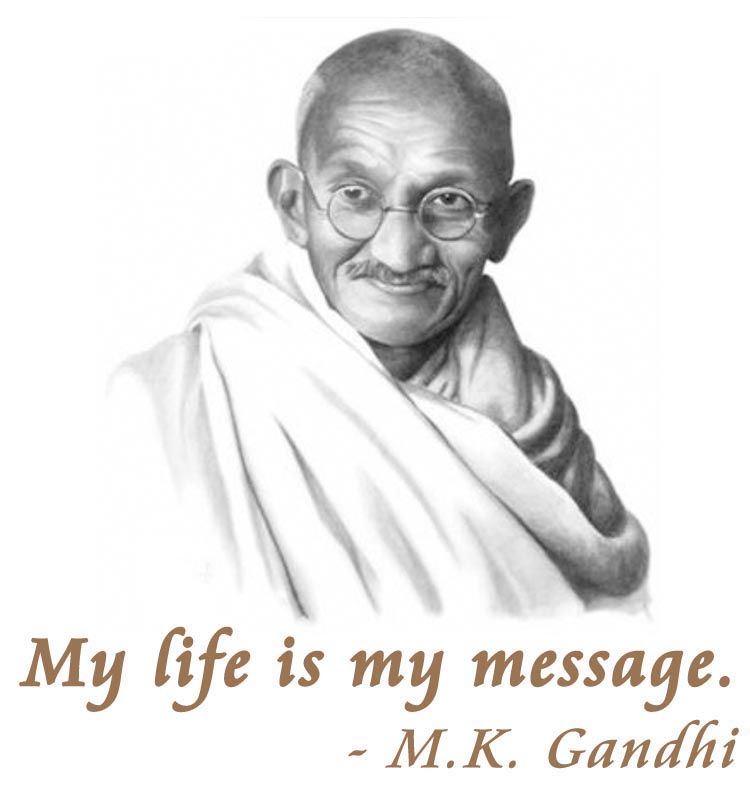
Gandhi, Ahimsa, and Jainism |
- By Tara Sethia*AbstractThis paper examines ahimsa in Jainism and in Mahatma Gandhi's thought and actions, arguing that while both share a commitment to ahimsa in their unique ways, they are fundamentally different in terms of how they define its meanings, purposes, and paths for achieving the desired goals. In Jainism ahimsa is a personal discipline aimed at spiritual liberation (moksha), grounded in the radical equality and interdependence of all beings, and sustained through vows, equanimity, and detachment from material engagement. Gandhi's ahimsa, in contrast, emerges as an evolving moral philosophy and practice rooted in truth, love, and active social engagement. Gandhi transformed ahimsa into a method of collective resistance and social change aimed at the well-being of all (sarvodaya). Together they offer complimentary lessons for humanity's ethical and peaceful future. I know the Jains. I know them and the principles of their religion as intimately as I do Vaishnavism and Vaishnavas. Some in their anger believe me to be a Jain. Others in their love wish that I should become a Jain. IntroductionAhimsa is the defining characteristic of Jainism and arguably the defining legacy of Mahatma Gandhi to humanity at large. The Jains believe Jainism to be a major influence on Gandhi. Some scholars also reinforce this view. They point out that Gandhi was exposed to Jainism as a child, in a family environment where Jain monks often visited his home. Later, exposure to Jainism continued through Gandhi's association with Shrimad Rajchandra, a scholar of Jain and Hindu texts (Hays 1970, pp. 29-38; Hays 1978, pp. 120-132). The interaction with other prominent Jains, such as Pranjivan Mehta, Virchand Gandhi, and Ambalal Sarabhai, has also been cited alongside the role of his parents, especially his mother, in helping Gandhi learn “practical ahimsa” (Jain 2017, pp. xiv-xv, 6). Ahimsa is “as old as the hills,” said Gandhi. He was referring to the ancient traditions of non-violence. He certainly learned from these traditions, including Jainism. However, Gandhi’s ahimsa is fundamentally different from Jain ahimsa in terms of its meaning, purpose, and the path to achieving that purpose. That is not to say there are no similarities between the two. However, in this paper I focus only on their uniqueness and on how the two differ. Jainism is known for the distinctive articulation of ahimsa as an ethic of personal discipline for one’s own good and salvation. Gandhi’s articulation of ahimsa is also unique. According to him ahimsa is a personal and political ethic for the good of society as a whole. He embraced ahimsa as a tenet and tactic of change and transformation, thereby becoming a pioneer of nonviolent social change. Nevertheless, the distinctive meanings, specific goals, and different paths of ahimsa in Jainism and in Gandhi are assets for humanity. Together, they offer us lessons for our own good and for the good of all. I will first discuss the meaning and purpose of ahimsa in Jainism, as well as the prescribed path(s) to achieve that purpose. I will then discuss the singularity of Gandhi’s ahimsa, which is the primary focus of this paper. Ahimsa in JainismAhimsa is recognised as a virtue in many religious traditions, but in Jainism it is regarded as “the virtue” (Jaini 1979, p. 167). It denotes non-violence or non-injury, yet its meaning extends far beyond the avoidance of physical harm. In Jain thought, violence includes intentional and unintentional harm committed through thought, word, or deed. Ahimsa, therefore, requires not only refraining from direct violence but also avoiding indirect forms such as encouraging others to commit violence or approving violence in any manner. Central to this principle is the belief that every living being (jiva) possesses an autonomous, imperishable soul characterised by consciousness and the capacity to experience pleasure and pain. The Jain understanding of ahimsa rests on the logic of equality among all living beings at the level of their souls, irrespective of physical forms, ranging from one-sense beings to five-sense beings. The Jain text Samansuttam expresses this foundation clearly: Just as pain is not agreeable to you, it is so with others. Knowing this principle of equality of all beings, treat all with respect and compassion (Tukul & Dixit 1999, #150, p. 57). Awareness of the essential sameness between oneself and other beings becomes indispensable for practising ahimsa. Since all beings desire life and none desire death (Mahapragya 1994, pp. 9-14, 216-217), Jainism upholds the sanctity of life and views non-violence as essential for one's spiritual well-being and growth (Tukul & Dixit 1999, #148, 149, p. 57). Ahimsa is rooted in the philosophy of anekānta, an epistemological tool for understanding reality in its multiple dimensions (Sethia 2004, p. 6). Knowledge plays a vital role in distinguishing between what is beneficial and what is harmful to the self. Unlike traditions where violence is primarily understood as harm inflicted on others, Jainism holds that violence toward others is simultaneously violence toward the self. Such conduct obstructs one's spiritual progress and the pursuit of moksha, the ultimate goal of liberation in Jainism (Jaini 1979, p. 167). Consequently, discussions of violence and non-violence in Jainism proceed from the perspective of the soul's welfare and salvation. The soul, according to Jain philosophy, undergoes continuous change between ignorance and omniscience depending on purity and impurity shaped by karma. Accumulation of karma results from attachment (raaga) and aversion (dwesha), binding the soul to the cycle of rebirth. Liberation requires overcoming these passions through detachment from worldly engagements and the removal of karmic matter. The realization of the fully liberated soul (siddha-hood), characterized by pure consciousness, represents moksha. This state is attained through the practice of ahimsa and equanimity (samata) under all conditions (Jaini 1979, p. 224). The Jain aspirational ideal expresses this disposition: I seek forgiveness from all and I forgive all. May I have amity with all beings and enmity with none" (Jaini 2000, pp. 17-18). The practice of equanimity in Jainism is aimed at one's spiritual well-being as a self-centered goal rather than motivated by altruistic purpose of "social fellow-feeling" (Wiley 2004, p. 16). Nevertheless, Jain thought simultaneously emphasises interdependence among all forms of life. The dictum "Parasparopagraho Jivanam" affirms that souls support one another in mutual interdependence. Acharya Umasvati interprets this as an ethically grounded relationship binding living beings together (Tatia 1994, p. 131). Such a worldview promotes ecological harmony, where life is celebrated as “a gift of togetherness, accommodation, and assistance in a universe teeming with interdependent constituents” (Singhvi 2006, p. 217). Thus, non-violence toward others ultimately contributes to one’s own spiritual progress (Tukul & Dixit 1999, #151, p. 57). Understanding ahimsa is insufficient without practice. Ahimsa develops through self-discipline and sustained training (Kanakprabha 2003, pp. 166-167). Jainism prescribes a structured system of vows — the great vows (mahavrata) and small vows (anuvrata) — that limit passions and reduce the influx of karma, thereby assisting the soul’s progress toward liberation (Jaini 1979, p. 170). Fasting is another important practice for cultivating self-control and purifying the soul. Through fasting, practitioners gradually diminish and overcome attachment and aversion. In rare cases, fasting may extend until death in the practice known as Sallekhana or Santhara, which means “thinning one’s own body and passions.” This vow represents the ultimate form of ahimsa in Jainism, symbolizing total detachment from material concerns, including bodily nourishment. Its purpose is to achieve equanimity and to “guard and nurture” the soul (Jaini 2000, pp. 16-17). Sallekhana is understood as a conscious realization of the distinction between the transient body and the eternal soul and is regarded as the “most auspicious way” to end life. Yet it remains controversial in modern debates, with critics viewing it as self-violence (BBC News 2015; Frontline/The Hindu 2015). Despite practical disciplines, Jainism holds that there is no limit to the practice of ahimsa. As Umaswati states, “Non-violence is unlimited, tolerance unconditional, and reverence for life supreme” (Tatia 1994, p. xxi). Genuine ahimsa requires relinquishing attachments and renouncing hostility (Jaini 2004, pp. 55, 59). While Jainism distinguishes between intentional violence and accidental or unavoidable harm necessary for survival, violence is never morally endorsed, and the tradition does not accommodate ideas such as “just war” (Tatia 1994, p. xxi). In sum, ahimsa in Jainism is distinctive because it is grounded in the radical equality of all beings, regardless of their forms, and frames non-violence as beneficial to one’s own spiritual progress. It functions as a creed and disciplined way of life built on the logic that violence toward others is violence toward oneself, while non-violence toward others benefits the self. This ethical framework encourages restraint and discourages harm. At the same time, ahimsa in Jainism is marked by depth and comprehensiveness. It is all-encompassing, without conditions or limits, demanding mindfulness in thought, speech, and action. Although its primary aim is spiritual liberation, its implications extend beyond the individual, shaping social conduct and ecological awareness. By encouraging reverence for all life, restraint in consumption, and sensitivity toward all beings, Jainism offers an ecological vision that supports conservation and sustainability (Kumar 2002, pp. 187-188; Chapple 2002). Gandhi’s AhimsaGandhi does not appear to have followed any single traditional formulation of ahimsa. According to Bhikhu Parekh, his reinterpretation departed significantly from inherited meanings and even upset many contemporaries, including the Jains (Parekh 1988, p. 200). Parekh aptly placed Gandhi’s ahimsa “in a class by itself” (Parekh 1988, p. 214). The distinctiveness of Gandhi’s ahimsa lies in its meanings, roles, purposes, and methods. It functioned not merely as a moral ideal but as both principle and practice, a personal discipline as well as a political strategy. Unlike Jain ahimsa, which is primarily tied to individual’s spiritual liberation, Gandhi transformed ahimsa into a dynamic and socially engaged ethic aimed at reform and collective transformation. The singularity of Gandhi’s ahimsa may be explained through three broad features. First, it was continuously evolving. Its roots lay in diverse experiences: personal encounters with violence, exposure to religious and philosophical traditions, and extensive reading. Through experience and experimentation, Gandhi defined “Ahimsa is not merely a negative state of harmlessness, but it is a positive state of love…” (SWMG Vol. 6, p. 153). This understanding of ahimsa gradually expanded from service to the Indian community in South Africa to the struggle for swaraj in India, and eventually toward sarvodaya, the welfare of all humanity. Second, Gandhi’s ahimsa became a living philosophy. Gandhi tested it through practical experiments in the context of his political struggles. He activated ahimsa as its exemplar. His example enabled others to witness its practical power and inspired them to participate in collective action grounded in this moral discipline. Ahimsa thus emerged as a lived reality rather than an abstract ideal. Third, Gandhi’s ahimsa possessed a transformative and revolutionary character. He demonstrated non-violence as a powerful instrument for social and political change. Calling it “the weapon of the strong,” he applied it through moral persuasion, constructive work, and satyagraha. These methods were revolutionary in scale and impact, inspiring global movements against authoritarianism, injustice, and exploitation. The above three aspects made Gandhi’s ahimsa singular and also different from Jainism as revealed across the following major phases of his life. In the process he framed ahimsa as a personal and political ethic, a tenet and tactic of reform and transformation. IGandhi was not born with a commitment to ahimsa. Although he grew up in a culturally eclectic environment shaped in part by vegetarian tradition, there is little evidence that nonviolence guided his early life. On the contrary, Gandhi later admitted that he consciously experimented with meat-eating, justified it through readings such as the Manusmriti, and even considered it his “moral duty” to kill insects or snakes (Gandhi 1957, pp. 20–21, 34). Even his vow to abstain from meat before traveling to England reflected obedience to his mother rather than conviction; he still believed meat gave strength and felt “every Indian should be a meat-eater” (Gandhi 1957, pp. 23, 48). Yet, the seeds of his ahimsa lay in his early fascination with truth and its exemplar, King Harishchandra, which deeply influenced him: The play Harishchandra captured my heart. I could never be tired of seeing it…I must have acted Harishchandra to myself times without number…To follow truth and to go through all the ordeals Harishchandra went through was the one ideal it inspired in me” (Gandhi 1957, p. 7). Truth gradually became for Gandhi a “sovereign principle” and eventually equivalent to God (SWMG, Vol. 6, pp. 98–99). Stories such as Shravana Pritibhakta Nataka reinforced ideals of duty and selfless service, leaving an “indelible impression” on him (Gandhi 1957, p. 7). Another formative moment occurred when he confessed adolescent thefts to his father. His father’s “sublime forgiveness” revealed the moral power of love and forgiveness (Gandhi 1957, p. 28). These early experiences planted the ideals of truth, duty, and love that later shaped his principle and practice of ahimsa. IITruth remained Gandhi’s guiding ideal. He later acknowledged, “In fact, it was in the course of my pursuit of truth… I discovered non-violence” (Gandhi 1936, p. 49). His ethical transformation deepened during his years in England, where he embraced vegetarianism as a moral principle rather than a family custom. Reading Henry Salt’s, A Plea for Vegetarianism opened new ethical horizons; he described it as "a great discovery in my search after truth" (CWMG, Vol. 54, pp. 188-189). Further readings—Anna Kingsford's The Perfect Way in Diet and Howard Williams' The Ethics of Diet — reinforced a moral view of food and human responsibility toward animals. These readings convinced Gandhi that vegetarianism represented an ethical duty. He joined the London Vegetarian Society, served on its Executive Committee, and wrote articles promoting vegetarianism (Gandhi 1957, pp. 55-56; Bhattacharya 1965, p. 1). What had begun as obedience to his mother evolved into life-long ethical commitment to vegetarianism. During this period Gandhi also encountered religious texts that deepened his moral horizons. Edwin Arnold's The Song Celestial introduced him to the Gita, which he regarded as "the book par excellence for the knowledge of Truth." Arnold's The Light of Asia acquainted him with the Buddha's compassion, while the New Testament and the Sermon on the Mount introduced him to ideals of love and forgiveness (Gandhi 1957, p. 68). These influences expanded his understanding of truth and compassion and gradually shaped his emerging conception of ahimsa. IIIReturning to India, Gandhi encountered two individuals who redirected his life. His meeting with Shrimad Rajchandra, a Jain thinker, deeply inspired his intellectual and spiritual trajectory. Gandhi admired Rajchandra's integrity and intellect and saw in him a "real seeker of truth" (Gandhi 1957, pp. 88-90). Rajchandra later became Gandhi's spiritual guide. Another formative event was his humiliating encounter with the British political agent Charles Ollivant. Attempting to help his brother, Gandhi was dismissed and removed from the office. The episode wounded his dignity but taught him a lasting lesson about ethical independence and personal integrity (Rudolph & Rudolph 1983, pp. 88-89). This changed Gandhi's professional trajectory and pushed him to accept an opportunity in South Africa, where his ahimsa continued to mature over a period of twenty-one years. IVSouth Africa proved decisive in shaping Gandhi's ahimsa. Personal experiences of racial discrimination and violence forced him to confront systemic injustice. During a period of spiritual crisis, he sought guidance from Rajchandra, who encouraged deeper study of Hinduism and introduced the idea of ahimsa parmo dharma. Rajchandra explained moksha as liberation through withdrawal from worldly affairs, but Gandhi rejected disengagement, choosing instead active involvement in the politics of South Africa (Gandhi, R. 2013, p. 102). Witnessing racial oppression convinced Gandhi that violence produces only more violence. Influenced by Dadabhai Naoroji's counsel to oppose evil with love (Rolland 2002, p. 7) and earlier moral teachings about returning good for evil (Gandhi, R. 2013, p. 102), he searched for a moral alternative. Leo Tolstoy's writings proved transformative. Tolstoy's ethic of universal love persuaded Gandhi that love was the only effective resistance to injustice, making him "a firm believer in ahimsa" (Iyer 1983, pp. 179, 221; Gandhi 1957, p. 160). Gandhi thus defined ahimsa in dual terms: positively as the "largest love" and negatively as non-injury. Reading Plato's Apology reinforced the idea that one should choose suffering rather than inflicting it (Parel 2009, p. xlvii; Parel 2006, pp. 117–118). South Africa became the testing ground for putting these ideas into action. He founded the Natal Indian Congress (1894), used publications such as "Grievances of Indians in South Africa," and later launched Indian Opinion (1903) to mobilize resistance campaign rooted in truth and love (Dalton 1993, p. 12). John Ruskin's Unto the Last inspired Gandhi's vision of community and social equality. Translating it as Sarvodaya, he embraced the principle that individual good lies in the good of all (Gandhi 1957, pp. 297–300). He established the Phoenix Settlement in 1904 to experiment with simplicity, shared living, and self-discipline. The year 1906 marked a major turning point. Gandhi's observations of British repression during the Zulu campaign strengthened his belief in the futility of violence. Seeking moral discipline, he re-engaged with the Gita, explored Patanjali's Yoga Sutra, adopted brahmacharya (celibacy) to channel his energy into service, and to strengthen his soul-force (Howard 2013). These developments culminated in the resistance campaign against the "Black Act." Gandhi had discovered a method for "securing the redress of wrongs" through non-violence (SWMG, Vol. 5, p. 389), which he called satyagraha or "holding on to truth." Gandhi described it as "a weapon of the strong," a "truth force, love force or the soul force" (SWMG Vol. 5, pp. 391, 397). Influenced by Thoreau's civil disobedience, he contrasted satyagraha with brute force in Hind Swaraj. Gandhi's South African movement (1906–1914) used dialogue, negotiation, non-cooperation, and civil disobedience, culminating in the Epic March of 1913 (SWMG, Vol. 3). By the time he left South Africa, Gandhi had forged ahimsa into a method of political action. His signature strategy of satyagraha combined the ethics of truth and nonviolence, which he would further refine in his pursuit of swaraj in India. VFor Gandhi, swaraj meant more than political independence. "If we become free, India is free...It is swaraj when we learn to rule ourselves" (Gandhi 1909, p. 71). Self-rule required mastery over passions and was therefore grounded in ahimsa. Freedom, he argued, would never come through arms but through "soul-force" (Gandhi 1909, p. 110). Returning to India in 1915, Gandhi founded the Satyagraha Ashram to train practitioners in truth and non-violence. Truth, he held, was foundational: "the vow of truth includes all others" (SWMG, Vol. 5, p. 449). Yet his ahimsa was pragmatic rather than absolute. He acknowledged moral dilemmas, arguing that killing a suffering animal might sometimes be "non-violent" if done for its welfare (Gandhi 1932, pp. 72-75). During World War I, Gandhi supported the British war effort, reasoning that true non-violence required strength, not weakness. He acknowledged: "...sometimes practice of ahimsa may even necessitate killing...Ahimsa is the renunciation of the highest type...Ahimsa is a renunciation out of strength, and not out of weakness." (SWMG, Vol. 5, pp. 386-387). Gandhi's approach to war and ahimsa was prompted by his politics at that time. Up until early 1919 Gandhi continued to have faith in British sense of fairness and justice (Fischer 1982, p. 57). VIPost-war events shattered this faith. Economic hardship, the Rowlatt Acts, and the Amritsar Massacre convinced Gandhi that cooperation with the empire was untenable. He embraced non-cooperation and deepened his commitment to ahimsa. He famously declared: "Non-violence is the Law of our Species, as violence is the Law of the Brute...The dignity of man requires obedience to a higher law—to the strength of the spirit." (SWMG, Vol. 6, pp. 156-157). Non-cooperation became both moral duty and political strategy. Gandhi emphasized that it required "greatest love with the greatest opposition to wrong" (SWMG, Vol. 6, p. 178). When violence erupted at Chauri Chaura, he suspended the movement, demonstrating his insistence that means must remain nonviolent. During the 1920s, Gandhi deepened his spiritual discipline through fasting and constructive work. He wrote: "I contemplate a mental and therefore a moral opposition to immoralities...The resistance of the soul...would at first dazzle him and last compel recognition..." (SWMG, Vol. 6, p. 176). His vision expanded from swaraj to poorna swaraj and sarvodaya, emphasizing national unity, self-reliance, and service to the poor. He regarded ahimsa as essential for achieving the "highest good" (SWMG, Vol. 6, pp. 162, 230). Amid growing political violence and economic crisis, Gandhi conceived the Salt Satyagraha as a mass demonstration of nonviolent power. He explained the injustices of the salt tax (CWMG, Vol. 48, pp. 349–350) and informed Viceroy Irwin of his intentions in advance, embodying transparency and truth. On the eve of the march, he declared: We have resolved to utilize all our resources in the pursuit of an exclusively non-violent struggle. Let no one commit a wrong in anger... (SWMG, Vol. 6, p. 25). Despite his arrest, the movement continued. At Dharasana Salt Works, satyagrahis displayed remarkable discipline under brutal repression, revealing non-violence as a moral force stronger than state violence. The campaign gained global attention and established Gandhi as a pioneer of non-violent social change. Through these phases, Gandhi’s ahimsa evolved from a personal search for truth into a comprehensive ethic combining love, discipline, and political action. Its uniqueness lay in its experimental nature, its transformation into a living philosophy, and its revolutionary impact. By integrating truth and non-violence into a coherent method of action, Gandhi demonstrated that moral principles could reshape politics and society. VIIGandhi’s faith in non-violence grew as he saw the satyagrahis who had kept the campaign nonviolent. Reassured by the success of the Salt Satyagraha, Gandhi’s approach to World War II differed from his stand during World War I. He felt duty-bound to protest all violence and wars. He accepted the Congress’s request to lead the nation in 1940 once again, on the condition that it wholeheartedly accept disciplined nonviolent resistance. In his writings and speeches Gandhi repeatedly emphasized his duty to speak against the war which was “brutalizing” humanity. He publicly condemned the war policies of the axis and the allied powers alike and made an open appeal to every Englishmen for denouncing violence and war, while embracing non-violence: This is no appeal made by a man who does not know his business. I have been practicing with scientific precision non-violence and its possibilities for an unbroken period of fifty years. I have applied it in every walk of my life...I know of no single case in which it has failed...My non-violence demands universal love, and you are not a small part of it. It is that love which has prompted my appeal to you. (SWMG, Vol 5, p. 249). Gandhi launched a limited satyagraha he called Individual Civil Disobedience (ICD). He carefully directed the ICD, chose its commanders, selected the participants who would follow all the instructions to keep the movement peaceful and non-violent. Invoking the right to free speech, Gandhi devised a campaign slogan, “It is wrong to help the British war effort with men and money. The only worthy effort is to resist all wars with non-violent resistance” (CWMG, Vol79, p. 361). Framing the ICD simultaneously against war and for global peace enabled Gandhi to gain the support of all those who opposed the war beyond India, thus creating a precedent for non-violent protest movements against war and in favor of peace. Gandhi’s focus on non-violence as an essential element for the well-being of humanity as a whole made the ICD a powerful symbol of peace and opposition to war on the international stage. VIIIThe biggest challenge to Gandhi’s ahimsa came in the year leading to India’s freedom and partition. Gandhi anticipated “it would be on the question of Hindu-Muslim unity that my ahimsa would be put to its severest test, and that the question presented the widest field for my experiments in ahimsa” (Gandhi 1957, p. 441). The unprecedented communal violence in India, following Jinnah’s declaration of Direct Action Day, had become contagious. Noakhali, a Muslim-majority district in eastern Bengal, was one of the worst-affected regions. In an environment charged with terror and suspicion, Gandhi, who had just turned 77, embarked on a painstaking journey of peace-making among people who were both victims and perpetrators of violence. He persuaded them to pray and protect one another even when he encountered direct threats to his life (Pyarelal 1956). Following his success in Noakhali, Gandhi took the peace mission to Bihar, where Hindus were killing thousands of Muslims avenging the deaths of Hindus in Noakhali. Gandhi lived with Hindus and Muslims, modeling ahimsa—as love, empathy, trust, and forgiveness. Within days of Gandhi’s arrival in Bihar, there were signs of remorse among Hindus who confessed their crimes, returned stolen goods, and surrendered their arms. Gandhi’s ahimsa had transformed the people of Noakhali and Bihar, infusing them with both fearlessness and forgiveness. It liberated them from seeking revenge, thus breaking the cycle of violence. Calcutta, however, remained in the grips of chronic communal violence for nearly a year. The “Great Calcutta Killing” had resulted in the death of four thousand and injuring more than ten thousand over a four-day period (August 16-20, 1946). Neither the local police nor the military could restore peace and order. Gandhi’s daring experiments demonstrated creative expression of his ahimsa-in-action. He collaborated with the chief minister of Bengal Hussain Shaheed Suhrawardy. The two lived together in a display of Hindu-Muslim brotherhood at the Haidari Mansion in Beliaghata, at the center of terror-traumatized city. This experiment first provoked the Hindus who attacked the mansion. Gandhi disarmed them through his non-violence, allowed them to express their emotions and vent their grievances. Then he counseled them with love and empathy. The experiment had a therapeutic impact on the Hindus and Muslims alike and kept Calcutta free from violence for the next several days. However, peace was short-lived. The outbreak of violence in Punjab in the aftermath of partition became contagious, and Calcutta was once again caught in the frenzy of violence. Gandhi knew the moment had come for his greatest experiment in ahimsa and for testing his conviction, “The law of satyagraha knows no defeat” (CWMG, Vol.77, p. 50). In what became the last few months of his life, Gandhi attempted to muster all his spiritual strength to mitigate the impact of unprecedented communal violence following partition. On September 1 Gandhi announced a fast unto death (SWMG Vol 6, p. 218), commencing the same evening until the return of peace to Calcutta. A fast, according to Gandhi is “the last weapon in the armory of the votary of Ahimsa. When human ingenuity fails, the votary fasts…” (SWMG, Vol 6, p.218). Inspired by Gandhi’s utmost dedication to truth and non-violence, the fast had a positive impact on all parties. Hindus and Muslims came to Gandhi, surrendered their weapons, confessed their complicity in the violence, repented for the pain and destruction they had caused, and wept. They pledged not to do the same again, and many joined Gandhi in a twenty-four-hour fast. Within three days the city appeared transformed. But the fast did not end. It was only when the most influential leaders in the city representing the various constituencies of the Hindu Muslim communities pleaded with Gandhi and pledged their commitment to keep Calcutta free from riots, that Gandhi was convinced by their social responsibility and concluded his fast with a warning that if they broke their pledge or failed in their commitment, he would undertake "an irrevocable fast." The people who came to see him and took responsibility for peacekeeping in the city became the precursors of the Shanti Sena, or peace army. Acknowledging the power Gandhi carried with the people, Lord Mountbatten, the last Viceroy of India, said, "In the Punjab we have 55,000 soldiers and large-scale rioting on our hands. In Bengal, our forces consist of one man, and there is no rioting. (CWMG, Vol. 96, p. 303). While Calcutta experienced peace, communal carnage continued in the north. When Gandhi arrived in Delhi on September 9, 1947, he learned communal riots had transformed it into "a city of the dead." He worked tirelessly to restore peace in the city. Harmony was essential not only for the Hindu-Muslim communities to co-exist peacefully, but also for the new neighboring nations. Gandhi was concerned about already deteriorating relations between India and Pakistan over Kashmir, which reached its peak point at the start of 1948. Complicating the conflict was the issue of Pakistan's share of the cash balances from undivided India. If India and Pakistan could settle their differences, Gandh was convinced, it would positively affect Hindu-Muslim relations (Lal 1989, pp. 171-191). In Gandhi's view, democracy in India could be measured by how it treats its minorities. How could India otherwise ask Pakistan to deal fairly with the Hindus and Sikhs there? Deeply distressed, Gandhi decided to fast. The fast commenced on January 13. Gandhi explained the context of the fast and the conditions that would have to be met before he would end it. (Lal 1989, p.175). When all the conditions were met to Gandhi's satisfaction, including the payment of the pending amount India owed to Pakistan, and a signed written pledge from representatives of various constituencies to establish communal harmony in Delhi and welcome the Muslims back into the city, Gandhi concluded the fast on January 18 with a caveat that he would fast again if the pledges were violated. Gandhi regarded this as his "greatest fast," one that brought him "higher happiness." As in Jainism, fasts were an integral part of Gandhi's practice of ahimsa. However, fasts had a specific purpose for Gandhi and were undertaken to achieve variety of objectives. At a personal level, a fast for Gandhi was the highest form of prayer, a means of self-purification, and a source of spiritual strength and good health. At the political level, fast was a form of satyagraha, and fast unto death, the ultimate form of satyagraha. Gandhi used fasts as “language of the heart” to appeal to people’s conscience for positive transformation. Apart from his regular fasts for personal reasons, Gandhi undertook seventeen fasts as satyagraha. These fasts ranged from a twenty-four-hour fast to a twenty-one-day fast. Each of these was aimed at a specific goal and was undertaken against specific people. The Calcutta and Delhi fasts, undertaken as satyagraha against his own people are regarded as the most powerful fasts. They awakened Hindus, Muslims, and Sikhs who were blinded by communal hatred. The Delhi fast infused a sense of ethics and just politics into the Indian government’s attitude toward Pakistan, persuading it to pay Pakistan its rightful share in the wealth of pre-partition India. It also persuaded people at the time to end communal violence. Unlike fasts which the Jains undertake for their own spiritual growth aimed at progress toward moksha, Gandhi’s fasts were aimed at building his soul-force to serve the cause of social justice and unity, and to address the wrongs. He used fasts to transform people’s hearts, build trust among them, and foster social harmony and peace. Gandhi’s fasts in the face of communal carnage in the final months of his life became the finest testament to the transformative power of his ahimsa. His experiments to muster all his spiritual strength to stop the violence in its tracks and heal its victims and perpetrators alike demonstrated the miraculous power of ahimsa. These experiments attested to the fact, “violence ceases in the presence of non-violence” (Parel 2006, p. 118). Gandhi’s application of non-violence to a mass movement that led to the largest change effort in history became a model. It inspired numerous movements across the political, social, economic, and ecological spheres, as well as leaders around the world. The nonviolent revolutions of the twentieth century owe significantly to Gandhi’s ideas and methods (Ackerman & Duvall, 2000). In India alone hundreds of non-governmental organizations are inspired by Constructive Program while undertaking satyagraha as a protest for injustice and exploitation (Sethia 2013, p. 2). Gandhi has been a singular influence on the global recognition of nonviolence as a force for achieving peace and justice, and on the development of pacifist movements aimed at rejecting war and violence. It has inspired leaders around the world (Sethia, 2005). In his “Pilgrimage to Non-violence” Martin Luther King, Jr. noted, “It was in this Gandhian emphasis on love and non-violence that I discovered the method for social reform …” (King, 1958). Gandhi’s reliance on ahimsa inspired certain new fields of study and brought new insights and perspectives to established disciplines. His non-violence has been a catalyst for example, in the emergence of new fields of study such as non-violence studies, peace studies, conflict resolution studies, and reverential ecology. (Sethia 2012, pp.158-175). The singularity of Gandhi's ahimsa is apparent through the various phases of his life. Throughout his life, Gandhi demonstrated ahimsa as an evolutionary process. During these phases and through his own initiatives, Gandhi showed that ahimsa can be embraced, learned, developed, and refined. He did not simply adopt and accept the ideas he came across from diverse sources. Rather, he experimented with them, developed them further, and integrated them into his principle and practice of ahimsa in response to the challenges he encountered. In the process, his ahimsa evolved in terms of its nature, scale, and scope. Over time, it became a common thread seamlessly connecting his life and work, his thoughts and actions. Gandhi's ahimsa is unique because he made it a living philosophy. His life became his message. Gandhi espoused and embodied ahimsa as its exemplar, inspiring the satyagrahis, who in turn became moral models for the masses. His integrity of thought and action allowed him to garner the people's support for his movements. He led by example demonstrating his dedication to ahimsa for which he sacrificed his life. Finally, Gandhi's ahimsa was revolutionary and transformative in nature. He enabled people to experience the pragmatic power of non-violence and to demonstrate it to the world. His own practice of ahimsa against the colonial state, his own people, and his own government proved a powerful force for social change and transformation, for peace and harmony. Thus, for Gandhi ahimsa was a transforming force for the individual, community, and the body politic. And it became a "force more powerful" for peoples' movements around the world. The global impact of Gandhi's ahimsa was also revolutionary, giving voice to the voiceless, power to the powerless, and hope to the hopeless (Ackerman & Duvall, 2000). ConclusionIn this paper, I have attempted to highlight the distinctiveness of ahimsa in Jainism and of Gandhi's ahimsa. The two, I have suggested, are fundamentally different. In Jainism, Ahimsa is the virtue of virtues, however complex and deep in its practical implications, tied to the goal of moksha. Yet the logic, non-violence to others is non-violence to the self (and thereby good for one's soul) offers an incentive to us to be nonviolent. Similarly, violence to others is violence to the self and thereby detrimental to the soul, serves as a deterrent to violence. The rationale for ahimsa in Jainism is the equality of living beings at the level of their souls, notwithstanding their physical forms. Such a radical notion of equality calls for more sensitivity on our part not just toward humans and animals, but toward the entire ecosystem. For Gandhi, however, ahimsa is not a “cloistered virtue” to be practiced for salvation. Instead, ahimsa is a “rule of conduct” for society to preserve human dignity. Gandhi’s ahimsa is a “panacea for all evils.” For him, ahimsa had different roles. Sometimes he felt that ahimsa is an end, and other times, ahimsa is the means. For example, he saw truth as an end and non-violence as the means. But he also saw the two as “the same thing,” or as “convertible terms.” Unlike Jainism, which guides us to follow ahimsa to attain moksha, Gandhi’s ahimsa is aimed at a more just, more humane world here and now. He charted and followed varied experimental paths to these goals which were not firmly set for all times but were context specific. In Jainism there is no limit to the practice of ahimsa, and it can be achieved in its absolute sense. Jainism does not condone any kind of violence or war. Gandhi held that there are limits to the practice of ahimsa and justified violence and war under certain circumstances. In Jainism, Ahimsa grows as one increasingly detaches from the outside world and reduces one’s engagement with it. However, Gandhi’s practice of ahimsa grew with an increasing degree of engagement with the world, especially the world of politics. Ahimsa is necessary in Jainism for one’s own spiritual good, leading to the final goal of moksha. Gandhi’s ahimsa is altruistic, aimed at the good of all, sarvodaya. Similarly, fasts in Jainism are aimed at purifying the soul in its journey toward salvation. For Gandhi fasts were political tools for transformation, in addition to purifying the soul, for ending conflict and violence, among others. Ahimsa has different goals in Jainism and for Gandhi requiring different paths. However, both Jainism and Gandhi offer us valuable lessons in ahimsa. Together, they can guide us in living a better life and in helping create a better society and a shared peaceful future. References:
Courtesy: Gandhi Marg, Volume 48, Number 1, April-June 2026 * Tara Sethia is Emerita Professor of History and the founder and Director of the Ahimsa Center at California State Polytechnic University, Pomona. Email: tsethia@cpp.edu |