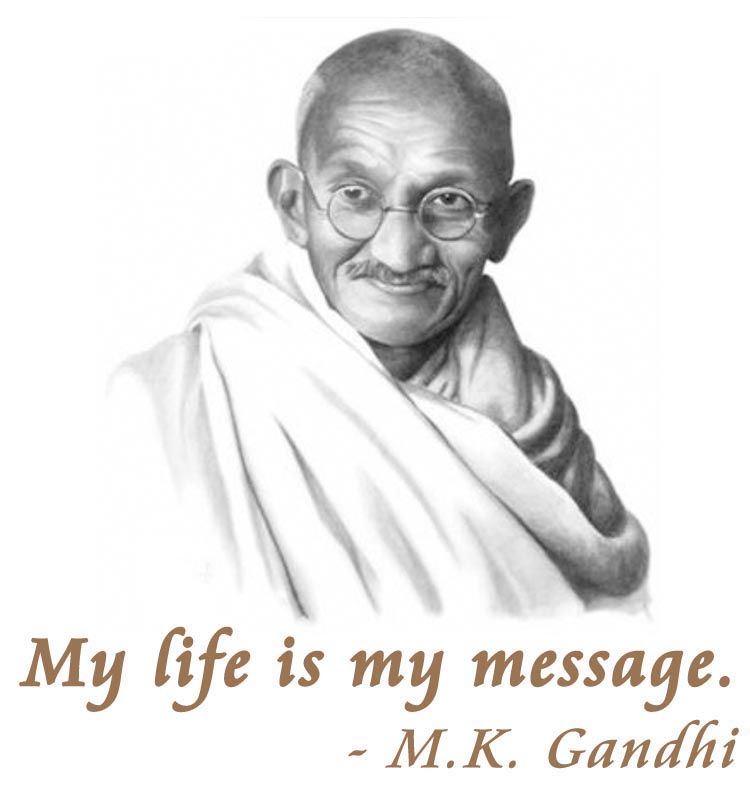
GANDHI : Rethinking the possibility of Non-violence |
- By Prof. Sudhir Chandra, Centre for Social StudiesFriends, It was in this very month of January, which has brought us together to remember and honour I.P. Desai, that my association with the Centre for Social Studies began twenty-seven years ago. This has been one of the most productive and enriching associations of my nomadic professional life. I had never thought that the Centre would one day graciously extend to me the privilege of delivering a lecture instituted in honour of its founder. But the Centre did, and I feel humbled by the honour. I knew Deasai Saheb personally. That was for just twenty days. But I was so completely charmed by him that when he died I felt deeply bereaved. The charm began within hours of my joining the Centre. The first thing I had done was to report to the Director, Ghanshyam Shah, with whom a testing friendship would soon begin to unfold. Before taking leave of him, I had asked Ghanshyam how I was to call on the 'Old Man'. The 'Old Man', I was told, lived on the first floor of the office building, and could be visited in the evening. Then I was taken to my own office on the ground floor. I had barely got into the room and was trying to get a feel of it before unpacking my books and papers when a chubby old man, dressed in a white lungi and half-sleeved short white kurta, walked in with an air of amiable authority and plunged into a most familiar conversation. That was Desai Saheb. I cannot recall how long he stayed on. What I can recall is that he posed insightful questions about my work, and assured me that joining a Centre concerned with the dis-privileged of the society was no reason to worry about pursuing my interest in elite social consciousness. I also recall the light banter that slipped into our conversation, making the interaction personal and pleasurable. Given the sociological nose he had developed for caste, Desai Saheb was quick to ferret my Chaube origins. He knew rather well the stereotypical image of the Chaubes as gluttons with a pronounced weakness for sweets. That got the two of us arguing bigotedly about the relative merits of Surti and north Indian sweets. Desai Saheb, the empiricist Anavil Brahman, ended the dispute with the confident declaration that he would one day have me taste some choicest Surti sweets and that would cure me of my partisan prejudice. That day, alas, never came. Even long residence in Gujarat, while it quickly convinced me of the superiority of Gujarati farsan, could not dent my prejudice in matters of sweet. Many more memories of Desai Saheb flood the mind. Of those there is one that I must share with you, before moving on to Gandhi and the question of non-violence. Those were the good old days when the Centre had but two telephone connections. Once the office had closed for the day or for holidays, telephonic connection between the Centre and the outside world was through the telephone at the Director's residence. One evening Ghanshyam received at his residence a phonogram announcing the death of my grandfather. Immediately he took out his scooter and came to the Centre. Not sure of how to break the news to me, he brought Desai Saheb along. The message Ghanmshyam had received was phrased in a way that could suggest that my father had died. When the misunderstanding was cleared, Desai Saheb started asking me about my grandfather. I told him that my grandfather had not been ailing, and that of the four generations living in the family, he - my grandfather - was the healthiest. To that Desai Saheb quietly remarked: 'That is how people of that generation die.' Ten days later, sipping his morning tea and reading the day's newspaper, he himself died a dream death. ILet me now turn to Gandhi, arguably the best friend humankind has had in the last few centuries. Contrary to the world's remembrance of him as a successful leader - and in keeping with the fate humankind has a knack of reserving for its benefactors - he died a sorrowful, lonely man. 'Yes,' he would say during his last days, 'I was once a big man in India. No one listens to me today. I am a very small person.... Mine is a cry in the wilderness.' The once-big man saw that he was now more a nuisance than an inspiring presence to the same beloved comrades who had for long years looked up to him for guidance. He lost his famous wish to live and serve for a hundred and twenty-five years, and started praying for death. Speaking on 2 October 1947, his sole birthday in independent India during his life-time, he said publicly: This is a day for me to mourn. I am surprised, indeed ashamed, that I am still alive. I am the same person whom crores of people obeyed the moment he asked for something to be done. No one listens to me today. I say, 'do this', and they answer back, 'no, we won't'.... the desire to live for 125 years has left me.... I am entering 79 today and even that pricks me. A few days later, he requested his audience to join in his 'day-and-night prayer to God to lift him from here.' He did not have to pray for long. In an irony that is rarely noticed, Gandhi lived to fight the British in India for thirty-one years; his own people could not protect him for as many weeks. Even during the five and a half months that he survived in free India, three unsuccessful attempts were made on his life. One of those came from the others, the other two from Gandhi himself. What anguished Gandhi? In answer can be cited a question he asked: "Whatever is happening in India today that could make me happy?' Gandhi's anguish was manifold. But it centred around his tragic discovery that the freedom struggle led by him had not been the unique non-violent struggle that he and the whole world had believed it to have been. The discovery forced itself upon him when the country erupted into savage violence on the eve of Independence. Could decades of non-violence, Gandhi wondered, have produced such savagery? 'No,' was his categorical answer. Whence, then, had the savagery come? Gandhi came up with an answer that has left academic wisdom as well as popular memory untouched. But it is an answer that necessitates a radical re-examination of what Gandhi is believed to have achieved and, consequently, of his potential as a continuing historical presence. Gandhi's answer was that there never had been a non-violent satyagraha during the freedom struggle. He confessed: Ahimsa never goes along with the weak. It [the non-violence of the weak] should, therefore, be called not ahimsa but passive resistance.... Passive resistance is a preparation for active armed resistance. The result is that the violence that had filled people's hearts has abruptly come out. The collective repressed had resurfaced. The violence that had all along lain suppressed in people's hearts had come out the moment the controlling external fear was gone. Worse, it was not the violence of the brave but of cowards. 'We', Gandhi lamented, 'have become such rogues that we have started fearing one another.' Gandhi's disillusionment with the Indian freedom movement - with his own people - carries serious implications for the acceptance or otherwise of non-violence. It means, and he said so plainly, that his people had accepted non-violence because they had realised the futility of violent resistance in the face of Britain's inordinately superior might. 'But', he remarked, 'today people say that Gandhi cannot show the way. We must assume arms for self-defence.... No one had at that time taught us to manufacture the atom bomb. Had we possessed that knowledge, we would have used it to finish off the English.' Ahimsa, Gandhi explained, was his dharma. For the Indian National Congress it had been but a pragmatic instrument. Once freedom was obtained, the Congress had lost use for the instrument. But dharma was eternal. It could not be changed or renounced. Gandhi could see that the grand dream he had dreamed for mankind lay shattered. But the failure to actualize the dream was, for him, no reason to lose faith in its truth and efficacy. 'I may have gone bankrupt', he said, 'but ahimsa can never be bankrupt.... Violence can only be effectively met by non-violence.' Retaliatory violence, he warned, can only result in ever-renewing violence. Like a 'shekhchilli', to use his own self-description, Gandhi recommenced his efforts to demonstrate the efficacy of ahimsa. Defying old age and declining health, he rushed from one trouble spot to another, pleading with people, and with those in power, appealing to their reason and humanity in the face of aggravating madness. Like a losing gambler, to use another of his preferred self-descriptions those days, he started increasing the stakes, until nothing short of staking his own life seemed to work. In the week preceding Independence Gandhi left for Noakhali to try and bring peace to the riot-torn Muslim-majority district in East Bengal. But he was detained in Calcutta where also communal passions had erupted. His staying helped. Within twenty-four hours, Gandhi reported, 'it seemed as if there never had been bad blood between the Hindus and the Muslims.' He was, however, uncertain whether this was a miracle or an accident. The answer came a fortnight later when, as he lay sleeping, an irate gang of Hindu youths attacked his lodging. Calcutta was again seized by anti-Muslim violence. Gandhi had to act fast and decisively. The following day he went on a fast unto death. The effect once again was instantaneous. Peace was back in three days and Gandhi's fast was over. Describing this as a 'victory over evil', Rajaji believed it was an achievement even greater than Independence. It famously moved Mountbatten to comment: 'In the Punjab we have 55,000 soldiers and large-scale rioting on our hands. In Bengal our forces consist of one man, and there is no rioting.... may I be allowed to pay my tribute to the one-man boundary force!' These euphoric tributes were justified in the circumstances. In retrospect, though, scepticism seems in order. Considerable haggling preceded the termination of Gandhi's Calcutta fast. When, representing the entire political spectrum, leading public figures brought news of the restoration of peace and requested Gandhi to break his fast, he asked them for three assurances. First, that they could honestly assure him that communal madness would never recur in Calcutta. Second, that peace had returned to Calcutta as a result of a change of heart that ruled out the recurrence of communal madness. Third, since they were not omniscient and violence could recur in spite of their assurances, Gandhi further asked the Hindus who had come to ask him to break his fast: '... would you give your word of honour that you would in that event suffer to the uttermost before an hair of the minority community is injured, that you would die in the attempt to put out the conflagration but not return alive to report failure? I want this from you in writing. But mind you, my blood will be upon your head, if you say one thing and mean another; rather than thoughtlessly hurry, let me prolong my fast a little longer.' The worthies who had brought the glad tidings of peace had not anticipated the dilemma. They could not let Gandhi die. Nor could they honestly pledge their lives for peace. They felt harassed and said so to the fasting old man. Suhrawarthy even tried a clever bit of reasoning. Gandhi's fast, he said, was to be broken with the return of normalcy to Calcutta. That condition having been fulfilled, no new conditions could now be brought in. Gandhi was not convinced. He said: 'If there is complete accord between your conviction and feeling, there should be no difficulty in signing that declaration. It is the acid test of your sincerity and courage of conviction. If, however, you sign it merely to keep me alive, you will be encompassing my death.' Cornered, the worthies retired for consultation among themselves. They emerged from their in camera deliberations with a pledge. The fast was broken. Those in camera deliberations were perhaps not recorded. Yet, it is reasonable to assume that the worthies had acted under duress. Even as they signed the pledge, and assured Gandhi that peace was the result of change of hearts, they were filled with apprehension. When, while breaking the fast, Gandhi announced that he would leave for the Panjab the following day, a nervous Suhrawarthy spoke for everyone as he pleaded: 'You cannot leave tomorrow. For your presence is necessary here for at least a couple of days yet to consolidate peace.' Equally notable is the decreasing power of Gandhi's word. The effect of his appeal, which had restored sanity in Calcutta within a day, lasted barely a fortnight. Thereafter he was compelled to put his life at stake. That worked, but not the way he wanted. Rather than heart-change, the dread of seeing the old man starve, combined with the fear of patricide, made the fast a success. Gandhi's Calcutta fast also suggests that the efficacy of non-violence is determined rather by the mundane interests of the affected parties than by their moral judgment. Illustrative of this is Suhrawarthy's remark to Gandhi: '... at one time, Muslims looked upon you as their arch enemy. But now their hearts have been so touched by the services you have rendered them that today they acclaim you as their friend and helper.' Equalyy pertinent in the context of the primacy of mundane interests is Rajaji's response to Suhrawarthy's remark. Rajaji said: 'If I may vary the language, I would say that he [Gandhi] is safer today in the hands of Muslims than those of Hindus. Suhrawarthy, as a Muslim, now knew, after a fast unto death, that Gandhi was beyond parochial considerations. The same Suhrawarthy, as Prime Minister of Bengal, had less than a year ago publicly taunted that Gandhi was more concerned about the Hindus in Noakhali, and admonished him to leave for Bihar and save its helpless Muslims. Reflecting the same interplay of interest and moral authority, Gandhi's sway over the Congress and the populace, with its Hindu majority, was much greater during the thick of the Indian national movement than in the hour of freedom and partition. In fact, during the roughly thirty years when his was the most powerful voice within the national movement, his authority had had its tides and ebbs. Gandhi left Calcutta for Delhi on 7 September 1947 with a view to reaching the Panjab at the earliest. On arrival he found Delhi in the grip of communal violence, and decided to stay on there. With what face could he, leaving Delhi's Muslims to their own fate, go to West Panjab to plead with the Muslims and the Government of Pakistan to protect their minorities? 'I must do my little bit', he declared the same day, 'to calm the heated atmosphere. I must apply the old formula "Do or Die" to the capital of India.' The same day Nehru said in a radio broadcast: 'This morning our leader, our master, Mahatma Gandhi, came to Delhi and I went to see him and I sat by his side, for a while, and wondered how low we had fallen from the great ideals that he had placed before us.' Whatever Gandhi's devaluation in terms of the new rulers' realpolitik, he alone could be trusted when the State was ineffectual. He struggled heroically to pierce through unimaginable anger, fear and vengefulness to reach out to people's residual humanity. He spoke a language that knew no 'other'. He said: With me all are one. With me it's not that this Gandhi is a Hindu and as such will only look after the Hindus, and not the Muslims. I am, I say, a Hindu, a true Hindu, a sanatani Hindu. Therefore I am also a Musalman, a Parsi, a Christian, and also a Jew. For me they are all branches of a single tree. So which branch do I hold on to and which one do I leave? Which leaves do I pick and which ones do I leave? They are all one. That's how I am made. What can I do about that? If everyone became like me, there would be complete peace. He was alone in this. And he knew it. 'If Hindu-Muslim unity exists today, it exists only in my heart,' he said. Gandhi's mission was to bring about unity of hearts. His way to do it carried the clarity and simplicity of common sense leavened with wisdom. While the others knew why what was happening was happening, Gandhi said disarmingly: 'Why they [Hindus and Muslims] are fighting, nobody knows. At least I don't.' Unencumbered with the theories that come with that kind of knowing, he plainly said: 'Both Hindus and Musalmans have become animals.... That one of them stops being animal is the only way out.' Reminding them of Calcutta's quick return to peace, Gandhi appealed to people in Delhi to regain their sanity. That would enable him to go to the Panjab. He would go to East Panjab and admonish the Hindus and Sikhs there to behave. From there he would proceed on to West Panjab. He would tell the people and the Government of Pakistan that they had got what they had wanted, so what was all the fighting about now. It was in the interest of both the countries to live peaceably and treat their minorities well. For four months Gandhi kept appealing in vain to people's reason and humanity. Then on the evening of 12 January, out of the blue, his prarthana pravachan began thus: People fast to better their health, under rules governing health. Fast is also observed by way of penance when one has done some wrong and realised one's error. To observe these fasts no faith in ahimsa is required. But occasions arise when a votary of ahimsa feels compelled to fast to protest against an injustice done by the society. He does that only when no other option remains available to him. Such an occasion has come for me. Beginning the following day, he would go on an indefinite fast. It would be broken only when the hearts of Delhi's different communities were again one. The fast, Gandhi made it clear, was undertaken for the Muslims of the Indian Union. It was, therefore, for the Hindus and the Sikhs of the Union to decide how they would respond to it. By the same logic, the fast was also for the minorities in Pakistan. For, knowing what he was doing for the Muslims of the Indian Union, Muslims in Pakistan had to decide how they would treat their minorities. This meant, Gandhi pointed out, that the fast was intended to rid of their madness people in both India and Pakistan. It heartened him to know from Mridula Sarabhai, who was then in Pakistan, that people there wanted to know what Gandhi expected them to do in Pakistan. His characteristically forthright reply was: Pakistan has to put a stop to this state of affairs. They must purify their hearts and pledge themselves that they will not rest till the Hindus and Sikhs can return and live in safety in Pakistan. His call was not without its effect. Especially because, right at its commencement, the fast had led the Indian Government to release the fifty-five crore rupees of Pakistan's share of the cash assets, which had been withheld pending the settlement of the Kashmir issue. Ghaznafar Ali Khan, Pakistan's Refugee Minister, said that Gandhi's fast should make people in Pakistan and India face the shame they had brought upon themselves and atone for it. He called upon the leaders of the two countries to meet together in a spirit of honest cooperation and eliminate all friction. Yet, not many understood Gandhi's way of dealing with the problem. This is revealed in the following question from a journalist 'Why have you gone on fast at a time when there is no conflict in any part of the Indian Union?' Gandhi's reply is equally revealing: 'People are systematically and resolutely trying to take forcible possession of Muslim houses, will it not be called conflict? This conflict has gone to such an extent that the police and the army have been forced to reluctantly use tear-gas and, albeit in the air, to use the guns.... It would have been utter folly on my part to keep witnessing this devious way of throwing out the Muslims. I call it killing by ordeal.' The Delhi fast, which Gandhi described as his greatest, lasted two days longer than the one in Calcutta. He broke it, on 18 January, after a statement, following frantic efforts by the Government in Delhi, had been signed by more than a hundred representatives of various communities and political organisations. The signatories declared their 'heart-felt desire that the Hindus, Muslims and Sikhs and members of other communities should once again live in Delhi like brothers'. The signatories also pledged 'to protect the life, property and faith of Muslims', and assured that communal violence would not recur in Delhi. They assured that the Muslims would get back the mosques which the Hindus and Sikhs had occupied, and further that there would be no objection to the return of those Muslim migrants who wished to come back to Delhi. Finally, assuring that all this would be done by their personal efforts without the help of the police or the military, they requested 'Mahatmaji to believe us and to give up his fast, and continue to lead us, as he has done hitherto.' The Mahatma ended his fast with the expectation: 'Till today, in my view, we were going towards Satan. From today I hope we start going towards God.' Two days later an attempt was made to kill him at his prayer meeting, the very place where he had expressed the pious hope of movement away from Satan towards God. Another ten days later he was, physically speaking, finally got rid of. Like in Calcutta, in Delhi also Gandhi's objective was not to suppress communal rancour, but to so transform people as to usher in lasting communal harmony. He failed yet again. Also, in putting his life at stake twice in quick succession, he had hoped to change the climate in the whole of India and Pakistan. What he managed was primarily localized peace. It was a far cry from the magical effect his calls had produced in days gone by. Was it not the beginning of the end? IIHaving so far focused on Gandhi's last days, I now want to go back to the 1930s to illustrate a persistence in the inefficacy of his non-violence. I shall, for the purpose, highlight the contrasting fates of two twin fasts that he was obliged to undertake within eight months. One of these fasts is the best and the other the least known of Gandhi's public fasts. Tellingly, the least known fast is the nearest Gandhi ever came to undertaking a pure non-violent fast. The best known, and also the most written about, fast was undertaken by Gandhi to negate the proposed introduction of separate electorates for the Depressed Classes. Begun in the Yervada jail on 20 September 1932 as a fast unto death, it lasted a week to end on 26 September. It sent the whole of India into a commotion. Frantic parleys were afoot. With Gandhi's life hanging in the balance, the most bigoted positions, hardened prejudices and entrenched interests were compromised, and the historic Poona or Yervada Pact was cobbled together within a week. An idea of what many among the Depressed Classes felt about Gandhi's fast can be had from Ambedkar's comment as he met Gandhi in the Yervada jail. 'Mahatmaji', Ambedkar said, 'you have been very unfair to us.' True, the Depressed Classes got through the Poona Pact greater representation than was proposed for them in the MacDonald Award. But that did not negate the violence that burst through Ambedkar's acerbic comment, a violence that left the Depressed Classes with no alternative but to forego separate representation. Gandhi, for his part, was involved in something more than political bargaining. He was out to create an atmosphere of trust between the Depressed Classes and the so-called caste Hindus. He wanted the Poona Pact to be an act of expiation by the caste Hindus, an earnest of their readiness to accept the Depressed Classes as equal members of the Hindu society. What followed was not expiation and acceptance but resentment among sections of the caste Hindus against the extra concessions made to the Depressed Classes. Noises were even made for amending the Poona Pact. This happened in spite of a clear warning from Gandhi before breaking his fast. He had said: 'I should be guilty of a breach of trust if I did not warn fellow reformers and caste Hindus in general that the breaking of the fast carried with it a sure promise of a resumption of it if this reform is not relentlessly pursued and achieved within a measurable period.' He had issued the warning because of his suspicion that the enthusiasm shown by caste Hindus during his fast, like throwing open their temples to the 'untouchables', might not continue. The fast - contrary to its valorisation as having 'awakened Hindu society's long-dormant conscience' - had failed to fulfill its purpose. Seeing that his warning had not worked, Gandhi started making impassioned appeals, asking his coreligionists to share his 'soul's agony'. In one of those agonised appeals he said: The Government is now out of it. Their part of the obligation they have fulfilled promptly. The major part of the resolutions of the Yervada pact has to be fulfilled by these millions, the so-called Caste Hindus, who have flocked to the meetings. It is they who have to embrace the suppressed brethren and sisters as their own, whom they have to invite to their temples, their homes and their schools. The 'untouchables' in the villages should be made to feel that their shackles have been broken, that they are in no way inferior to their fellow villagers, that they are worshippers of the same God as other villagers and are entitled to the same rights and privileges that the latter enjoy. But if these vital conditions of the Pact are not carried out by the Caste Hindus, could I possibly live to face God and man? Then, referring to the fast that he had warned about, Gandhi said: The fast, if it has to come, will not be for the coercion of those who are opponents of reform, but it will be intended to sting into action those who have been my comrades or who have taken pledges for the removal of untouchability. The fast will be resumed in obedience to the inner voice, and only if there is a manifest breakdown of the Yervada pact, owing to the criminal neglect of the Caste Hindus to implement its conditions. Such neglect would mean a betrayal of Hinduism. I should not care to remain its living witness. The appeals fell on deaf ears. Time passed, and the dreaded resumption of the fast lost its urgency. Then, suddenly, the call to action came to Gandhi on the night of 28-29 April 1933. This is what he says happened: I had gone to sleep the night before without the slightest idea of having to declare a fast next morning. At about twelve o'clock in the night something wakes me up suddenly, and some voice - within or without, I cannot say - whispers, 'Thou must go on a fast.' 'How many days?' I ask. The voice again says, 'Twenty-one days.' 'When does it begin?' I ask. It says, 'You begin tomorrow.' I went off to sleep after making the decision.' The following day Gandhi issued a statement, demystifying the 'call'. It said: A tempest has been raging within me for some days, and I have been struggling against it. On the eve of the Harijan Day, the voice became insistent, and said: 'Why don't you do it?' I resisted it. But resistance was in vain, and the resolution was made to go on an unconditional and irrevocable fast for 21 days commencing from Monday noon, the 8th May, ending on Monday noon, the 29th May. As they did in Gandhi's time, people will make sense of this fast according to their own inclination. For Gandhi it was divinely ordained, a 'sacred necessity' that he could say little about. Speaking to Patel hours after the ineffable experience, he said: 'Does one tell another everything that is in one's mind? Can one do that?' As would appear from his uncertainty whether the voice came from within or without, Gandhi was closely scrutinising what was happening to him. He even considered the possibility that he was 'under self-delusion, a prey to my own heated imagination made hotter by the suffocation produced by the cramping walls of the prison.' But he ruled out the possibility, arguing that: I am a habitual prisoner. The prison walls have never known[sic] to have warped my judgement, nor induced in me the habit of brooding.... I have undoubtedly brooded over the wrongs done to the Harijans. But such brooding has always resulted in a definite exaction on my part. ... My claim to hear the voice of God is not new. Unfortunately, there is no way of proving my claim except through results. God will not be God, if He allowed Himself to be the object of proof by His creatures.... God's ways are inscrutable. And who knows, He may not want my death during the fast to be more fruitful of beneficent results than my life? As a possible warning against dismissing Gandhi's language out of hand, we may recall some eminent contemporary reactions. C.F. Andrews wrote: 'Accept your decision. Understand.' And Romain Rolland assured: 'Ever with you.' Defying the sanatanist Hindu opposition to Gandhi on this issue, Madan Mohan Malaviya, the very epitome of sanatanism, cabled: God bless you... I am fully convinced that He has guided you in your decision. I have been praying that He may grant you strength to go successfully through your great vrata and have faith that He will.... Some great tapasvis are watching you with tender care, and vast millions are praying for you. There was also Sardar Patel, an unlikely exception among the top Congress leaders. who perfectly understood the impulse behind this fast. Even as he doubted if Gandhi would survive the 21-day ordeal - and agonized over that dreadful eventuality - Patel understood its unavoidability. He saw 'the utter falsehood and deceit that is being practised in the name of the Hindu religion', and the anti-Yervada Pact propaganda carried on by 'certain orthodox Hindus, and also some educated Hindus'. 'Under such circumstances', Patel asked, 'how long can Bapu remain indifferent? The very pledge he has given to millions of poor Harijans is jeopardised. Can you think of any other method of reforming religion, and if there is no other way then what else can a person like him do, to whom his religion is dearer than life itself?' Whatever one's difficulty regarding Gandhi's communion with God on grave public issues, it seems hard to miss the purity of this 21-day fast and the sincerity of Gandhi's statement: 'The fast is against nobody in particular, and against everybody who wants to participate in the joy of it .... But it is particularly against myself. It is a heart prayer for purification of self and associates, for greater vigilance and watchfulness.' The fast threatened no one. It set no tangible objective, the dire consequences of the non-realisation of which might coerce people to do what they otherwise would not. It was for a specified period, and no matter what happened, it would not end earlier. Moreover, Gandhi had requested people not to ask him 'to postpone, abandon or vary the approaching fast in any way whatsoever.' Ten years earlier also, in September 1924 when serious Hindu-Muslim violence had broken out, he had undertaken a 21-day self-purificatory fast. But he had at that time hoped that the heads of all the communities would 'meet and end this quarrel which is a disgrace to religion and to humanity.' This time it was a religious act undertaken for self-purification and, through his self, the purification of others. Gandhi, as he had hoped, survived the fast rather well, although he lost 22 kilograms and became a skeleton during those 21 days. In stark contrast to 1932, this time there were no rushed parleys, no emergency huddles of disparate leaders, no display of fraternization with the 'untouchables', no throwing open of schools, wells or temples to them. Even the Guruvayur temple in Malabar refused to permit entry to the 'untouchables' although it was known that Gandhi was seriously meaning to go on a fast unto death for that purpose. For most sanatanist Hindus, Gandhi's fast was a deep political move. They even detected coercion in it. Vainly did Gandhi hope: When they [Sanatanist Hindus] realize that it cannot be broken before its period, even if every temple was opened and untouchability wholly removed from the heart, they will perhaps admit that it cannot be regarded as in any way coercive. The fast is intended to remove bitterness, to purify hearts and to make it clear that the movement is wholly moral, to be prosecuted by wholly moral persons. Let alone those in other parties and the bulk of sanatanist Hindus, the fast could not sensitize even Gandhi's friends and colleagues within the Congress. Their response ranged from incomprehension and apathy to bafflement and hostility. This is best summed up in Nehru's reply to one of the most moving letters Gandhi wrote about the fast. Knowing of Nehru's scepticism about matters religious, Gandhi had said in his letter: As I was struggling against the coming fast, you were before me as it were in flesh and blood. But it was no use. How I wish I could feel that you had understood the absolute necessity of it. The Harijan movement is too big for mere intellectual effort. There is nothing so bad in all the world. My life would be a burden to me, if Hinduism failed me....Take it away and nothing remains for me. But then I cannot tolerate it with untouchability - the high-and-low belief. Fortunately Hinduism contains a sovereign remedy [fasting] for the evil. I have applied the remedy. I want you to feel, if you can, that it is well if I survive the fast and well also if the body dissolves in spite of the effort to live.... And surely death is not an end to all effort. Rightly faced, it may be but the beginning of a noble effort. But I won't convince you by argument, if you did not see the truth intuitively. Nehru's laconic reply was: 'What can I say about matters that I do not understand?' Even Rajaji, Gandhi's conscience keeper, considered the fast 'a mistake' from which no good would result. Steeped in the Hindu tradition, he engaged Gandhi in a serious discussion. Besides emphasising the political futility of the fast, Rajaji argued that 'Hinduism does not sanction suicide.' It would be 'folly' to be certain that Gandhi would 'pass through this sacrificial test'. Should the worst happen, 'not only will the progress of the country be retarded but the progress of Harijan cause also be affected and skewed down.' Most people viewed in the 21-day fast needless dissipation of political energies, an unnecessary digression from the struggle for freedom. They failed to appreciate, in this actual instance, something that was otherwise self-evident, i.e., that the struggle for freedom could not be an exclusively political project. The last straw, for many, was the suspension for six weeks, at Gandhi's behest, of the already languishing Civil Disobedience Movement. However, because they considered Gandhi's leadership to be still indispensable, most Congress leaders protested directly to him or among themselves. There were, though, two prominent exceptions. Subhas Chandra Bose and Vithalbhai Patel, then away in Europe, demanded Gandhi's removal from the leadership of the Congress. Even as Gandhi - insisting that the age of miracles was not over - was hoping through his fast to touch the hearts at least of his colleagues and collaborators, the two eminent leaders declared to the whole world: 'The time has now come for a radical reorganization of the Congress on new principles with a new method for which a new leader is essential....' Amply illustrative while the above examples are, nothing reveals more starkly the powerlessness of Gandhi's purest exercise in non-violence than its failure to appeal to Tagore. The two great men had even earlier had serious differences. But those differences had arisen from Tagore's acute understanding of actual or potential excesses in Gandhi's world-view, including his non-violence. This time it was different. Following his usual practice, Gandhi asked certain individuals for their blessings before undertaking the fast. One of these was Tagore. 'Dear Gurudev,' Gandhi wrote, 'It is just now 1.45 a.m. and I think of you and some other friends. If your heart endorses contemplated fast, I want your blessings again.' Eight months earlier also, before going on the fast of which this fast was a sequel, Gandhi had sought Tagore's blessings. He had then received an effusive telegram, saying: It is worth sacrificing precious life for the sake of India's unity and her social integrity. Though we cannot anticipate what effect it may have upon our rulers, who may not understand its immense importance for our people, we feel certain that the supreme appeal of such self offering to the conscience of our own countrymen will not be in vain. I fervently hope that we will not callously allow such national tragedy to reach its extreme length. Our sorrowing hearts will follow your sublime penance with reverence and love. This time Gandhi received a letter in which Tagore said that he felt handicapped because he did not have before him 'the entire background of thoughts and facts against which should be placed your own judgement in order to understand its significance.' Tagore also lectured Gandhi on the duty of not courting death 'unless there is no alternative for the expression of the ultimate purpose of life itself.' He warned: 'It is not unlikely that you are mistaken about the imperative necessity of your present vow, and when we realise that there is a grave risk of its fatal termination we shudder at the possibility of the tremendous mistake never having the opportunity of being rectified.' What Tagore did not realise, or left unsaid, was that his inability to bless Gandhi on this occasion might have owed something to his simmering reservations - to which we shall presently return - about the Poona Pact. Whatever the truth, Tagore, the poet, remained unaffected by the outpourings of Gandhi's agonising soul. Nor, as his protestation against courting death would suggest, did he take seriously Gandhi's frequent reiteration during those days that he would continue to live beyond the dissolution of his mortal body. I am not detecting duplicity or bad faith in Tagore. My concern is different. Tagore was not exceptional in his response. He was, though, exceptional in his sensitivity and empathetic reach. If neither the eloquence of Gandhi's anguished appeals nor, following their failure, the eloquence of his 21-day penance could touch one such as Tagore, what chance did, and does, pure non-violence have of succeeding on its own? 'Succeeding on its own' implies a success that comes from convincing the others - followers as well as adversaries - of the rightness of the cause at issue. It is not the result of such factors as convergence of interest or psychological coercion. Whatever limited success Gandhi's 1932 fast achieved was not the success of non-violence. The fast, in terms of non-violence, was a failure. The Poona Pact, thanks to which the fast ended, was precipitated by a universal anxiety to save Gandhi's life. It was, however, an internally differentiated anxiety in terms of its source, character and intensity. Taking them as emblematic figures, the anxiety of Tagore was not the same as Ambedkar's anxiety. Also, the Pact had little to do with the various groups' and individuals' acceptance of Gandhi's categorical rejection of 'untouchability'. Were it otherwise, the 1933 fast would not have been necessary. At the very least, there would have been greater understanding than there was of the compulsion of that fast for Gandhi. The great enthusiasm among the caste Hindus for the 1932 fast was the result of a partial convergence of sentiment with Gandhi. That convergence is expressed in Tagore's effusive telegram where he describes the fast as one undertaken 'for the sake of India's unity and her social integrity.' There the convergence ended. It did not extend to what Gandhi meant by that unity and social integrity. In that regard, judging by Gandhi's subsequent disillusionment, helplessness, and relative loneliness, there remained a wide chasm. The convergence was about something - the outer form of India's unity and social integrity - that for the caste Hindus was precious enough to deserve the sacrifice of a life as precious as Gandhi's. That with regard to which there was no convergence - expiation as a necessary beginning for social unity - did not deserve, in their view, even a fast for a limited duration. Over that fast all kinds of reservations and objections began to crop up. These ranged from theological arguments against suicide to political warnings against dissipating national energies, and psychologistic diagnosis that Gandhi might have lost the capacity for balanced thinking following prolonged incarceration. As always, there was at work a fluid ensemble of different factors, such as material and ideal interests, reason and passion. It affected people powerfully and - adding to that power - very often stealthily. Two months after the completion of the fast that he had refused to bless, and within less than a year of hailing Gandhi's 'sublime penance' on behalf of India's unity and social integrity, Tagore disowned the Poona Pact. Pronouncing it to be detrimental to the 'country's permanent interest', he protested that he had been inveigled into endorsing the Pact. He said: Never having any experience in political dealings, while entertaining a great love for Mr. Gandhi and a complete faith in his wisdom in Indian politics, I dared not wait for further consideration, which was unfortunate as justice has certainly been sacrificed in the case of Bengal. I have not the least doubt now that such an injustice will continue to cause mischief for all parties concerned, keeping alive the spirit of communal conflict in our province in an intense form and making peaceful government of the country perpetually difficult. Although Tagore announced his volte-face on the Poona Pact two months later, it is likely that he had started reconsidering his position when Gandhi asked him to bless the 21-day sequel to the Yervada fast. If so, his simmering reservations also must have held him back. Explicitly he did not say so in his reply to Gandhi. But it is plausible that in saying that he did not have 'the entire background of thoughts and facts' against which to judge Gandhi's new fast, Tagore had in mind the as yet unclear background that would, within the next two months, turn him against the Yervada Pact. Closer study may perhaps tell us something more definitive. Be that as it may, Tagore did not consider it necessary, or proper, to discuss his misgivings with 'Mr. Gandhi' before denouncing the Poona Pact. Gandhi learnt about it from the newspapers, and wrote to 'Gurudev': It caused me deep grief to find that you were misled by very deep affection for me and by your confidence in my judgement into approving of a Pact which was discovered to have done a grave injustice to Bengal. It is now no use my saying that affection for me should not have affected your judgement, or that confidence in my judgement ought not to have made you accept a Pact about which you had ample means for coming to an independent judgement.... But I am not at all convinced that there was any error made. Tagore was now complaining of injustice to Bengal and seeing in that injustice a perpetual threat to peaceful government of the country. But soon after the Poona Pact he had written Gandhi a glowing letter, asking him to do something similar to solve the Hindu-Muslim problem. Tagore had in that letter suggested that, following the generosity shown to the Depressed Classes in the Poona Pact, some extra concessions could be made to the Muslims for the sake of forging communal unity. He had added that Gandhi alone possessed the power to accomplish this. The same generosity towards the Depressed Classes was now rankling as injustice because Bengal had to bear a little more than its proportional share of that generosity. Tagore was a professed humanist. He had in his fiction as much as in his discursive writing consistently exposed the hideousness of nationalism. Yet, no matter why, when he lacked the inner readiness to respond to the intrinsic grandeur of Gandhi's all-too-brief exercise in pure non-violence, even Tagore responded coldly. The ineffectuality of that near-perfect fusion of Gandhian theory and practice carries troubling suggestions that I dare not explicate. IIINever during the deepening depression of those last days did Gandhi lose sight of the fundamental problem. When everyone's normal response was to think of urgent deployment of the police and the armed forces, he remained focused even in the most pressing crises on the people gone mad. His mode of dealing with the immediate present had at its centre the longer term and the larger perspective. Ironically, what he did was, typically for his day and today, seen by Nehru as 'going round with ointment trying to heal one sore spot after another on the body of India.' Nehru's prescription, again typically, was to diagnose 'the cause of this eruption of sores' and treat 'the body as a whole.' Nehru saw the ointment, not the rationale of Gandhi's refusal to give up on the better instincts of fellow human beings. Even if Gandhi could, for the briefest while, transform some people, make them taller than they were or would ever again be, he achieved more than did any diagnosis and treatment of the body as a whole. Even in terms of immediate concrete results, the one-man boundary force had more to show. Nehru's insistence on treating the body as a whole, I dare say, has produced a teleology, the consequences of which he could not have imagined even in his most pessimistic moments. The irony is that while faith in systemic change continues - albeit without the variety that was on offer till the demise of the Soviet system - Gandhi's kind of healing is dismissed as tinkering with individuals, and not as a radical attempt to humanise our psychic system. Take it or leave it, Gandhi's conviction was: 'The society comprises us all. It does not make us. We make it.' Yatha pinde tatha brahmande - as the atom so the universe - he would recall the old adage, and back it up with: 'What is right for me is right for everyone.' Gandhi had a deeper sense of the system-individual causality. His Hind Swaraj was inspired precisely by that causality. Modern industrial civilization, he would say, was not conducive to non-violence. That is why, in that wilderness, he had come up with his Hind Swaraj cry. That wilderness has since thickened the world over, creating a piquant paradox. More than ever before, non-violence seems a quixotic option today. And never before has humankind needed non-violence more desperately. Will non-violence come when it is still a viable alternative? Or will it come after violence has spent itself out? By when what succeeds violence may have become inconsequential. |