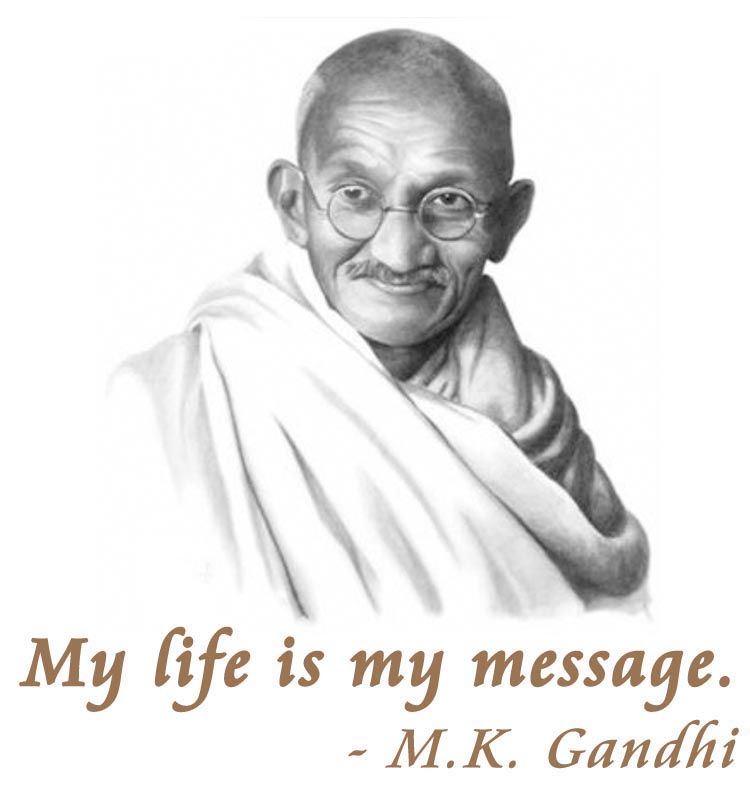
Interpretations and understanding of Gandhi's Philosophy of Nonviolence |
Gandhi, through Satyagraha, has provided the world with a universal and timeless philosophy. Like Socrates, Gandhi was like a gadfly and was often an embarrassment and an irritant even to his friends and allies. He challenged mostly power positions that pretended to be based on sound knowledge and morality. Like Kant, he focused much of his attention to motives and intentions, but moved a step further to emphasize the primacy of morality. He therefore had little sympathy for detached theories of knowledge that are not grounded in morality or for theology and metaphysics which pretend to transcend morality. Gandhi emphasized an integral relationship between means and ends. One cannot use impure or immoral means to achieve worthy goals. Gandhi departs from the Utilitarians as Sisir Sanyal attests: The utilitarian philosophers in the west enunciated the concept of greatest good of the greatest number as the aim of state policy. This has failed to take a holistic view of the entire human race and ignored man; that is to say each and every man, as the prime concern of the state... As against this, Gandhi propounded the theory of sarvodaya, which means the rise of all that too in the fullest measure each man is capable of.1 In order to understand this 'timeless philosophy' propounded by Gandhi, it will be good to see the various interpretations given to it. After this, the basic principles of nonviolence at public and private levels will be exposed. This chapter will end with an understanding of Gandhi's dialectics and political theory, deduced from his philosophy of nonviolence. The Etic and Emic Interpretations of Gandhian SatyagrahaSatyagraha has not been understood by all, especially those alien to the oriental traditions. As a result, there have emerged two different views of Satyagraha viz. the Emic and Etic views. When the perspective stems from common culture and history, it may be termed Emic. This contrasts to the perspective of an outsider to a culture, which can be termed Etic. The Emic view of Satyagraha is seldom evident to an untrained outsider because, while insensitive to the nuances of a given culture, it invites generalizations and comparisons. Differences in context might require differences of expression of Satyagraha. Events generally have different meanings with respect to the actor and viewer. The way things are done by a particular set of people may not be interpreted same as when viewed by outsiders not having the same history and culture. These views have been well explained and used by William J. Starosta and Angu G. Chaudhery in their article "I can wait 40 or 400 years: Gandhian Satyagraha East and West."2 Satyagraha in the West is seen as Etic while in the east it is seen as Emic. This is because Satyagraha has much in common with Eastern Traditions and Philosophy. We don't negate in any way that there might be a substantial tradition of Satyagraha, called by whatever names, in the West. Etic Interpretation: Satyagraha in the WestTo understand Gandhi's Satyagraha in the West, most students turn to a familiar American Landmark. In the west, Gandhi's Satyagraha has been understood in terms of Henry David Thoreau's 'Civil Disobedience', though some others move a little further than Thoreau. The Salt March is often described ambiguously as Civil Disobedience. At times even Gandhi himself referred to the Salt March as civil disobedience when he attests that "you have given me a teacher in Thoreau who furnished me through his essay on 'the Duty of Civil Disobedience. Scientific confirmation of what I was doing in South Africa" Gandhi differentiated his Satyagraha from Civil Disobedience. Civil Disobedience is at most a branch of Satyagraha. For him, "Satyagraha is like a Banyan tree with innumerable branches. Civil Disobedience is one such branch. Satya (truth) and ahimsa (Nonviolence) together make the present trunk from which innumerable branches shoot out."4 Krishna Shridharani's book on "War Without Violence" has been quoted by Gene Sharp to show us 13 techniques most characteristic of Satyagraha. Of these, Civil disobedience is the 11th technique. The Etic interpretation seems too reductionist. The Emic interpretation will give a better understanding of Gandhian Satyagraha. Emic Interpretation: Satyagraha in the EastGandhi and Satyagraha are viewed here as continuous with three millennia old traditions of Indian tradition and practice. In other words Gandhi's Satyagraha is deeply rooted in the Indian traditions. There are seven Emic aspects of Gandhian Satyagraha. 1) Nonduality:since the Post-Vendantic, Indian philosophic religion had evolved in the direction of philosophic monism. This implies no distinctions between self and absolute, thought and action, means and ends. While western philosophy sees distinction between "means and ends"5, Gandhi does not distinguish between them. To achieve good ends, one could use none other than good means. Violence begets Violence, Nonviolence begets Nonviolence. 2) Purification:In order to fetch Good out of Evil via Satyagraha constitutes a total effort of heart, mind, and body. There is constant need in the Hindu culture for purification. Purification can be done through renunciation of worldly things. The Indian term for this is Bramacharya (Celibacy, Chastity). Gandhi himself took the Bramachyrya vow and recommended it to the 3) Sacrifice:The earliest forms of Hinduism stressed 'vrata' and 'tapas'6and properly would produce results in defiance of the gods themselves. The power of sacrifice was highly recommended by Gandhi. The Satyagrahi like Gandhi is asked to sacrifice life, family, things on earth, self-importance, and to court suffering in the belief that unearned suffering is redemptive. Gandhi was optimistic that just as Vedic sacrifice could defy the gods, so too self-sacrifice could defy British authorities 4) Inevitability:Gandhi was never daunted by length of time. "How long will a desired end take to be effected by means of Satyagraha? The result was inevitable; Gandhi never doubted". The stress in Hinduism upon samsara- a belief in repeated rebirths for so long as the person is lacking in perfection or understanding (samsara means 'world cycle'). One object is to transcend rebirth through disciplined action. This places Satyagraha into a mythic time frame, wherein laws of sacrifice will work themselves out in however long the process must take. A quick result might be politically desirable, but a religiously inevitable result would certainly be assured if not this time, then in the next. 5) Conversion:Satyagraha aims at converting the opponent. Evil is present in many forms within the world. In its mildest form, evil could represent error in a friend while in another case; it could represent evil in an opponent. The remedy for any degree of evil in the emic view was conversion through self-effacement. For example, if a follower of Satyagraha decides to put on a foreign dress instead of home spurn clothes, a Satyagrahi would be assigned to meet the offender on one's knees and humbly implore the person to correct the error. Satyagraha aims at fighting the person's deed and not the person. General Jan Smut was a target for conversion by means of Gandhian Satyagraha. 6) Nonmanipulation:The very fact that Satyagraha in publicly permitting evil to act upon a transparently defenseless target is the expectation that such evil would destroy itself through conversion to Good in Nonmanipulation. Manipulation is another form of force. Nonmanipulation sets up a scene in which an actor risks characterization as evil because his acts become visible and morally accountable. In such a scene, only morally acceptable acts are likely to be performed. One writer refers to this force as "one of purification rather than of manipulation." 7) Being versus Doing:Satyagraha grew as a philosophy within a context that stressed being, contemplation, asceticism, and intrinsic goodness of character as preferred social ends. Civil disobedience grew in a culture which favoured doing over being. Contrary to a Western view, which would like to respond to act with act, anger with anger, deed with deed, a satagrahi is trained to thank the jail keeper for performing the arrest, to congratulate those who were imprisoned. By this preference for being over doing, the conflict was joined between spiritual truth and corrupt deeds not directly between antagonists. In a nutshell it is good to understand Satyagraha within the cultural background form, which it evolved. It should be noted that the etic accounts saw the British as enemies and not friends. However, if understood with an emic view, Satyagraha will be seen as a public expression of pure thought, thought that is one with action; which is performed as a moral duty with no dread of consequence. "Such detached witness as sacrifice leading immutably and inexorably to conversion of evil to good", Starosta and Chaudhery attest "if not now, then sometime later." Gandhian Satyagraha for an emic culture resulted in the rendering of Gandhian techniques as syncretic. This is because the impact of the west, with etic views upon the several traditions of India bears traces of the thought and experience of modern Europe. The transplanting of social and political philosophies current in the west to the rich cultural soil of the Indian sub-continent has resulted in a growth both vigorous and productive. The impact of this syncretism Bondurant attests, has been "more tellingly demonstrated... in the development of the Gandhian technique."10 Essential Principles of Gandhi's Philosophy of NonviolenceA more Emic understanding of Gandhi's Philosophy of Nonviolence will reveal some essential principles both at the public and private level. The principles of Gandhi's Philosophy at the public level include; Truth, Ahimsa, Trusteeship and Constructive Action/Programme. While at private level we have; Respect, Understanding, Appreciation and acceptance. Gandhi's Philosophy of Nonviolence at Public levelThe Essential principles at public level are: - 1) Truth:The imperfect translation of the Sanskrit satya. The meaning of truth is, of course obvious. It must be noted that truth has many sides and is ever changing. What appears true today may not be true tomorrow, or what appears true to us may not be same for others. We must develop the ability to look at everything from different perspectives. However, we have to aim at the absolute truth, which Gandhi identifies with God. Aiming at this absolute truth implies numerous experiments with the truth, which Gandhi applied at public level. 2) Ahimsa:This is nonviolence in thought, word and deed. Far from meaning mere peacefulness or the absence of overt violence, Gandhi understood it to denote active love. It is used at public level to bring about positive changes. We should therefore aim at an A+ grade in our perception of nonviolence. 3) Trusteeship:For Gandhi,violence is inherent in our present economic, social and industrial systems. He therefore aims at bringing a change through the application of his concept of Trusteeship. Trusteeship according to Bader means "Having faith and confidence in a process of taking responsibility for assets and social values and administering their rightful and creative usage for benefit of others now and in the coming ages."11 Its objective is to create nonviolent and nonexploitative relationships. Gandhi believes that the concepts of possession and private property were sources of violence. All wealth belongs to all people. He recognizes that the concept of ownership cannot wither easily and that the rich cannot be easily persuaded to share their wealth. He therefore invites those people who consider themselves today as owners to act as trustees; that is, owners, not in their own right, but owners in the right of those whom they have exploited. This principle seeks to destroy not the capitalists, but capitalism. Trusteeship provides a means of attaining an egalitarian society. The basis of this socialism is economic equality. Trusteeship is strongly based on participatory democracy. It is a "fraternal partnership between all factors of production with the aim of achieving larger social benefit rather that working toward a narrow economic objective such as profit."12 Trusteeship is the natural corollary to constructive action/programme. 4) Constructive Programme:Gandhi devoted himself to the social, economic and spiritual regeneration of the country and felt this would be achieved by the efforts of the people themselves. Gandhi therefore emphasized on what he had originally conceived as "spiritual socialism", the positive counterpart of noncooperation and civil disobedience and eventually called the constructive program. To win independence, Gandhi felt the only truthful and nonviolent way would be through the constructive action. Gandhi therefore feels that the constructive programme may more otherwise and more fittingly be called "Construction of Poorna Swaraj or complete independence by the truthful and nonviolent means."13 It means getting involved in finding constructive solutions to problems. We usually ward our responsibilities on someone else's shoulders, usually government's shoulders. Yet they have serious consequences. The constructive programme was the greatest means to economic development for a poor country like India. Mahatma Gandhi feels strongly that the constructive programme is another form of Satyagraha, which could bring about a nonviolent agrarian revolution. The following are the various constructive programmes listed by Gandhi: Unity of religious communities, Removal of untouchability, Prohibition, Khadi, Other Village Industries, Village Sanitation, News of Basic Sanitation, Adult Education, Upliftment of Women, Education in health Hygiene, Provincial Languages, Propagation of Rastra Basha (National Language), Promotion of Economic Equality, Kisans (peasants), Labour, Adivasis, Lepers, Students. The Constructive Programme gave "Content to the Satyagraha framework and applied Gandhian principles in the Indian conscience."14 Gandhi's Philosophy of Nonviolence at the Private LevelAccording to Hector Ayala, true Gandhian peace has to come "through the proper understanding and practice of nonviolence based on the four principles of nonviolence at personal level which includes respect, understanding acceptance and appreciation".15 If we learn to build good relationships based on the four cardinal principles, then conflict will be minimized. They all go to make the world more peaceful. The essential principles here include:1) Respect:This is a behaviour and attitude, which reflect one's ability to see the worth and value in people, situations and institutions. When there is no respect between people, conflict arises and leads to violence. Gandhi therefore advocated fearlessly for the dignity of the human person. Gandhian Nonviolence teaches us to respect ourselves and others and all of creation if this respect is cultivated at personal level, we will be open to respect different cultures and belief systems. 2) Understanding:This is reached when we learn who we are and what our role in creation is. In our arrogance, we believe that humans are not part of nature. We are therefore prone to destroying our habitat and cannot expect to survive for very long. By understanding ourselves, and our reactions to life's events, we can become better able to make changes we wish to see; with this knowledge, which does not always come easily, we can map our response to life. Gandhi advocated for understanding and dialogue. When well practiced at personal level, the philosophy of nonviolence will help to foster dialogue. 3) Acceptance:This is the first step to tolerance. Acceptance does not necessarily equate to approval. However, it is a conscious decision to see value and inherent worth of others. One needs a level of humility to cultivate acceptance. This is attained when we accept differences, Physical and philosophical between human beings. When these differences begin to melt away then we accept each other as human beings and can dispense with the label that keep people apart. 4) Appreciation:This is the recognition of the value and worth of all living creatures having the ability to see goodness by learning to focus on the good, in people rather than on the bad even with some difficulty, to see God in all of life. Appreciation is a by-product of nonviolence. It implies developing an ability to recognise the value and worth in other human beings. Gandhi's Philosophy of Nonviolence in PoliticsGandhi's experiments with truth led him to sample many political approaches. These can be examined by measuring it against two trends in western political thinking: Anarchism and Conservatism. On one hand, Gandhi strove to conserve many things like his religious convictions, local languages, etc. However, his infusion of his Satyagraha from which he developed his concepts of trusteeship and Constructive programme sees him deviating from some of his hereditary traditions, like untouchability. In Gandhi too, we may find some elements of anarchical thought. He strove for the "greatest good of all". He believed this could be realized only; and stateless democracy of autonomous village communities based on nonviolence instead of coercion, on service instead of exploitation, on renunciation instead of acquisitiveness and on the largest measure of local and individual initiative instead of centralization.16 It is not easy to just refer to Gandhi's political ideas as just conservative or anarchist. The former label is rightly dismissed as doing injustice to the important elements of rationalism, radicalism and individualism on Gandhi. The latter makes central those references to a future ideal society, which for Gandhi were peripheral to his preoccupation with present means. Attempts to place Gandhi in the Development of political theory have led to an insight into Gandhi's Dialectics. Gandhi's DialecticsThe Gandhian Dialectic is understood side-by-side Hegel and Marx's. In Hegel, there is insistence on the objective absolute and on the inexorable march of History. For Marx, both the direction and structure of conflict is predetermined. Gandhi lays emphasis on the very process by which conflict is to be resolved. The Hegelian dialectic is a system of logic describing inherent natural processes. Marxian dialectic is a method by which both the direction and the structure of conflict are predetermined. Gandhian dialectic describes a process of a technique of action to any situation of human conflict, a process essentially creative and inherently constructive. Gandhi, in his dialectics, is preoccupied with the problem of means and ends. In his Satyagraha, he propounds the nonduality of means and ends. The means precede the ends in time but there can be no question of moral priority. Truth is inseparable from nonviolence and the method of achieving and clinging to the truth is nonviolence. Gandhi has referred to nonviolence as being both the end and the means. Shortly before his death, Gandhi commented in a prayer speech in New Delhi that "means and ends are convertible terms".17 The problem of means and ends has been a very central issue in political philosophy. The schools really concerned with these are Marxism and Liberal democratic theory. Gandhi's Philosophy of nonviolence supercedes these schools because of this convertibility of means and ends. The dialectic implicit in the Gandhian method of Satyagraha is not dependent upon Gandhi's metaphysical assumptions, nor upon his Hindu based theology. It could operate in Non-Hindu societies as it did among the Muslim Pathans in the North West frontier province. The Place of Civil Disobedience in Gandhi's Political PhilosophyThe two crucial points in Gandhi's Politics are those of obedience to the law and the employment of Force. He was much concerned with the duty of the citizen in the imperfect states of the world. He cooperated with the Government but never condoned laws that disregarded the human person. In his Famous letter to the Viceroy, Inaugurating the Noncooperation Movement in 1921, Gandhi confessed openly that "From a staunch loyalist and cooperator, I have become an uncompromising, disaffectionist and noncooperator".18 In Gandhian Satyagraha Civil disobedience is justified. One should disobey such laws as are in themselves bad and obedience to which should be inconsistent with one's self respect. One should disobey Laws of state that lack moral turpitude. He warns however that: Disobedience to the civil must be sincere, respectful, restrained, never defiant, must be based upon some well understood principle, must not be capricious and above all must have no ill-will or hatred behind it19 End Notes
|