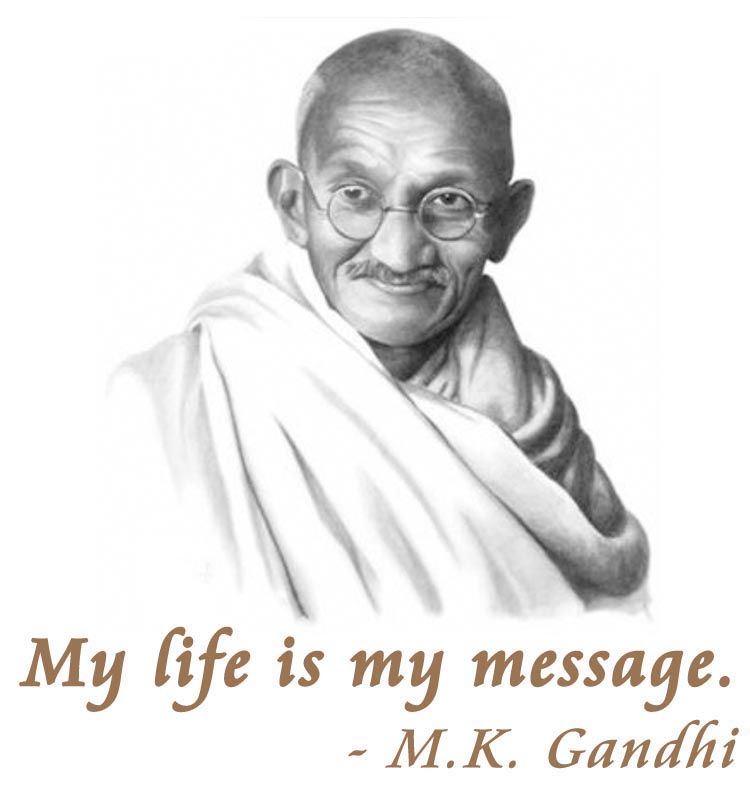
Gandhi's 11 Vows |
|
Ahimsa ( Nonviolence ) Satya ( Truth ) Asteya ( Non Stealing ) Brahmacharya ( Self Discipline ) Asangraha ( Non-possession ) Sharirshrama ( Bread labour ) Aswada ( Control of the palate ) Sarvatra Bhayavarjana ( Fearlessness ) Sarva Dharma Samantva ( Equality of all religions) Swadeshi ( Use locally made goods ) Sparshbhavana ( Remove untouchability ) - From the book 'Yeravda Mandir' by M. K. Gandhi. Mahatma Gandhi's 11 principles (Video Clip) New |
TruthTruth is not fulfilled by mere abstinence from telling or practising an untruth in ordinary relations with fellow-men. But Truth is God, the one and only Reality. All other observances take their rise from the quest for, and the worship of, Truth. Worshippers of Truth must not resort to untruth, even for what they may believe to be the good of the country, and they may be required, like Pralhad, civilly to disobey the orders even of parents and elders in virtue of their paramount loyalty to Truth. |
Non-ViolenceMere not-killing (the animals) is not enough (for this observance). The active part of Non-violence is Love. The law of Love requires equal consideration for all life from the tiniest insect to the highest man. One who follows this law must not be angry even with the perpetrator of the greatest imaginable wrong, but must love him, wish him well and serve him. Although he must thus love the wrong doer, he must never submit to his wrong or his injustice, but must oppose it with all his might, must patiently and without resentment suffer all the hardships to which the wrong doer many subject him in punishment for his opposition. |
Chastity (Brahmacharya)Observance of the foregoing principles is impossible without the observance of celibacy. It is not enough that one should not look upon any woman or man with a lustful eye; animal passion must be so controlled as to be excluded even from the mind. If married, one must not have a carnal mind regarding one's wife or husband, but consider her or him as one's lifelong friend, and establish relationship of perfect purity. A sinful touch, gesture or word is a direct breach of this principal. |
Control of the PalateThe observance of Brahmacharya has been found, from experience, to be extremely difficult so long as one has not acquired mastery over taste. Control of the palate has therefore been placed as a principle by itself. Eating is necessary only for sustaining the body and keeping it a fit instrument for service, and must never be practised for self-indulgence. Food must therefore be taken, like medicine, under proper restraint. In pursuance of this principle one must eschew exciting foods, such as spices and condiments. Meat, liquor, tobacco, bhang etc. are excluded from the Ashram. This principle requires abstinence from feasts or dinners which has pleasure as their object. |
Non-StealingIt is not enough not to take another's property without his permission. One becomes guilty of theft even by using differently anything which one has received in trust for use in particular way, as well as by using a thing longer than the period for which it has been lent. It is also theft if one receives anything which he does not really need. The fine truth at the bottom of this principle is that Nature provides just enough, and no more, for our daily need. Hence it is also a theft to posses anything more than one's minimum requirement. |
Non-possession or PovertyThis principle is really a part of Non-stealing. Just as one must not receive, so must one not posses anything which one does not really need. It would be a breach of this principle to posses unnecessary foodstuffs, clothing or furniture. For instance, one must not keep a chair if can do without it. In observing this principle one is led to a progressive simplification of one's own life. |
SwadeshiMan is not omnipotent. He therefore serves the world best by first serving his neighbour. This is Swadeshi, a principle which is broken when one professes to serve those who are more remote in preference to those who are near. Observance of swadeshi makes for order in the world; the breach of it leads to chaos. Following this principle, one must as far as possible purchase one's requirements locally and not buy things imported from foreign lands, which can easily be manufactured in the country. There is no place for self interest in Swadeshi, which enjoins the sacrifice of oneself for the family, of the family for the village, of the village for the country, and of the country for humanity. |
FearlessnessOne cannot follow Truth or Love so long as one is subject to fear. As there is at present a reign of fear in the country, meditation on and cultivation of fearlessness have a particular importance. Hence its separate mention as an observance. A seeker after truth must give up the fear of caste, government, robbers etc. and he must not be frightened by poverty or death. |
Removal of UntouchabilityUntouchability, which has taken such deep root in Hinduism, is altogether irreligious. Its removal has therefore been treated as an independent principle. The so-called untouchables have equal place in the Ashram with other classes. |
Varnashrama DharmaIn the Ashram caste distinction has no place. It is believed that caste distinction has caused harm to the Hindu dharma. The ideas of the superior and inferior status and pollution by contact implied in cast distinction serve to destroy the dharma of non-violence. However, the Ashram does believe in Varna and Ashram dharma. The division of Varna is based upon occupation. One who follows that division lives by his parents' occupation, not inconsistent with larger dharma, and spends his spare time in acquiring and advancing true knowledge as well as performing service. The Ashram believes, as in the Varna, so in the four Ashrams of the Brahmacharya, Grihastha, Varnaprastha, and Sanyasa. But the Ashram does not believe that life of renunciation can be lived in a forest only or by giving up performance of one's duties. The Ashram believes that dharma of renunciation can be and should be observed while leading a normal life and that it alone is true renunciation. |
ToleranceThe Ashram believes that the principal faiths of the world constitute a revelation of truth, but as they have all been outlined by imperfect men, they have been affected by imperfections and alloyed with untruth. One must therefore entertain the same respect for the religious faiths of others as one accords to one's own. |
Physical Labour*Man can be saved from injuring society, as well as himself, only if he sustains his physical existence by physical labour. Able-bodied adults should do all their personal work themselves, and should not be served by others, except for proper reasons. But they should, at the same, remember, that service of children, as well as of the disabled, the old and the sick, is a duty incumbent on every person who has the required strength. Keeping in view this object, no labourers are employed in the Ashram, and if at all they are inevitably employed, the dealing with them would not be of an employer-employee. *This was added afterwards by Gandhiji. |