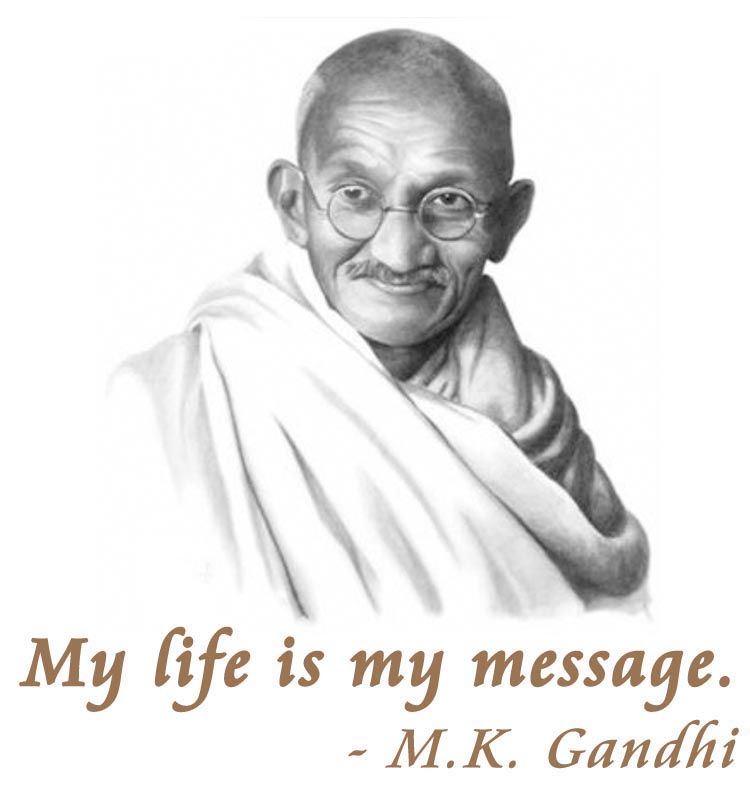
Gandhiji supported the idea of a separate state for Muslims. In a sense he was responsible for the creation of Pakistan. |
Scrutinized in the light of the recorded history these prove to be clever distortions to misguide the gullible. Gandhiji in those days was very active in the rough and tumble of politics. The proposal for partition of the country and violent reaction against it generated tensions which ultimately resulted in sectarian killings on a scale unprecedented in human history. For the ethnic Muslims, Gandhiji was a Hindu leader who opposed creation of Pakistan on sectarian grounds. Ethnic Hindus looked upon him as an impediment of their plan to revenge the atrocities on Hindus. Godse was a child of this extremist thinking. The assassination of Gandhiji was a culmination of decades of systematic brain-washing. Gandhiji had become a thorn in the flesh of the hardcore Hindus and in course of time this resentment turned into a phobia. Beginning with the year 1934 over a period of 14 years on as many as six occasions attempts were made to kill Gandhiji. The last one by Godse on 30-1-48 was successful. The remaining five were made in 1934, in the months of July and September 1944, September 1946 and 20th January 1948. Godse was involved in two previous attempts. When the unsuccessful attempts of 1934, 1944 and 1946 were made the proposal regarding the partition and the matter regarding release of Rs. 55 crore to Pakistan were not in existence at all. The conspiracy to do away with Gandhiji was conceived much earlier than the successful accomplishment thereof. Tire grounds advanced for this heinous crime are clever rationalization to hoodwink the gullible. The staging of the play entitled, "Mee Nathuram Godse Boltoy" (Nathuram Godse speaking) is a clear proof of the fact that the mindset that led to Gandhiji's assassination has not disappeared from our national life. A civil society is wedded to the democratic method of resolving differences by a frank and open debate and evolving a working consensus. Gandhiji was always open to persuasion. Gandhiji had invited Godse for discussions but the later did not avail of this opportunity given to him. This is indicative of the lack of faith in democratic way of resolving differences on the part of Godse and his ilk. Such fascist mindset seeks to do away with dissent by liquidating the opponents. The Hindu backlash was as much responsible for the creation of Pakistan as the sentiments of the ethnic Muslims. The hard core Hindus looked down upon the Muslims as misguided "Mlechchh" - unclean and came to believe that coexistence with them was not possible. Mutual distrust and recriminations led the extremists among both the groups to regard Hindus and Muslims as different nationalities and this strengthened the Muslim league's demand for partition as the only possible solution to the communal problem. Vested interests on both the sides stirred up the separatist sentiment and sought to justify their hate - campaign by clever and selective distortion of history. It is indeed a matter for serious concern for the nation that this mentality has not disappeared even today. Poet Mohamed Iqbal who wrote the famous song "Sare Jahanse Acchchha Hindostan Hamara" was the first to formulate the concept of a separate state for Muslims as early as 1930. Needless to state that this sentiment was in a sense, strengthened by Hindu extremists. In 1937 at the open session of the Hindu Mahasabha held at Ahmedabad, Veer Savarkar in his presidential address asserted : "India cannot be assumed today to be Unitarian and homogenous nation, but on the contrary there are two nations in the main - the Hindus and the Muslims." (Vide writings Swatantrya Veer Savarkar, Vol. 6 page 296, Maharashtra Prantiya Hindu Mahasabha, Pune). In 1945, he had stated "I have no quarrel with Mr. Jinnah's two nation theory. We, the Hindus are a nation by ourselves, and it is a historical fact that the Hindus and the Muslims are two nations." (vide Indian Educational Register 1943 vol. 2 page 10). It was this sentiment of separate and irreconcilable identities of the followers of these religions that led to the formation of Pakistan. In complete contrast to this mentality Gandhiji throughout his life remained an un-compromising advocate of oneness of God, respect for all religions, equality of all men and nonviolence in thought, speech and action. His daily prayers comprised verses, devotional songs and readings from different scriptures. All people irrespective of their allegiance to different religions, attended those meetings. Till his dying day Gandhiji held the view that the nationality of fellow citizens was not in any way affected by the fact of his subscribing to religious belief other than yours. During his life, on more than one occasions he strove for unity and equality among Hindus themselves as well as amity among Hindus and Muslims even risking his life. The idea of partition was an anathema to him. He was given to saying that he would sooner die than subscribe to such a pernicious doctrine. His life was an open book and no substantiation is necessary on this score. Under Gandhiji's leadership communal amity occupied the pride of place in the constructive programmes of the Congress. Muslim leaders and intellectuals of national stature like Abdul Gaffer Khan, Maulana Azad, Dr. Ansari Hakim Ajmal Khan, Badruddin Tayabji, even Mr. Jinnah himself were in the Congress fold. It is but natural that Congress opposed the proposal for the division of the country but as a result of the incitement on the part of the lumpen elements among the Hindus and Muslims a tidal wave of carnage and lawlessness engulfed the nation. Faced with the breakdown of law and order in Sindh, Punjab, Baluchistan, North West Frontier Province and Bengal, Congress lost nerve. Mr. Jinnah adopted an inflexible attitude. Lord Mountbatten being motivated by the time-limit given to him by the British Cabinet used all his powers of persuasion and charm to steer all the leaders to solution quick and yet acceptable to all; but the adamantine attitude of Mr. Jinnah made everything except partition unacceptable. Partition seemed to be the only solution. In the nationwide elections of 1946 Muslim league secured 90 p.c. seats. Faced with such a scenario Congress found it difficult to keep up its morale. Gandhiji conveyed to lord Mountbatten on 5th of April 1947 that he would agree even if the Britishers made Mr. Jinnah the Prime Minister and left the country as it was. But on the other hand Lord Mountbatten succeeded in getting the Congress to agree to partition. Gandhiji was in the dark about it; he was shell-shocked when he learned about it. The only remedy available to him was fasting unto death to dissuade his followers from acquiescence to a ruinous course of action. After sustained soul searching he came to the conclusion that in the prevalent situation such a step on his part would further deteriorate the situation, demoralize the Congress and the whole country. The factors that weighed with him were : (a) Importunate demands of a rapidly changing national scenario, b) Non-existence of alternate set or leaders of proved nationalist credentials. The most perplexing and yet pertinent question is that Mr. Jinnah was the most vocal protagonist of Pakistan and with the intentional or otherwise efforts of Mountbatten he succeeded in carving it out; then, instead of making the two his targets why did Godse select one for murder who vehemently opposed the idea of partition till the resolution by the Congress accepting the partition of the country was passed on 3rd June 1947 and Pakistan became fate accompli? Or is it that, as Savarkar put it, he had no quarrel with Mr. Jinnah and his two-nation theory but, can one surmise that he and his apologists had real quarrel with Gandhi and Gandhi alone? In view of this Gandhiji acquiesced into the situation. It is necessary to point out an aspect of Gandhiji's personality that made him source of unabated distrust and dislike in the eyes of hard core Hindus. Though he was devout Hindu, he had most amicable and warm relations with many who did not belong to the Hindu fold. As a result of this exposure he had developed an eclectic religious sense based on oneness of God and equality of all religious sense based on oneness of God and equality of all religions. Caste divisions and untouchability prevalent among the Hindu social organisation distressed him immensely. He advocated and actively encouraged inter-caste marriages. Lastly he blessed only those marriages wherein one of the partners belonged to the untouchable castes. Vested interests amongst high caste Hindus viewed this reformist and other religious programmes with bitter resentment. In course of time it developed into a phobia and thus he became an anathema to them. |