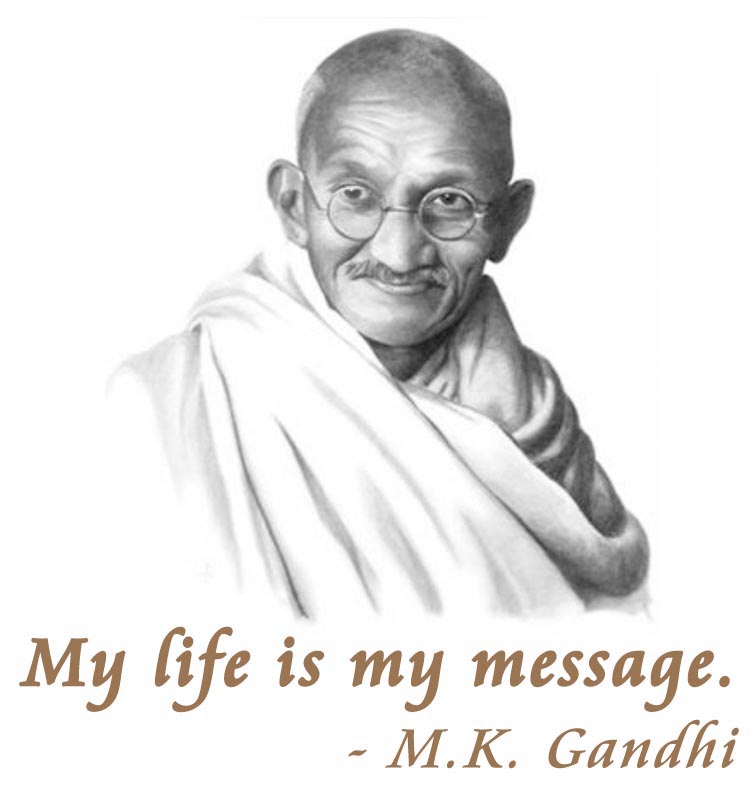
Gandhiji's Views On Youth As An Agent For Social Transformation | ||||||||||||
Ms. Preeti Gharse / Mr. Santosh Sharma, University of Mumbai"What is my inheritance? To what am I an heir? To all that humanity has achieved during tens of thousands of years, to all that is has felt and suffered and taken pleasure in, to its cries and triumphs and its bitter agony of defeat, to that astonishing adventure of man which began so long ago and yet continues and beckons to us. To all this and more in common with all men. But there is a special heritage for those of us of India, not an exclusive one, for none is exclusive and all are common to the race of man, one more especially applicable to us, something that is in our flesh and blood and bones, that has gone to make us what we are and what we are likely to be........an agent........an agent for social transformation! Today we are here to present our research on Gandhiji's views on youth as an agent for social transformation. Even as we sit here in this gathering peacefully little do we know that there is a war being waged. A war where the youth of nation will actively participate...a war of good vs. evil, a war of virtues vs. vices, a war of knowledge of science vs. wisdom of soul, a war of material prosperity vs. peace of mind, a war of education vs. character building, a war of professional management vs. social commitment. The lines for battle have been drawn and this battle will be fought on three fronts;
This will indeed be a unique battle where everyone will emerge as a winner. What are the weapons to be used in this war? Right Conduct, Love, Co-operation, Justice, Equality, Patriotism, Non-Violence, Peace, Excellence and last but not the least, the all powerful weapon of Truth. The able-bodied soldiers namely the youth of India are being lead by none else but our beloved Mahatma as the Commander-in-chief. Let us take a closer look at the various strategies that we shall be using in this war and how we shall tackle the enemy on each front. One important factor to be remembered is that this battle started nearly a hundred years ago when the Mahatma himself fought in the ranks of a soldier and continues till date. It is important to know the history of this war before we decide what tactics are to be adopted in the future. Hence we need to visit each of the warfronts to get a better idea. The Environmental FrontLet us deal with this battlefield in a Gandhian manner by incorporating the two vital issues of Peace and Patriotism. Right from the beginning of human life, the entire humanity has been craving for peace at different levels such as individual, social, communal, national and international levels. Gandhiji was of the view that peace is a feeling which is to be emotionally experienced by everyone. It is experienced when emotional equilibrium and self-equilisation is achieved. It is this superpower, he felt, which if realised, leads to eternal happiness. Attainment of peace should be the ultimate goal of any youthful human emotions and actions. Once their minds are at rest they can concentrate their energies for spreading the message of peace. Youth should know that social harmony is an index of peace. They should strive peacefully to make their and other people's social lives happy and undisturbed which is the aim of any society. Gandhiji also warned youngsters against misinterpreting religions. All the religions such as Hinduism, Christianity, Islam, Buddhism, Jainism, etc. have preached peace and harmony. The advocacy of war was for the purpose of saving the religion, performing one's duty and eliminating the evils so that society can enjoy a happy and peaceful life. Mahatma Gandhi himself made skillful use of Satyagraha to achieve peace and harmony and thus proved his point. He always believed that peace contains a negative and a positive sense; the absence of configuration, elimination of wars, absence of conflicts between different classes, castes, religions, and nations is a negative sense and love, rest, mental equilibrium, harmony, co-operation, unity, happiness are the positive indices of peace. In broader sense, peace would include social harmony which involves natural resources. Gandhiji believed that natural resources are the primary sources for valuable and useful commodities. They are mainly raw materials and energy resources present in the environment. e.g. minerals, forest, animals, water, soil. Youth should ensure its proper utilisation and conservation. This would imply rational use of resources and their preservation from reckless exploitation and destruction. Gandhiji's love for animals is known to all. He further advocated effective control and management of resources in such a way that they will be useful to man for longer time. He underlined young student's importance in ensuring uniform distribution of all resources. In the same context of environment another weapon that Gandhiji has provided us with is Patriotism. The nation, he emphasised, is built on the foundation of selfless devotion by its citizens. Young people are vibrant, energetic and enthusiastic. They should show the same enthusiasm when the nation demands for sacrifice of their wealth, their lives, their families etc. Gandhiji often recited a verse in Sanskrit stating that Mother and Motherland are superior to Heaven. He went to the extent of coining his own definition of Patriotism wherein he described it as a sense of loyalty and affection to the soil, the national symbols etc. This feeling, sentiment or attitude of patriotism, he believed would make youth serve the nation selflessly. Let us now consider the battle taking place on THE SOCIAL FRONT:History has numerous instances of old and well-established civilizations fading away or being ended suddenly, and vigorous new cultures taking their place. It is some vital energy, some inner source of strength that gives life to civilization or people without which all efforts are ineffective, like the vain attempt of an aged person to play the part of a youth? Such was the vitality attached to young students by our beloved Father of the Nation! So what is this social transformation that he was referring to using youth as a catalyst? Society, as defined, is a group of individuals dwelling together who symbiotically carries out various activities to bring happiness and stabilization. As it is a unique blend of diverse religions, cultures, and races its structure keeps changing with respect to time. After all, nothing is constant but "change"! Gandhiji had stressed upon youth participation in bringing out various social reforms during his struggle for independence in the Sati Pratha, Polygamy, Child marriage, Education of women, Widow remarriage, Untouchability, Caste system, Exploitation and Religious misguidance. And the attributes that make youth swim through were Non-violence, Co-operation, Justice, Equality and Love. Non-violence, Gandhiji advocated, has a religious, social, spiritual and personal significance. Force or aggression leads to a total destruction of society. Violent feelings provoke conflicts which grow in strength and threaten the very society it was initially supposed to protect. As violence or force grows in size it takes a negative and destructive path and affects society. The only force, Mahatma Gandhi proposed was fasting which could be coercive but upright. The path proposed was of Non-co-operation, boycott or Satyagraha. Let us not forget that satyagraha was the subtle force which he used to shake the very foundation of the British Empire! He believed in the destruction of the false and the wicked by non-violence which would eventually result in the ultimate triumph of good over all evil. Gandhiji described the term co-operation as all individuals coming together to achieve the designed goals and all of them sharing the fruits of the achievements. Nobody is overburdened nor over regarded. Youth should co-operate with elders and children. It should be looked upon as a way of life. "Vina Sahakar Nahi Uddhar" (No prosperity without co-operation). He underlined that co-operation is the basis for peace, love, equality and justice. Mahatma Gandhi advocated joint families and village communities as the co-operation among different individuals, classes, castes and groups in the society ensures growth in all walks of human life from basic needs of food, clothing and shelter to more complex requirement of the people like industries, transportation, recreation, finance, etc. Gandhiji also proposed the young entrepreneurs concept to achieve primary objectives of growth and equality. Gandhiji wanted youth against the misuse of Co-operation like undue publicisation, excessive government intervention, exploitation, promotion of self-interest etc. Love, as per the Mahatma, is a feeling or sentiment which originates in the soul. Love for young people is a form of energy which would charge them every now and then. The entire structure of society is built upon a sound foundation of love. He advocated love strongly as it develops co-operation and a sense of understanding that makes the entire society happy. Equality, in youth, is a noble, desirable and valuable principle. A comparison between two individuals, groups, societies, natures etc. is against the natural Law, said Mahatma. After all everyone is equal in the eyes of God. Is it logical, leave alone ethical to say that one person is superior to another? Accordingly Gandhiji appealed youngsters to strive towards nullifying the wide gap between various sections of the society. He proposed elimination of all sorts of artificial discrimination, exploitation and oppression to establish equality. Men and Women are equal. They complement each other through the different functions they perform in a society. He once stated that "If we do not efface untouchability we shall all be effaced from the face of the Earth". Caste, he felt does not connote superiority or inferiority. It simply recognizes differences in outlooks and corresponding modes of life. He proposed youth to provide equal protection and security to all. Economic inequality implying concentration of wealth and income in few hands is the root cause of political instability and social inequality. He further suggested abolition of exploitation, forced labor, sexual discrimination so as to restore social harmony. Untouchability, according to him, was an offence. It was one of those evils which plagued society, a crime against not only humanity but against God. Unity and Equality are core values on which a nation rests. About justice, he said, that there exists a close relationship between equality and justice. Youth must know that justice is done when equality is established and when equality exists justice is done. Justice is natural or Godly ensuring the balance in the universe through young exercisers. Justice is normative connotation depending upon the accepted morals of the society, the predictions and customs instituted by the society for betterment of all. What is more important for youth is spreading the light of justice and creating awareness. We now move over to the INDIVIDUAL FRONT:The third warfront where the war is being fought is individual level. i.e. the young mind itself! Here Gandhiji advocated the principles of Right Conduct. Excellence and Truth as the effective weapons with which to fight this war. Gandhiji was himself a disciple of the "BHAGWAD GEETA" and exalted the younger generation to follow it too. The Gita mentions three different qualities viz. Satva, Rajas and Tamas. In case of Tamas the happening comes from violence and laziness. In case of Rajas it comes from material gains. Gandhiji proposed that the youth follow the Satvik model where happiness is inward development, i.e. it emphasizes the inclusion of basic human values. Right conduct refers to a set of norms or code of conduct accepted by the society on the basis of thoughtful behavior and is displayed when we discharge our duties and various actions such as obedience, etiquettes, fulfillment of social obligations, co-operation, sympathy etc. The youth should take into consideration various dimensions of their conduct such as the social, cultural, religious and the political aspect. In young people, there is a constant flow of energy. They are dynamic, vibrant and excessively energetic. Hence, it becomes all the more necessary for them to discharge their energies in a positive manner to attain long-term happiness and goodwill in society and to contribute to the progress of society. Gandhiji often reiterated the Hindu philosophy of Moksha or Salvation. According to him a Sadachari—a person with right conduct is ensured a place in heaven, while it is believed that a sinner will go to hell. He therefore stressed on Truth, Humanity, Sacrifice and Non-avarices as the important elements of right conduct. Right conduct, he believed, comes from the right education and education should not only help to gain knowledge, but should also contribute towards character building. Gandhiji often said that one should do his duty and remain unconcerned about the fruits. Gandhiji also pointed out that each one of us should strive to attain Excellence at the personal as well as the social level. He implored the youth to pursue this value without any reservations. This would ensure not only holistic development of the individual, but also progress of the society at large. Here Gandhiji makes a reference to our age-old scriptures where Dharma, Artha, Kama and Moksha have been mentioned as the four Purusharthas, the pursuit of which leads to perfection in all walks of human life. He strongly believe in the adage that if any job is worth doing, it is worth doing well. Excellence in any field brings peace of mind and satisfaction. According to him the age-old concept life being divided into four stages or ashrams, contributed to an individual's attaining excellence.
Only if a person adhered strictly to these stages then his life would become worthwhile. Truth was Gandhiji's favorite human value which inspired his autobiography "My Experiments with Truth" Satya Meva Jayate was his slogan. Youth must differentiate between truth and blind belief. Gandhiji wanted every individual and society to practice truth at any cost. He emphasised that all religions, philosophies, societies have unambiguously advocated truth. According to him truth was God and that truth must manifest itself in thought, word and deed. He did accept the path of truth will always be full of hardships, difficulties, sufferings, and sacrifices. To tell the truth one must be courageous. Youth must note that no society readily accepts any social transformation. Hence the students who are acting as agents for reformation will have to face public censure and the wrath of society. Self determination, strong will power and profound belief in one's conviction will help the youth to lead the society. Treading the path of truth is a continuous and unending process which has to be followed by every generation. Gandhiji advocated that education was the means to attain virtues. Basic education was every person's right. Children should not only learn to read and write, they must also learn skills which will make them independent and self-reliant. Basic education should be made compulsory for all Children up to the age of fourteen. The medium for education should be in one's mother tongue, so that they can easily grasp it. Education should not end with childhood and adult education plays an equally vital role in the development of an individual. CONCLUSION:Thus on all fronts Gandhiji believed in creating from youth a cadre of inspiring and competent role models and change agents with the courage of conviction who in turn will trigger off the process of building a healthy nation. The war started over 100 years ago and remains incomplete as we fight it even today. Social transformation must be undertaken on a priority and this is nothing less than a revolution. Long term fundamental changes and not merely outward changes are required. Civil cleansing and mass action is the key to this change and the youth are the catalysts who will bring about the change. The entire system needs revamping and the young people will play an instrumental role. The challenge before us is to build a good society out of bad individuals. The weapons he gave were not just meant to overthrow the British but to be used at all times. Today we require these weapons more than ever to build a better society. Even after 50 years of freedom we are still struggling to gain independence in the true sense; to pull ourselves out of the clutches of violence, crime and corruption which have rendered our entire society sick. Although free from foreign rule, we are still enchained by foreign influences which are corrupting our youth and driving them astray. The very agents of social transformation are engulfed by the fatal diseases of poverty, illiteracy, over-population and unemployment. The time is ripe for an uprising and we must all awaken and revolt; a nonviolent but effective war needs to be waged keeping in mind all that the great Mahatma taught us years ago. As we progress into the next millennium, we need to carry forward his ideologies with us. What better tribute can we give the Father of the Nation, than pledging to build a nation of his dreams? We shall end this presentation with a small verse in praise of a man so great that his greatness is unfathomable! His is the One Luminous, Creator of all, Mahatma |