Declaration of complete Independence |
The Lahore session proved a momentous one. At Gandhi’s instance, the All India Congress Committee had elected Jawaharlal Nehru as its president. The Congress, instinct with new hope and energy, needed a young man at the helm. The forty-year-old Jawaharlal whom Gandhi described "pure as crystal…. truthful beyond suspicion… a knight sans peur et sans reproche" was to be in fullness of time the Mahatma’s political heir. There was a bond of deep affection between the two men in spite of the twenty years and widely differing intellectual backgrounds which separated them. The year of grace which the Calcutta Congress had granted had drawn to a close. Dominion Status had not been conceded; the offer of the minimum national demand embodied in the Nehru Report lapsed. At midnight on December 31, 1929, as the new year dawned, the Indian National Congress unfurled the flag of independence on the bank of the river Ravi. The Congress called upon its members in central and provincial legislatures to resign their seats and authorized the launching of a civil disobedience campaign. In January 1930, Gandhi wrote that he was "furiously thinking night and day" The first step he took was to call for the celebration of an "Independence Day" on January 26. On that day, in the towns and villages of India, hundreds of thousands of people took a pledge that "it was a crime against man and God to submit to British rule." Gandhi was encouraged by the latent enthusiasm in the country revealed by the observance of the Independence Day; he felt the country was ripe for a mass movement. He suggested the inauguration of the movement with the breach of Salt Laws. The salt tax, though relatively light in incidence, hit the poorest in the land. But salt did not quite seem to fit into the plan of a national struggle for liberation. And when Gandhi announced that he would walk the 241 miles from his ashram in Ahmedabad to Dandi on the Arabian Sea, the first impulse of the Government, as of the Congress intellectual, was to ridicule the "kindergarten stage of political revolution", and to laugh away the idea that the King-Emperor could be unseated by boiling sea-water in a kettle. 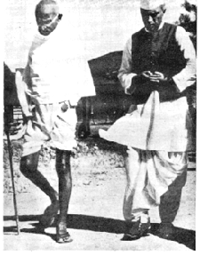
Gandhi and Nehru 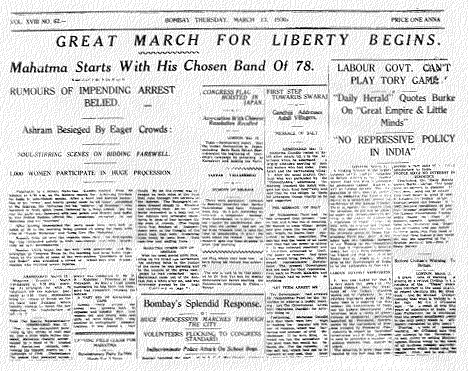
Newspaper report on the commencement of Dandi March 12, 1930 Events were to show that those who had scoffed at Salt Satyagraha and failed to see any connection between salt and swaraj (independence) had underrated Gandhi’s knack for organizing the Indian masses for corporate action. Gandhi was arrested on May 5. Just before his arrest he had planned a more "aggressive" phase of his non-violent rebellion by raiding and taking possession of the salt depots at Dharasana. The raid took place a fortnight after Gandhi’s arrest. There were 2500 volunteers. Before they advanced, Sarojini Naidu, the poetess, led them in prayer and appealed to them to be true to Gandhi’s teaching and to abstain from violence. Round the depot, a barrier of barbed wire had been erected and a ditch dug. As the first column of volunteers advanced, police officers ordered them to disperse. The volunteers advanced in silence even though scores of policemen fell on them and rained blows upon them. Not one man so much as raised his arm to fend off the blows. Webb Miller, an American correspondent, who witnessed the scene, wrote: "In eighteen years of reporting in twenty two countries, FI have never witnessed such harrowing scenes as at Dharasana. Sometimes the scenes were so painful that I had to turn away momentarily. One surprising feature was the discipline of volunteers. It seemed they were thoroughly imbued with Gandhi’s non-violent creed." 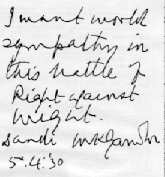 A message from Gandhi 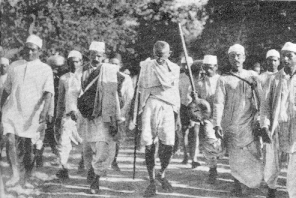 Gandhi and fellow satyagrahis on the march.
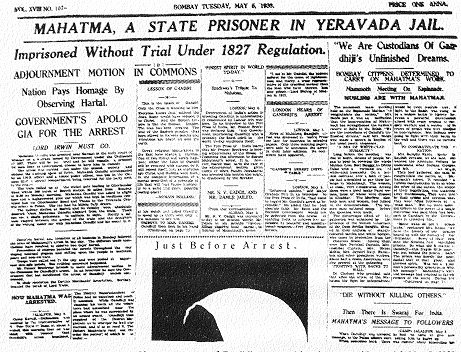 Newspaper report of Gandhi's arrest and imprisonment without trail, May 5, 1930
The Satyagraha campaign was extended by the Congress to include breach of salt as well as forest laws, the non-payment of taxes and the boycott of foreign cloth, banks and shipping. The Government replied by issuing "ordinances" which conferred extraordinary powers on the executive authority for arrest and prosecution of Congress workers. |