Cripps Mission |
Gandhi was thus firmly anchored to pacifism when the war broke out in 1939, but many of his closest colleagues and the rank and file in the Indian National Congress could not bring themselves to accept the feasibility of defending the country against aggression without resort to arms. Twice during the war—after the fall of France in 1940, and the collapse of the British position in South East Asia in 1941—when there was a possibility of a rapprochement between the Congress and the Government for a united war effort, Gandhi stepped aside rather than be a party to organized violence. The rapprochement did not come. The only serious British effort for a compromise was made in the Spring of 1942 with the dispatch of the Cripps Mission to India; it proved abortive. For nearly two and a half years, Gandhi had resisted pressure from a section of his following for the launching of a mass movement. It became clear that the British Government first under Chamberlain, and then under Churchill, was reluctant to assure Indian freedom in the future, or to offer a practical token of it in the present Gandhi had endeavoured to restrain the radical wing of the Congress party, and diverted its discontent into "individual Satyagraha", a subdued form of civil resistance confined to "selected individuals" 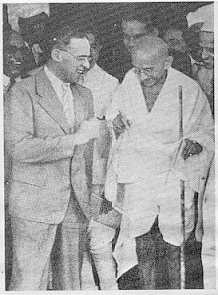 Gandhi with Sir Stafford Cripps, March 1942 After the failure of the Cripps Mission, Gandhi noted with concern that in the face of grave peril posed by the Japanese advance in South East Asia, the mood of the people of India was not one of resolute defiance, but of panic, frustration and helplessness. If India was not to go the way of Malaya and Burma, something had to be done, and done quickly. He came to the conclusion that only an immediate declaration of Indian independence by the British Government could give the people of India a stake in the defence of their country. |