22. Author |
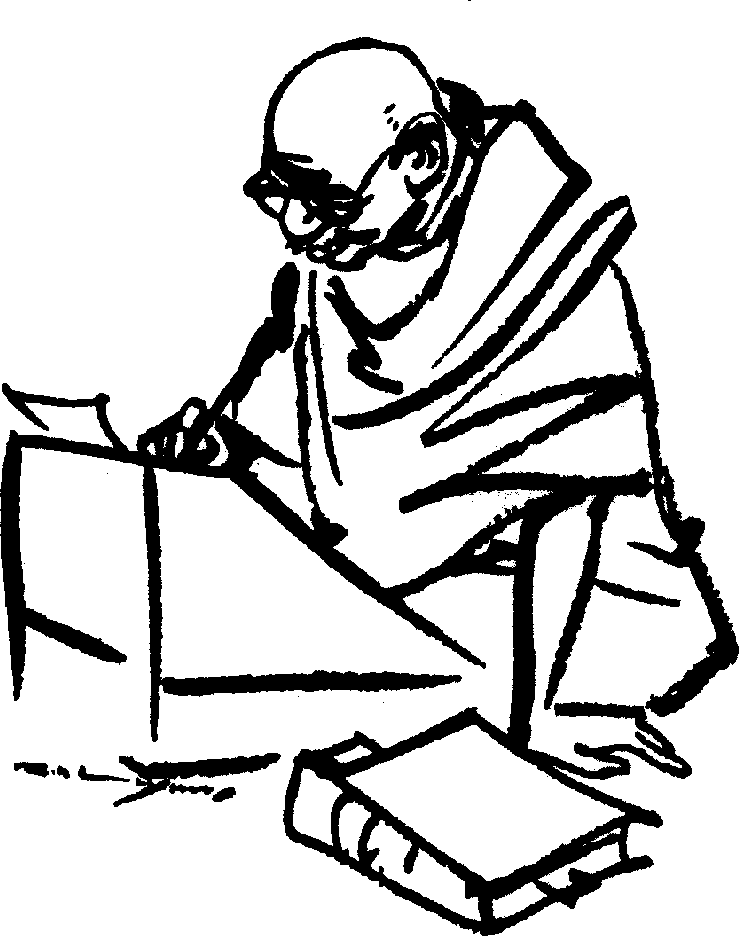
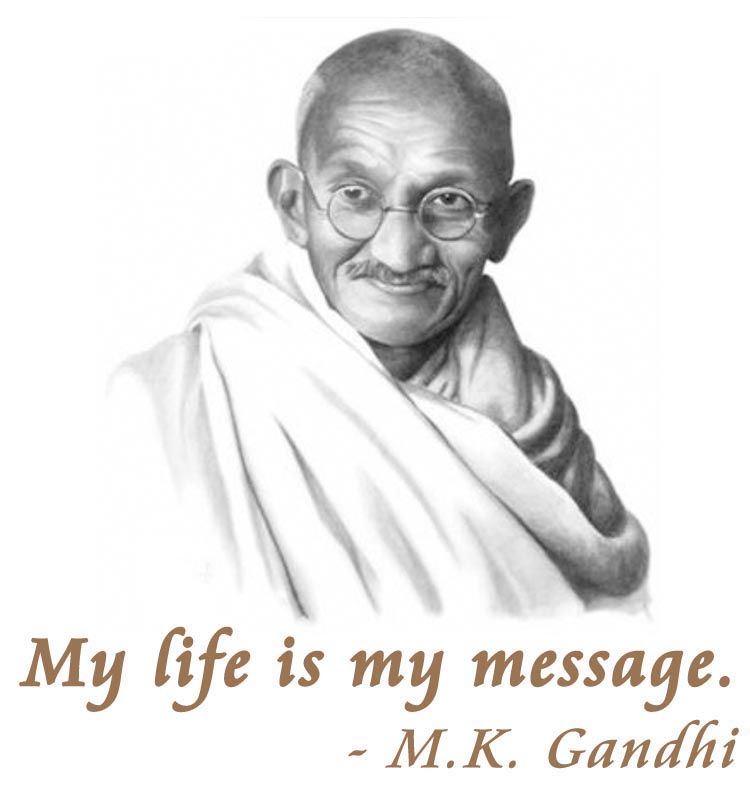
A number of books bear the authorship of M. K. Gandhi. Majority of them were not written in a book form. They were collections of his articles and speeches on truth and ahimsa, Swadeshi and charkha or of his addresses to women , students and princes. Gandhi was accepted as a very good writer. He never aimed at a style nor used flowery words merely to please the ears. He had a forceful style of his own which mirrored his hopes and faith, his sorrows and disappointments. His style of writing was simple, precise, clear and as devoid of artificialities as the life of its author. Some English Viceroys admitted that Gandhi was direct and expressed himself in excellent English with a fine appreciation of the value of words he used. Gandhi claimed that a thoughtless word never escaped his lips or pen. A professor at the Oxford University, who assisted in drafting some of Gandhi's statements made at the Round Table Conference, said: "I have never met an Indian who had mastered the prepositions as Gandhi had... I took a deal of trouble over this drafting. Mr. Gandhi would glance over my work and would make just one suitable prepositional change. It did its work. It changed my meaning into Mr. Gandhi's meaning." Perhaps Gandhi's love for and careful reading of choice English writers and the Bible trained his ears for making proper use of words. He read widely and digested what he read. His first attempt in his teens as a writer was a booklet London Guide written for Indian students. It contained helpful details about London. Next came two pamphlets An Appeal to Every Briton and The Indian Franchise. The first describes the general condition of Natal Indians and the other is a history of Indian franchise in Natal. The language of the Green Pamphlet which followed was factual. In a month's time, a second revised edition of it was published. A summary of the Green Pamphlet in South African newspapers angered the Europeans and when he next landed in South Africa, he was mobbed and lynched. To his bitter experience Gandhi found that his writing could not be properly in a condensed form. He himself had a knack for writing in condensed form. He drafted the Congress constitution and many resolutions. Gandhi's experiments in diet were recorded in A guide to Health. It is an English translation of his articles printed in the Gujarati Indian Opinion and was widely read in India and abroad and translated into English, European and Indian languages. When any idea gripped his mind, he put it in writing with conviction without any fear of being ridiculed. His urge to write made him scribble on running trains and rocking ships. He prepared the whole of the Green Pamphlet while on voyage home in 1896. Hind Swaraj, a severe criticism of modern civilisation , was written at a stretch during his voyage from England to South Africa in 1909. He used the steamer stationery. When he got tired of writing with his right hand, he used the left and finished the book in ten days. Tolstoy read it and said that the question of passive resistance was " of very great importance not only for India but for the whole world" . Constructive Programme, a booklet on nation building work, was written on a train. His manuscripts had few marks of correction and seldom needed any change. And that, he said, was due to " the spiritual discipline of a votary of truth". His knack for picking up apt words for translating an idea into another language was remarkable. He did dance he called Patanga Nritya Ruskin's Unto this Last echoing Gandhi's deepest belief appealed to him and he adapted it into Gujarati. It was called Sarvodaya. Some portions from Carlyle and from the life of Kemal Pasha were also translated into Gujarati by him. His " Story of a Satyagrahi" is a paraphrase of the "Defense and Death of socrates" by Plato. Gandhi translated into English Ashram Bhajanavali and some poems of the saint poets of India when he was in jail. the latter was entitled songs from the Prison. He wrote his autobiography in Gujarati. He introduced a simple, forceful style that turned the Gujarati language into a people's language. The English rendering of The Story of my Experiments with Truth has been judged a good piece of literature by many eminent persons. Apart from unfolding the live human personality of a world figure, the pen pictures of his parents, wife and friends, of dramatic events and his exercise of suspense and interweaving of stray dialogues sustain the interest of the readers. It was translated into almost all the Indian languages and also into English, French , Russian German, Chinese and Japanese. all his writing cherish truth and high moral values. at the same time they are not records of dry codes of behavior. For children he wrote a primer Balpothi and a book on ethics Nitidharma. He did not went to preach anything to children which they could not put into practice. His letters to ashram children from jail were both amusing and instructive. He was a voluminous letter writer and could in one day write 50 letters in long hand. Collection of his letters, numbering about 100,000, forms a vital part of his writing. Gandhi was against "art for art's sake". For him all art had to be based on truth and literature had value only so far as it helped man to rise upward. For the half-starved masses he felt the need of simple good stories and such couples that a peasant goading a bullock could sing lustily and forget filthy abuses. In a literary conference he asked the writers: " Did you have any thought of these dumb millions' appetites and aspirations? For whose sake are we going to have our literature? what am I to read to them?" As a model he referred to Dean Farrar's life of Christ written in a language which the masses of England could understand. He wrote short sketches of many outstanding men and women in the Gujarati Indian Opinion. When he was asked to write a biography of his favourite poet philosopher Raichandbhai, he said: " If I want to write his life story, I shall have to study carefully his home, his playground, mix with his friends, schoolmates, relatives and followers." In this sphere too, truth and not imagination was his guiding star. Gandhi often referred to incidents, examples and moral found in the Indian epics, in the lives of Rama, Krishna and Mohomed. This made his ideas lucid to the masses and gave him that amazing power of touching their hearts. Boldness of his expressions decrying such evil customs as lynching, white hooliganism, untouchability, degeneration of self-seeking Congress men into white robed goondas etc. were trenchant and prophetic. In protest to Lord Curzon's statement " the ideal of truth is to a large extent a western conception", Gandhi quoted a host of evidence supporting thru worship of truth in India from the Ramayana, Mahabharata, Vedas etc. He challenged that as an English gentlemen a Lord Curzon should with draw his baseless and offensive imputations. Gandhi once asked:" where is Mahomed and his message of peace? If Mahomed came to India today, he would disown many of his so-called followers and own me as true Muslim, as Jesus own me as a true Christian. there is no Christianity in the West, or there should have been no war." Gandhi used to say that " the poet in a magic world of his own creation " but he himself was a slave of the spinning wheel which was somebody else's creation. But many passages from his writings testify how with a few strokes of his pen, he could create vivid, living pictures:- " in Mysore , I saw in the ancient temple a bracket in stone made of a little statuette which spoke out to me. It was just a woman , half-naked , struggling with the folds of her clothes to extricate herself from shafts of Cupid, who is after all lying defeated at her feet in the shape of a scorpion. I could see the agony of the form, the agony of the sting of the scorpion," " Do you know Orissa and its skeletons? well, from that hunger-stricken impoverished land of skeletons have come men who have wrought miracles in bone, horn, and silver. Go and see how a soul of a man even in an impoverished body can breathe life into lifeless horns and metals. A poor potter has worked miracles out of clay." " The spot lay on a river bank. The river ran between a row of homely hills shaded with trees and shrubs. The bed of the river was sandy, not muddy. The platform was erected in the waters of the river. On either side of the road that lay in front of the platform, huge masses of men and women over twelve thousands sat in perfect silence." ' Early in the morning I entered Malabar. as I was passing by the familiar places, the face of a Nayadi whom I had seen during the previous visit, rose before my eyes. In the midst of a discussion about untouchability, a shrill voice was heard. those who were talking to me said, ' we can show you a live Nayadi." The public road was not for him. Unshod he was walking across the fields with a noiseless tread. I asked him to come and talk to me. Tremblingly he talked to me. I told him the public road was as much for walk on the public road.' You will be finding me smiling with you and cracking jokes with you, but you also may know that, behind all these jokes and smiles and laughs, the face of the Nayadi and that scene will keep haunting me throughout my tour in Malabar.' The beauty of his thoughts and language made deep impression on some of the great men of our age. |