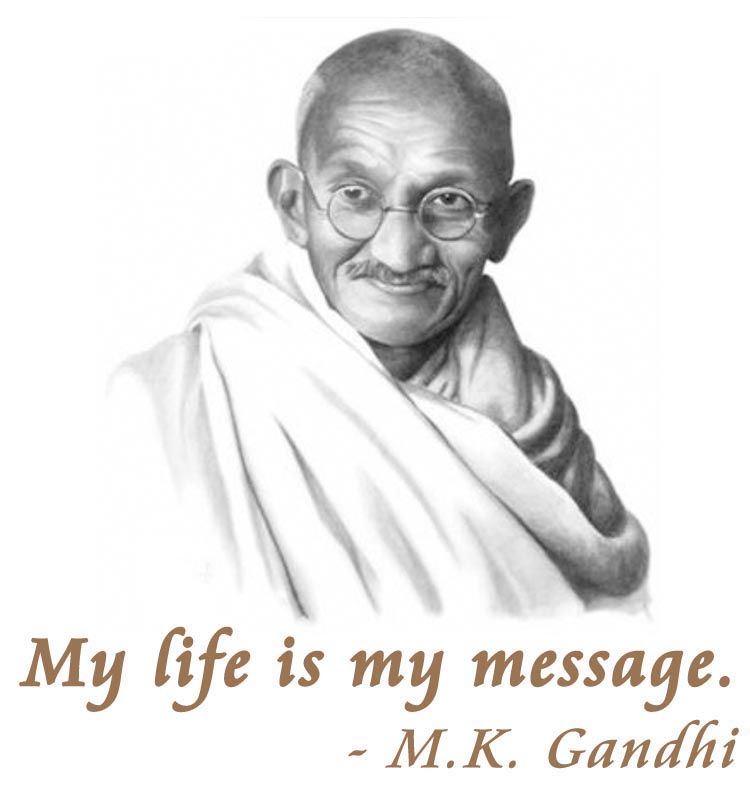
Appendix B: Gandhiji on the observances |
To many of the students who came here last year to converse with me, I said I was about to establish an institution - ashram - somewhere in India, and it is about that place that I am going to talk to you this morning*. I feel and I have felt during the whole of my public life that what we need, what a nation needs, but we perhaps of all the nations of the world need just now, is nothing else and nothing less than character-building. And this is the view propounded by that great patriot, Mr Gokhale (cheers). As you know, in many of his speeches he used to say that we would get nothing, we would deserve nothing, unless we had character to back what we wished for. Hence his founding of the great body, the Servants of India Society. And as you know, in the prospectus that has been issued in connection with the Society, Mr Gokhale has deliberately stated that it is necessary to spiritualize the political life of the country. You know also that he used to say often that our average was less than the average of so many European nations. I do not know whether that statement by him, whom with pride I consider my political guru, has foundation in fact, but I do believe that there is much to be said to justify it in so far as educated India is concerned; not because we, the educated portion of the community, have blundered, but because we have been creatures of circumstances. Be that as it may, this is the maxim of life which I have accepted, namely, that no work done by any man, no matter how great he is, will really prosper unless he has a religious backing. But what is religion? - the question will be immediately asked. I for one would answer: Not the religion which you will get after reading all the scriptures of the world; it is not really a grasp by the brain, but it is a heart-grasp. It is a thing which is not alien to us, but which has to be evolved out of us. It is always within us, with some consciously so, with others quite unconsciously. But it is there; and whether we wake up this religious instinct in us through outside assistance or by inward growth, no matter how it is done, it has got to be done if we want to do anything in the right manner and anything that is going to persist. Our scriptures have laid down certain rules as maxims of life and as axioms which we have to take for granted as self- evident truths. The shastras tell us that without living according to these maxims, we are incapable even of having a reasonable perception of religion. Believing in these implicitly for all these long years and having actually endeavoured to reduce to practice these injunctions of the shastras, I have deemed it necessary to seek the association of those who think with me in founding this institution. And I shall venture this morning to place before you the rules that have been drawn up and that have to be observed by everyone who seeks to be a member of that ashram. Five of these are known as yamas, and the first and foremost is Truth. TruthNot truth simply as we ordinarily understand it, that as far as possible we ought not to resort to a lie; that is to say, not truth which merely answers the saying "Honesty is the best policy" implying that if it is not the best policy, we may depart from it. But Truth, as it is conceived here, means that we have to rule our life by this law of Truth at any cost. In order to clarify the definition, I have drawn upon the celebrated illustration of the life of Prahlad. For the sake of Truth, he dared to oppose his own father, and he defended himself, not by retaliation, by paying his father back in his own coin, but in defence of Truth as he knew it, he was prepared to die without caring to return the blows that he received from his father or from those who were charged with his father's instructions. Not only that; he would not even parry the blows. On the contrary, with a smile on his lips, he underwent the innumerable tortures to which he was subjected, with the result that at last Truth rose triumphant. Not that Prahlad suffered the tortures because he knew that some day or other in his very lifetime he would be able to demonstrate the infallibility of the law of Truth. The fact was there; but if he had died in the midst of tortures, he would still have adhered to Truth. That is the Truth which I would like to follow. There was an incident I noticed yesterday. It was a trifling incident, but I think these trifling incidents are like straws which show which way the wind is blowing. It happened like this. I was talking to a friend who wanted to talk to me aside, and we were engaged in a private conversation. Another friend dropped in, and he politely asked whether he was intruding. The friend to whom I was talking said: "Oh, no; there is nothing private here." I felt taken aback a little, because as I was taken aside, I knew that so far as this friend was concerned, the conversation was private. But he immediately out of politeness, I would call it over-politeness, said that there was no private conversation and that he (the other friend) could join. I suggest to you that this is a departure from my definition of Truth. I think that the friend should have, in the gentlest manner possible, but still openly and frankly said, "Yes, just now, as you rightly say, you would be intruding," without giving the slightest offence to the person if he was himself a gentleman - and we are bound to consider everybody a gentleman unless he proves to be otherwise. But I may be told that the incident, after all, proves the gentility of the nation. I think that it is over-proving the case. If we continue to say these things out of politeness, we really become a nation of hypocrites. I recall a conversation I had with an English friend. He was comparatively a stranger. He is principal of a college and has been in India for several years. He was comparing notes with me, and he asked me whether I would admit that we, unlike most Englishmen, would not dare to say no when it was not that we meant. And I must confess that I immediately said yes; I agreed with that statement. We do hesitate to say no frankly and boldly, when we want to pay undue regard to the sentiment of the person whom we are addressing. In this Ashram we make it a rule that we must say no when we mean no, regardless of consequences. This then is the first rule. Then we come to ahimsa. AhimsaLiterally ahimsa means non-killing. But to me it has a world of meaning and takes me into realms much higher, infinitely higher, than the realm to which I would go if I merely understood by ahimsa non-killing. Ahimsa really means that you may not offend anybody, you may not harbour an uncharitable thought even in connection with one who may consider himself to be your enemy. Pray notice the guarded nature of this thought. I do not say "whom you consider your enemy," but "who may consider himself your enemy." For one who follows the doctrine of ahimsa there is no room for an enemy; he denies the existence of an enemy. But there are people who consider themselves to be his enemies, and he cannot help it. So it is held that we may not harbour an evil thought even in connection with such persons. If we return blow for blow, we depart from the doctrine of ahimsa. But I go further. If we resent a friend's action or the so-called enemy's action, we still fall short of this doctrine. But when I say we should not resent, I do not say that we should acquiesce. By resenting I mean wishing that some harm should be done to the enemy, or that he should be put out of the way, not even by any action of ours, but by the action of somebody else, or say by divine agency. If we harbour even this thought, we commit a breach of ahimsa. Those who join the Ashram have literally to accept that meaning. That does not mean that we practise this doctrine in its entirety. Far from it. It is an ideal which we have to reach, and it is an ideal to be reached even at this very moment if we were capable of doing so. But it is not a proposition in geometry to be learnt by heart; it is not even like solving difficult problems in higher mathematics; it is infinitely more difficult than that. Many of you have burnt the midnight oil in solving those problems. If you want to follow out this doctrine, you will have to do much more than burn the midnight oil. You will have to pass many a sleepless night, and go through many a mental torture and agony before you can reach, before you can even be within measurable distance of this goal. It is the goal, and nothing less than that, you and I have to reach, if we want to understand what religious life means. I will not say more on this doctrine than this; that a "man who believes in the efficacy of this doctrine finds, in the ultimate stage when he is about to reach the goal, the whole world at his feet. Not that he wants the whole world at his feet, but it must be so. If you express your love - ahimsa - in such a manner that it impresses itself indelibly upon your so-called enemy, he must return that love. Another thought which comes out of this is that under this rule there is no room for organized assassinations, and there is no room for murders even openly committed, and there is no room for any violence even for the sake of your country, and even for guarding the honour of precious ones that may be in your charge. After all that would be a poor defence of honour. This doctrine of ahimsa tells us that we may guard the honour of those who are in our charge by delivering ourselves into the hands of the man who would commit the sacrilege. And that requires far greater physical and mental courage than the delivering of blows. You may have some degree of physical power, - I do not say courage, - and you may use that power. But after that is expended, what happens? The other man is filled with wrath and indignation, and you have made him more angry by matching your violence against his ; and when he has done you to death, the rest of his violence is delivered against your charge. But if you do not retaliate but stand your ground between your charge and the opponent, simply receiving the blows without retaliating, what happens? I give you my promise that the whole of his violence will be expended on you and your charge will be left unscathed. Under this plan of life there is no conception of patriotism which justifies such wars as you witness today in Europe. Then there is celibacy. CelibacyThose who want to perform national service, or those who want to have a glimpse of real religious life, must lead a celibate life, no matter whether married or unmarried. Marriage but brings a woman closer to the man. and they become friends in a special sense, never to be parted either in this life or in the lives that are to come. I do not think, that in our conception of marriage, our lust should necessarily enter. Be that as it may, this is what is placed before those who come to the Ashram. Then we have control of the palate. Control of the PalateA man who wants to control animal passion does so more easily if he controls his palate. I am afraid this is a rather difficult observance. I am just now coming after having inspected the Victoria hostel. I saw there not to my dismay, - though it should be to my dismay, - but I am used to it now, that there are so many kitchens, not kitchens that are established in order to serve caste restrictions but kitchens that have become necessary in order that people can have the condiments and the exact weight of the condiments to which they are accustomed in the places from which they have come. And therefore we find that for the Brahmans themselves there are different compartments and different kitchens catering for the delicate tastes of all those different groups. I suggest that this is simply slavery to the palate, rather than mastery over it. I may say this. Unless we take our minds off from this habit, unless we shut our eyes to the tea shops and coffee shops and all these kitchens, unless we are satisfied with foods that are necessary for the maintenance of health, and unless we are prepared to rid ourselves of stimulating, heating and exciting condiments that we mix with our food, we shall certainly not be able to control the overabundant and unnecessary stimulation that we may have. If we do not do that, the result naturally is that we abuse ourselves and we abuse even the sacred trust given to us, and we become inferior to animals. Eating, drinking and indulging in passion we share in common with the animals; but have you ever seen a horse or a cow indulging in the abuse of the palate as we do? Do you suppose that it is a sign of civilization, a sign of real life that we should multiply our eatables so far that we do not even know where we are and seek dish after dish until at last we have become absolutely mad and run after the newspaper sheets which give us advertisements about these dishes? Then we have Non-stealing. Non-stealingI suggest that we are thieves in a way. If I take anything that I do not need for my own immediate use and keep it, I steal it from somebody else. I venture to suggest that it is the fundamental law of Nature without exception, that she produces enough for our wants from day to day, and if everybody took enough for himself and nothing more, there would be no pauperism, there would be no man dying of starvation in this world. But so long as we have got this inequality, so long we are stealing. I am no socialist, and I do not want to dispossess those who have got possessions; but I do say that those of us who want to see light out of darkness have to follow this rule in their own lives. I do not want to dispossess anybody, for J should then be departing from the rule of ahimsa. If somebody else possesses more than I do, let him. But so far as my own life has to be regulated. I do say that I dare not possess anything which I do not need. In India we have got millions of people living on one meal a day, and that meal consisting of a chapati with no fat spread on it and a pinch of salt. You and I have no right to anything more until these millions are clothed and fed better. You and I, who ought to know better, must adjust our wants, and even undergo voluntary starvation, in order that they may be fed and clothed. Then there is Non-possession which follows as a matter of course. Next is Swadeshi. SwadeshiSwadeshi is an essential observance. I suggest that we are departing from one of the sacred laws of our being when we leave our neighbour and go out somewhere else in order to satisfy our wants. If a man comes from Bombay here and offers you wares, you are not justified in supporting the Bombay merchant so long as you have got a merchant at your very door, born and bred in Madras. That is my view of Swadeshi. In your village, so long as you have got your village barber, you are bound to support him to the exclusion of the finished barber who may come to you from Madras. If you find it necessary that your village barber should reach the attainments of the barber from Madras, you may train him to that. Send him to Madras by all means, if you wish, in order that he may learn his calling. Until you do that you are not justified in going to another barber. That is Swadeshi. So when we find that there are many things that we cannot get in India, we must try to do without them. We have to do without many things which we may consider necessary; but believe me, when you are in that frame of mind, you will find a great burden taken off your shoulders, even as the Pilgrim did in the inimitable book, The Pilgrim's Progress. There came a time when the mighty burden that the Pilgrim was carrying on his shoulders dropped from him, and he felt a freer man than he was when he started on the journey. So will you feel freer men than you are now, immediately you adopt Swadeshi. We then have Fearlessness. FearlessnessI found throughout my wanderings in India, that India, educated India is seized with a paralysing fear. We may not open our lips in public; we may not declare our confirmed opinions in public; we may hold those opinions and may talk about them secretly, but they are not for public consumption. If we had taken a vow of silence, I would have nothing to say. But when we open our lips in public, we say things we do not really believe in. I do not know whether this is not true of almost every public man who speaks in India. I then suggest to you that there is only one Being, - if Being is the proper term to be used, - whom we have to fear, and that is God. When we fear God, we shall fear no man, no matter how highly placed he may be. And if you want to follow the vow of Truth in any shape or form, you must be fearless. And so you find, in the Bhagavadgita, fearlessness is designated the first essential quality of a good man. We fear consequences, and therefore we are afraid to tell the truth. A man who fears God will certainly not fear any earthly consequence. Before we can aspire to understand what religion is, and before we can aspire to guide the destinies of India, do you not see that we should adopt this habit of fearlessness? Or shall we overawe our countrymen, even as we are overawed? We thus see how important fearlessness is. Then we come to the removal of untouchability. Removing UntouchabilityUntouchability is a blot that Hinduism today carries with it. I decline to believe that it has been handed to us from immemorial times. I think that this miserable, wretched, enslaving spirit of untouchability must have come to us when we were in the cycle of our lives at our lowest ebb, and that evil has still stuck to us and it still remains with us. It is to my mind a curse, that has come to us, and as long as that curse remains with us, so long I think we are bound to hold that every affliction that we labour under in this sacred land is a fit and proper punishment for this great crime that we are committing. That any person should be considered untouchable because of his calling passes one's comprehension; and you, the student world who receive all this modern education, if you become a party to this crime, it were better that you received no education whatsoever. Of course, we are labouring under a very heavy handicap. Although you may realize that there cannot be a single human being on this earth who should be considered untouchable, you cannot react upon your families, you cannot react upon your surroundings, because all your thought is conceived in a foreign tongue, and all your energy is devoted to it. Therefore we have also introduced a rule in this Ashram, that the medium of instruction shall be the mother tongue. Education through the Mother TongueIn Europe every cultured man learns, not only his language, but also other languages, sometimes three or four. And even as they do in Europe, in order to solve the problem of language in India, we in this Ashram make it a point to learn as many Indian languages as we can. And I assure you that the trouble of learning these languages is nothing compared with the trouble that we have to take in mastering English. Indeed we never master English: with some exceptions it has not been possible for us to do so: we can never express ourselves as clearly in English as in the mother tongue. How dare we rub out of our memory all the years of our infancy? But that is precisely what we do, when we commence our higher education, as we call it, through the medium of a foreign tongue. This creates a breach in our life, for which we shall have to pay dearly and heavily. And you will see now the connection between these two things, - education and untouchability - this persistence of the spirit of untouchability even at this time of the day in spite of the spread of education. Education has enabled us to see the horrible crime. But we are seized with fear and therefore we cannot take this doctrine to our homes. And we have got a superstitious veneration for our family traditions and for the members of our family. You say, "My parents will die if I tell them that I at least can no longer participate in this crime." I say that Prahlad never feared that his father would die if he took the holy name of Vishnu. On the contrary, he made the whole house ring from one corner to another, by repeating that name even in the sacred presence of his father. And so you and I may do this thing in the presence of our parents. If, after receiving this rude shock, some of them expire, I think that would be no calamity. It may be that some rude shocks of this kind might have to be delivered. So long as we persist in these things which have been handed down to us for generations, these incidents may happen. But there is a higher law of Nature, and in due obedience to that higher law, my parents and myself should make that sacrifice. And next we come to hand weaving. Hand WeavingYou may ask: "Why should we use our hands?" and say, "Manual work must be done by those who are illiterate. I can only occupy myself with reading literature and political essays." But I think we have to realize the dignity of labour. If a barber or shoe-maker attends a college, he ought not to abandon the profession of barber or shoe-maker. I hold that a barber's profession is just as good for instance as that of medicine. PoliticsLast of all, when you have observed these rules, think that then, and not till then, you may come to politics and dabble in them to your heart's content, and certainly you will then never go wrong. Politics, divorced of religion, has absolutely no meaning. If the student world crowd the political platforms of this country, to my mind it is not necessarily a healthy sign of national growth. But that does not mean that you, in your student life, ought not to study politics. Politics are a part of our being; we ought to understand our national institutions, and we ought to understand our national growth and all those things. We may do it from our infancy. So, in our Ashram, every child is taught to understand the political institutions of our country, and to know how the country is vibrating with new emotions, with new aspirations, with a new life. But we want also the steady light, the infallible light, of religious faith, not a faith which appeals to the intelligence, but a faith which is indelibly inscribed on the heart. First, we want to realize that religious consciousness; and once we have done that, I think all departments of life are open to us and it should then be a sacred privilege of students as well as others, to participate in the whole of life, so that when they grow to manhood and when they leave their colleges, they may do so as men properly equipped for the battle of life. Today what happens is this. Much of the political life is confined to student life; immediately the students leave their colleges and cease to be students, they sink into oblivion, they seek miserable employment, carrying miserable emoluments, rising no higher in their aspirations, knowing nothing of God, knowing nothing of fresh air or bright light, and nothing of the real vigorous independence that comes out of obedience to these laws that I have ventured to place before you. [This address has been reported very badly, but the report has been passed with only some essential corrections, as the discerning reader will not find it difficult to understand what Gandhiji meant to say. V. G. D.] 1. Address delivered at the Y. M. C. A. Auditorium, Madras, on February 6, 1916 (Speeches and Writings of Mahatma Gandhi. Natesan, Madras). |