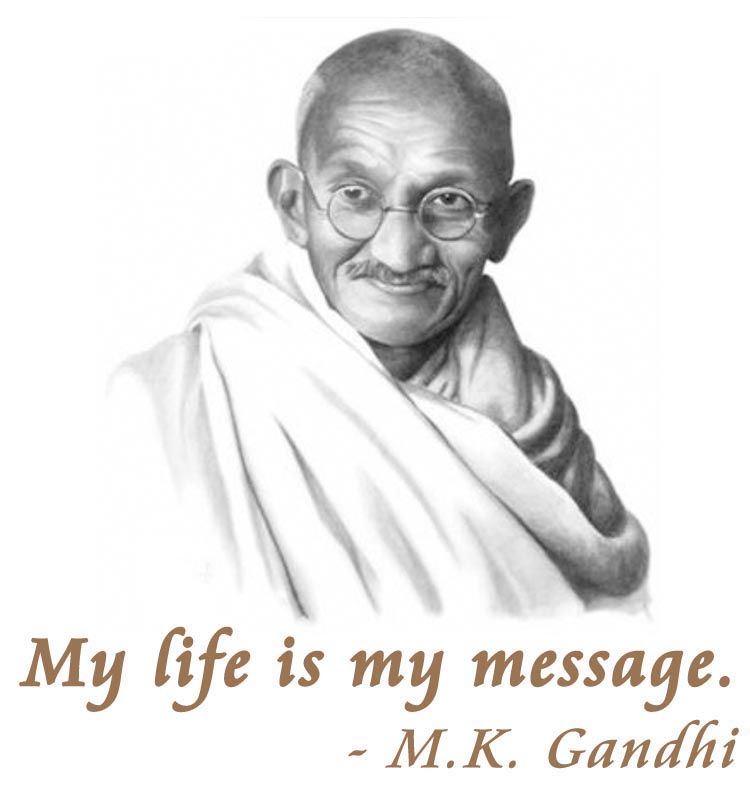
Gandhi and Women Empowerment |
- By Dr. Shubhangi Rathi*Abstract:The status of women in India has been subject to many great changes over the past few millennia. From equal status with men in ancient times, through the low points of the medieval period, to the promotion of equal rights by many reformers. One of them is Mahatma Gandhi. The history of women in India has been eventful. In modern India, women have adorned high offices in India including that of the President, Prime minister, Speaker of the Lok Sabha, Leader of Opposition etc. The current President of India is a woman. In fact its credit goes to Mahatma Gandhi. In India he was involved women in Political movement first time of Satyagrah. He worked not only for the political emancipation of the nation, but for liberation of all the suppressed and oppressed sections of society. One of the notes worthy results of his life-work has been the awakening of women. This made them shed their deep-rooted sense of inferiority and rises to dignity and self- esteem. Women, urban and rural, educated and uneducated, Indian and foreign, were attracted to his ideas and deeds. An attempt is made in the present paper to understand Gandhi's views on women in the context of social, economic and political issues. In this paper discuss on Gandhiji's thought on women upliftment, against child marriage, social and religious barriers to widow remarriage, purdha system, dowry system, heavy expenditure in connection to marriage, etc. As well as discuss on Gandhiji's view of women participation in politics. After Gandhi which position of women in India also focus in this paper. The status of women in India has been subject to many great changes over the past few millennia. From equal status with men in ancient times through the low points of the medieval period, to the promotion of equal rights by many reformers, the history of women in India has been eventful. In modern India, women have adorned high offices in India including that of the President, Prime minister, Speaker of the Lok Sabha, Leader of Opposition, etc. The current President of India is a woman. In fact its credit goes to Mahatma Gandhi. In India he was involved women in Political movement like Satyagraha. An attempt is made in the present paper to understand Gandhi's views on women in the context of social, economic and political issues. But Main focus on Political issue. Gandhiji's view on Women Liberty:Gandhi worked not only for the political emancipation of the nation, but for liberation of all the suppressed and oppressed sections of society. One of the note worthy results of his life-work has been the awakening of women, which made them shed their deep-rooted sense of inferiority and rise to dignity and self- esteem. For Gandhi, "When woman, whom we all call abala becomes sabala, all those who are helpless will become powerful". The welfare of the weaker sections of society was dear to his heart. He had no qualms about the priority of social over political ends. In his opinion, to postpone social reform till after the attainment of Swaraj. Gandhiji's Influence on Women:Women, urban and rural, educated and uneducated, Indian and foreign, were attracted to his ideas and deeds. While some like Sarojini Naidu, Lakshmi Menon, Sushila Nayyar and Rajkumari Amrit Kaur rose to prominence, there were thousands of unsung and unnoticed heroines of India who learnt the meaning of liberation from him and contributed with all their energy to the struggle for independence. Life sketches and reminiscences of women freedom-fighters give us glimpses of their crusade against injustice and inequality. Gandhiji's view on Women upliftment:
Gandhiji's View on Participation of Women in Politics:M.K. Gandhi is known to be one of the few people who encouraged women's active participation in the freedom struggle-marking him as a rare promoter of women's liberation. In Gandhi words, "My contribution to the great problem (of women's role in society) lies in my presenting for acceptance of truth and ahimsa in every walk of life, whether for individuals or nations. I have hugged the hope that in this, woman will be the unquestioned leader and, having thus found her place in human evolution, will shed her inferiority complex. Women's entry into national politics through non-violent methods brought miraculous results. On the one hand, women became aware of their inner strength, and on the other, the process brought human and moral elements into politics. Gandhi had tremendous faith in women's inherent capacity for non-violence. And his experience of participation by women in politics from his days in South Africa till the end of his life bears testimony to the fact that they never failed his expectations. With Gandhi's inspiration, they took the struggle right into their homes and raised it to a moral level. Women organized public meetings, sold Khadi and prescribed literature, started picketing shops of liquor and foreign goods, prepared contraband salt, and came forward to face all sorts of atrocities, including inhuman treatment by police officers and imprisonment. They came forward to give all that they had - their wealth and strength, their jewellery and belongings, their skills and labour-all with sacrifices for this unusual and unprecedented struggle. Gandhi's call to women to involve themselves in the freedom struggle had far-reaching results in changing their outlook. "The cause of Swaraj swept all taboos and old customs before it". Many women in their individual lives shed their age-old prejudices against the caste system. They had no hesitation in leaving the boundaries of their protected homes and going to the jail. They even broke their glass bangles (a sign of ill omen for married women) when they were told that they were made of Czechoslovakian glass. Women's participation in the freedom struggle feminized nationalism and the nationalist struggle helped them to liberate from age-old traditions. Though Gandhi never challenged the traditional set up, he inspired women to carve out their own destinies within it, and thereby changing its very essence. Women learnt from Gandhi that one can be strong, even if seemingly weak, to protest against injustice. They realised that they do not have to accept the norms of male-dominated politics. They evolved their own perspectives and formulated their own methods. In a way they presented a critique of the colonial unethical state. Gandhi could see woman as connected with service and not with power. When a woman wrote to him in 1946 about the political scene and the paucity of women in it, he wrote: "So long as considerations of caste and community continue to weigh with us and rule our choice, women will be well-advised to remain aloof and thereby build up their prestige. Women workers should enroll women as voters, impart or have imparted to them practical education, teach them to think independently, release them from the chains of caste that bind them so as to bring about a change in them which will compel men to realise women's strength and capacity for sacrifice and give her places of honour. If they will do this, they will purify the present unclear atmosphere." His advice to women was to teach people in villages simple lessons of hygiene and sanitation. Seeking power would be, for them, "reversion of barbarity". And still Gandhi believed that, "Women must have votes and an equal status. But the problem does not end there. It only commences at the point where women begin to affect the political deliberations of the nation." Present Position of Women in India:
Conclusion:Lastly we can conclude that the position of woman in India compared to other countries is poor. In some villages they are considering woman as a kitchen bee. This type of attitude has to be changed. But compared to the early days, these days' women are coming out freely and participating in every field. It's a good sign of women upliftment & empowerment. So, today also need to know Gandhijian thought of women upliftment. Footnotes:
References:
* H.O.D. Political Science, Smt. P. K. Kotecha Mahila Mahavidyalaya (College), Bhusawal, Maharashtra, India. Email: rathi.shubha19@gmail.com |