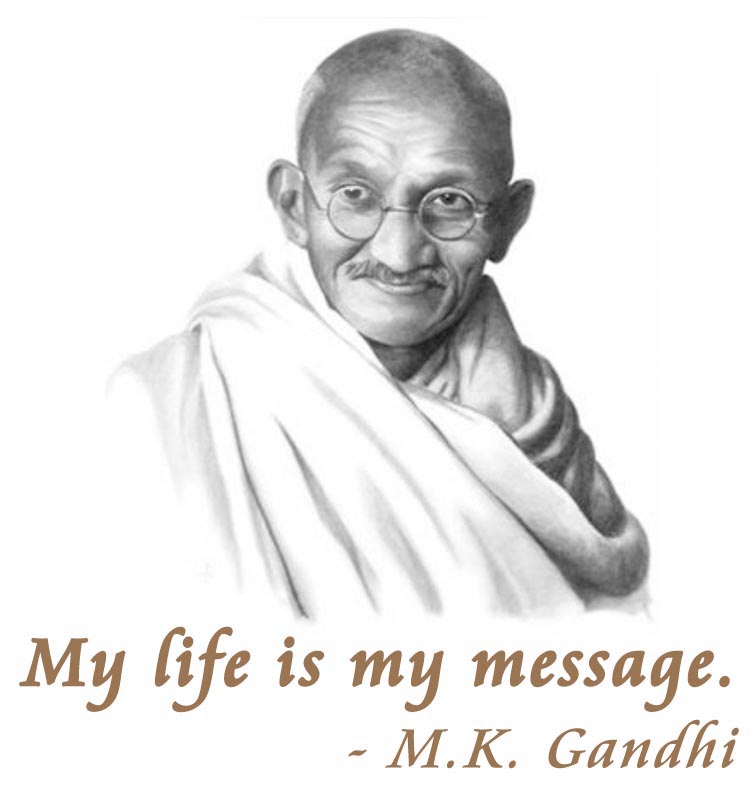
Timeless AppealA Simple Man from India Continues to Influence the World |
- By Lord Meghnad Desai*  What is it about Gandhi that still fascinates the world? Sixty-three years after his death, books still pour out at regular intervals exploring his life and personality. People are supposed to be shocked by revelations about his life. But as always we find that there is nothing any one can expose about Gandhi which he has not already put down in writing with brutal honesty. In terms of frankness about private life, Mahatma Gandhi breached the outer limits of possibility. Yet if the President of the United States, Barack Obama, wants him as his dinner guest—hoping of course that that is not one of Gandhi's fast days or worse yet one of his silent days, then Gandhiji must have 21st century appeal. He was chosen as one of the three most influential persons by TIME magazine on its 20th century issue along with former President of the United States, Franklin D. Roosevelt, and physicist Albert Einstein. He must have something timeless in his appeal. Of course what makes Gandhi perpetually relevant is his ability to make people fearless in the presence of superior force. Most importantly, he did this for men and women equally thus removing the very idea that bravery or fearlessness were intrinsically male endowments. He was the first major political leader to treat women equally as men. He was a pioneer of the Gender Revolution. In Tahrir Square or in Tunis, the people who defied the Army were Gandhi's students. We also saw for the first time women coming out with men practising the Gandhian methods of struggle. The greatest thing he did was to make people fearless against the forces of power and authority. He taught ordinary people not to fear armed adversaries. This lesson has been learnt in Tahrir Square and in Tunis; it is still being used in Bahrain and Yemen and even during the bloody confrontations in Syria. Gandhi armed the unarmed masses with courage. It does not matter whether the oppressed are larger in number than their oppressors or whether they are different people. The poor and oppressed are always many and their oppressors are always few. It was this lesson that Martin Luther King Jr. absorbed from his study of Gandhi's works and deeds. In this context, the African-Americans were a minority in the USA. Faced not so much with alien power but fellow Americans in whose presence the Black people felt deprived and alien, he used his Christian faith and Gandhian techniques of unarmed and peaceful struggle to shame those who wielded power and overstepped human limits. I well recall those summers in the early 1960s, while I was in America as a student on the East Coast and a recent graduate working on the West Coast, how patiently the civil rights marchers faced the highway patrols and the National Guard arraigned against them. It was when the adversary saw their wish to resist change they inflicted damage and often that damage was on their own neighbours and fellow citizens. This was what shamed them. Satyagraha—the insistence on truth—works by revealing to the oppressor the truth of his situation which is exposed by the non-resistance of the oppressed. It was this demonstration which so moved Lyndon B. Johnson, a Texas Senator, who became President after John Kennedy's death, that he had to give up his past prejudices and join hands with the Civil Rights Movement to bring justice to the Black people. If Barrack Obama is President of USA today it is because a Texas-born President was moved to say on national television, "we shall overcome". The anti-apartheid movement in South Africa was never fully non-violent but when the final settlement came it was Nelson Mandela's long reflections in Robben Island which brought him to the path of peaceful reconciliation for constructing post-apartheid South Africa. The armed struggle that the African National Congress (ANC) had waged had its own limits against a powerful white minority bolstered by the exigencies of the Cold War. But again when the end came, it was the world outside South Africa which joined in many forms of boycott and peaceful demonstrations against the South African regime—the peaceful force of the many round the world which turned the tide. By the 1980s, the Civil Rights Movement in America had resulted in a powerful, tough small presence of Black legislators which compelled the US Congress to initiate peaceful action against apartheid. Thus Mandela benefited from Gandhi via Martin Luther King Jr. and ANC's struggle became a global peaceful struggle against apartheid. That said, there are many other aspects of Gandhi's philosophy and lifestyle which has widespread appeal to particular groups of people. His wish to be frugal in his demands on the natural ecosystem, in his food and clothing and other aspects of daily life has attracted much admiration. He has become a hero for the Green Movement. There are those who are persuaded by his vegetarianism either for reasons of avoiding harm to animals or just for health reasons. Gandhi is a lifestyle statement for many today. A man born in the middle of the 19th century, at the height of the Victorian era, still has relevance a century-and-a-half later. The secret has to be his simple and transparent humanity. Gandhi is every person who has ever suffered and fought back, who has needed courage and found it within himself or herself. He is a man for all times. Source: India Perspectives, October 2011, originally published in Bhavan Australia, August 2012. * Lord Meghnad Desai, is Emeritus Professor of Economics at the London School of Economics. |