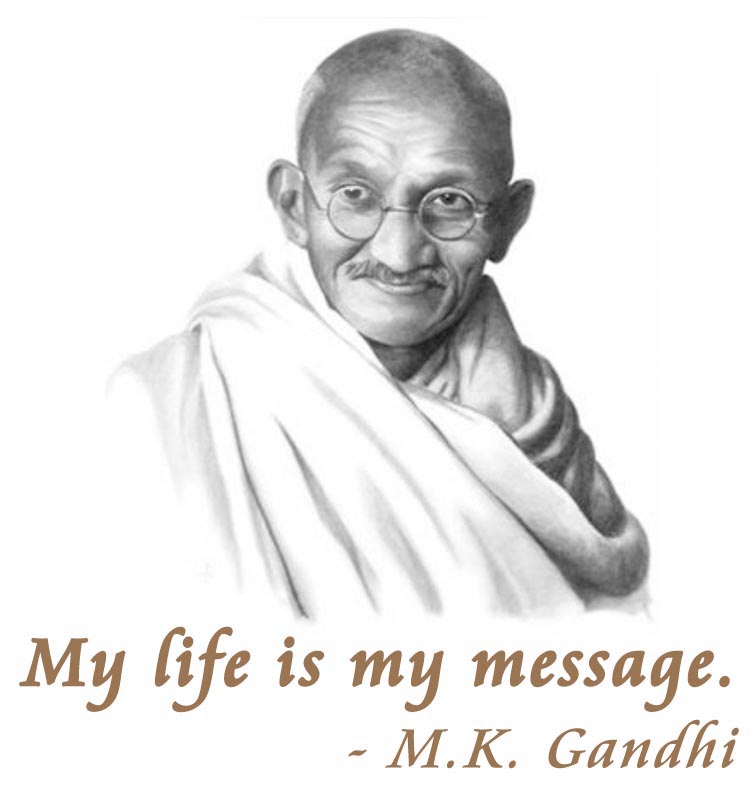
Mahatma Gandhi and Today's Mass Movement |
- By Dr. Shubhangi Rathi* Introduction:One of the greatest men in the history of India is Mahatma Gandhi. The way he gave shape and character to India's freedom struggle is worthy of a standing ovation. He sacrificed his own life for the sake of his country. The respect that he earned for himself despite leading a simple lifestyle is much appreciable. Mahatma Gandhi played a pivotal role in the freedom struggle of India. His non violent ways and peaceful methods were the foundation for gaining independence from the British. After Independence, in democratic India, people can either petition the government for redress of grievances or stand for elections themselves. Today in India, whether we want to start a car factory or simply get our car registered we have to pay a bribe to any of post persons. Bribery has become a syndicated business, in every government department as well as in the private sector - it has become part of the system. All of us have at some point of time paid bribes to get driver's licenses, passports, birth, marriage and death certificates, building approval, property deeds, gas connections, school entry, pensions and even medical treatment. Just as fuel is needed to start the engine of a car, in India, a bribe is the fuel to get work done. As Indians have become more affluent, some citizens are quite willing - and able - to pay bribes to get transactions done quickly. We're not scared of offering bribes and people don't hesitate before taking them. Some people don't want to wait. They pay 'speed money' to get things done fast. No wonder, global anti-graft body Transparency International ranks India 87th on its corruption perception index, which orders the cleanest countries first. One of the leading analyst and participant in social movements in India, Sanajay Sangvi, identified the major agendas of them as "Movements of landless, unorganised labour in rural and urban areas, adivasis, dalits, displaced people, peasants, urban poor, small entrepreneurs and unemployed youth took up the issues of livelihood, opportunities, dignity and development." Most well known movements in the country are Chipko movement, Save Silent Valley, Narmada Bachao Andolan, Koel Karo, Chhattisgarh Mukti Morcha, Jhola Aandolan . These movements largely distanced themselves from political parties, or tried to cut across the ideologies of the political parties. Yet many of them rooted themselves or drew from ideologies of the Mahatma Gandhi, various shades environmentalisms or gender politics, or socialism. Aims & Objectives of Research:
Research Methodology :For this research paper primary & secondary data is used. Gandhian mass movement information was collected from Gandhian literature. Present mass movement in India’s information is collected from secondary data. Descriptive & Analytic methods were used for such research paper. Nature & Scope of Research:In this research paper I only discussed on concept of mass movement. Before Independence Mahatma Gandhi used such mass movement activities to free India from British Rule. After Independent such type of Instrument were used by various person e.g. Jai Prakash Narayan, Anna Hazare, Baba Ramdev. We know that Anna Hazare, Baba Ramdev used this instrument against corruption. Mahatma Gandhi and Mass Movement:Satyagraha, The Rowlatt Act, Non-Cooperation Movement, Dandi March, Quit India Movement, Social Movements After Independence areStarted by Mahatma Gandhi for Independence of India as per the need of the society. He successfully organized mass movement on the following incidence & got aim of Independence of India. After arriving in India, Mahatma Gandhi successfully organized Satyagraha movements in various places. The effects of Non Cooperation on the economic front were more dramatic -
Impact of these mass movements the import of foreign cloth halved between 1921 and 1922. It’s value war dropping dramatically. Production of Indian goods went up. Change the System:We as individuals are as much responsible for corruption as those who perpetrate it. All Indians on an individual basis need to show strength of character on this issue. We just need to be firm in our own decision. We just have to pledge OURSELVES not to pay bribe to anyone, whatever situations may come. That will be a real movement. The real strength in this line of action is patience and wait and more patience. Secondly, we need a strong anti-corruption law. The anti-corruption law should be raised in a parliamentary and democratic way. The common man need to exercise their voting rights with utmost caution. Criminals, looters, thugs, cheaters, fraudsters, liars, scams, etc. should be voted out. People have a right to live in a cleaner and less corrupt system. They tried getting the existing government to put in place effective anti-corruption measures by petitioning the government - which the government ignored. Government cannot be expected to solve every problem - but we expect each administration to take one or two tough problems and solve those. That is what these people are doing by focusing on a few important big issues for that country. Seems like the way to govern an upcoming nation. It’s great to see a thriving democracy take care of the problems it faces while staying free in a world where too often dictators and despots thrive in such situations. A large section of the people’s representatives and some of the regulators are so steeped in corruption that we urgently need a strong, independent, effective Lokpal that can investigate and punish speedily. The Jan Lokpal proposed by Team Anna Hazare meets these requirements. Corruption may not vanish, but at least it will become a very risky business. Conclusion:Lastly we can conclude that aim of Mahatma Gandhi of mass Movement was freedom of India. For achieving this good aim all Indian people should support him. So Mahatma Gandhi was successives in this mass movement programme. But present situation is very different. Various Political issues & different views of Indian people do not support to such type of mass movement which is necessary for cleaner and less corrupt system. It has been a great movement by the population, but I do have a concern here. The people got a chance to express their frustration towards the rulers of this nation. It is always easy to criticize and throw stones at others. All these people gathered on the street over the last few days show same commitment towards demonstrating good civil sense in their day to day life. If we all start becoming responsible citizens, the corruption will not have place in the society. Today stress on the need to launch a mass movement for Good Governance on the lines of Self-Rule once launched before independence by freedom fighters. India attained self governance but not good governance. Mass movements can be a solution to solve many problems in the society. Just as Mahatma Gandhi led the freedom struggle, there is need to launch a mass movement for development of better Society and stronger nation. References:
* Associate Professor & Head of Dept. of Political Science, Smt. P. K. Kotecha Mahila Mahavidhalaya, Bhusawal. |