Khadi and Village Industries - The Only Solution |
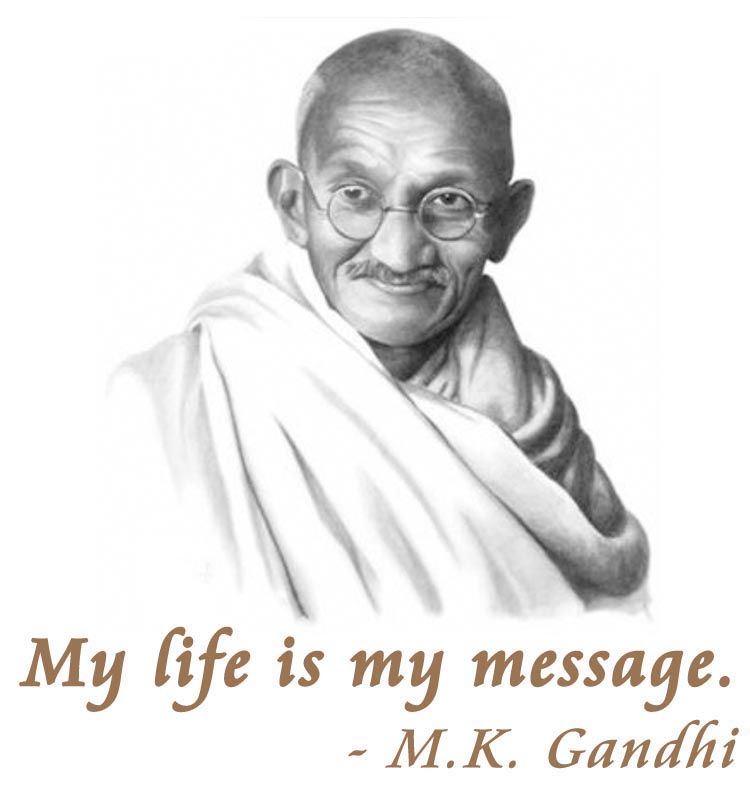
- By T. Krishna MurthyAny concept associated with Gandhiji should necessarily be a derivative of truth and non-violence. For this Indian rural economy is not an exception. For Gandhiji "Truth and Ahimsa must incarnate in socialism. That economics is untrue which ignores or disregards moral values." Violence is an offshoot of exploitation is it political, social or economic. All wars between countries are fought for economic reasons directly or indirectly. The recent gulf war is an example. Similarly, lot of killings takes place due to social or inequalities and exploitation. The ever widening gulf between the have and have-nots is the root cause, leading to misery and "When the cup of misery fills it overflow is the form of revolution". Hence, an economic order free from the bane of exploitation is a prerequisite for a nonviolent peaceful society. The Alternatives: Then, how to build an economic system which does not give room for exploitation of one by the other? We have seen that it is the unbridled play of profit motive of the privileged classes that leads to exploitation is of the under privileged. Such a situation exists in a capitalistic economy where the individual's profit motive is allowed a free play and he is given every opportunity to exploit all situations to his gain even to the extent of injuring the very society he lives in. In trying to stem this rot, the communistic ideology swings the pendulum to the other end by curbing the profit motive of the individual to such an extent that the person loses his individuality and initiative altogether and becomes yet another cogwheel in the machine. We have seen this system also crumble. The vey 'proletariat' for whose benefit the communist philosophy was supposed to have taken birth, rose in revolt against it, because the individual, his aspiration and values were lost sight of. For Gandhiji "No society can be built on a denial of individual freedom." Gandhiji suggested the third alternative, the 'Sarvodaya' social order, which believes "that every individual has a personality which when properly developed, has a contribution to make to society." In the economic field "decentralized commodity production ensures the producer the product of his labour." Where the producer is ensured of the fruits of his labour, there is no exploitation and there is no violence. Mass production or production by masses: Mere production does not contribute to rise in the standard of consumption, which is supposed to indicate the standard of living. What is produced has to be consumed and for consuming, the people require the purchasing power. Purchasing power cannot be distributed either as doles or by emergency programmers like laying roads or building dams. The only effective means of distributing purchasing power is to provide productive employment to all people universally. If the stress is on mass production and not on production by the masses and for the masses there won't be consumption and in its absence there con not be further production. If the economy has to be healthy the chain of "production-consumption-production" should remain unbroken. Consumption us said to be the mother or production. Students of economies read about the "Great Depression of 1930" its cause, effects and cure. Our production pattern should have a built-in system of providing universal employment side be side with production so that larger number of people gets the purchasing power to purchase what is produced. The only alternative that answers this requirement is the labour intensive decentralized production. 2. Chakravarthi Rajagopalachari also said the same thing in different words. "You can not distribute wealth after producing it. You won't succeed in getting neb to agree to it. But you can produce wealth so as to secure equitable distribution before producing it" 3. Gandhiji conceived Khadi Programme as a key to solve the economic problems of the country. According to him " Its'one great merit is that it solves, as nothing else cab, the economic problem of Indian and removes starvation" (collected works of Mahatma Gandhi, Volume 23:45859). In the year 1925 he wrote in Young India "If we want the millions to earn a few paises by doing honest and honorable work, the only possible instrument to present them with, in our country, is the gentle and graceful spinning wheel." By advocating spinning wheel, one should not think that Gandhiji was against machines. But he asserted and said "that to produce cloth, which is our basic need, in mills is an economic blunder of the first magnitude just as it would be to supply cheap bread through huge bakeries established in big cities and to destroy the family stove." He also associated Khadi with his unique concepts of peace, non-violence, trust and self sufficiency. With the all pervading inspiration given by Gandhiji, Khadi not only prospered but also became the livery of Freedom Movement, in spite of the stiff opposition from the alien government. 4. After we attained freedom the Union Government of free India, continued the legacy of the freedom movement and gave support of the Khadi programme . A statutory Khadi and village Industries Commission was constituted at the All India Level, and State Khadi and Village Industries Boards sprang up in each state. As a result of this all round support, the Khadi sector could make enormous contribution to the nation's economy in terms of production and employment. The annual production of Khadi has touched Rs. 350 Crores, thereby providing employment to 13.87 lakhs of rural people. Considering the useful contribution the Khadi Sector is making to the country's economy, particularly in the field of rural employment, the Government of India thought it fit to ensure its continuation even by subsiding its product. The selling price of Khadi is slightly higher than that of mill made cloth because it is handspun and hand woven. The wage component in the Khadi cloth is higher than in the mill cloth. To ensure that Khadi is sold even though its price is higher and at the same time to see that the buyer is not penalized on account of this, the Government offered what we know as 'Rebate'. This rebate actually goes to the buyer and not to the producing institutions. In fact the Khadi institution are actually the losers because they allow rebate to the buyers and wait for years to get it reimbursed by the Government. Waning InterestsOf late, the Government of India appears to be losing interest in the development of Khadi Sector. This is perhaps in tune with the policy of Liberalization, Globalization and Free Market Economy. The same Government, which a few decades back, considered assistance to Khadi a Justifiable necessity because of its useful contribution to the economy and its inability to withstand the competition with mill sector. The Government conveniently forgets of Khadi that it is had spun and hand woven which makes it costly is an asset to the society in as much as it results in providing employment to millions of rural people, particularly women. Some people question about the economic viability of Khadi. If what is meant by the question is whether Khadi can compete in price with the mill cloth, the answer is an emphatic 'no'. But, this negative answer applies to everything produced by man power applies to everything produced by man power as against the articles produced by labour machinery. Even goods manufactured in factories in India like cloth, iron, sugar etc. required state aid in some form or the other. Such being the case to expect Khadi to stand on its own legs is to ignore its basic character and useful contribution to Indian economy. Khadi sector employs 20 spinners, mostly woman, to produce the same quantity of yarn which is produced by a single power operated spindle. A PittanceThe extent of support the Khadi sector gets from the Government is a pittance compared to what other Government enterprises and Multi-national companies get in the normal course. Take for instance Maruthi Udyog. To quote Sri Murusoli Maran, Union Minister for industries "Though the Government's contribution to Maruthi Udyog's equity is half of the Rs.133 corers, the public exchequer have already spent hundreds of corers by way of excise concessions, customs duty relief and sales tax waivers. It has become a monopoly company, a champion because of state." Suzuki of Japan has already repatriated Rs. 988.87 corers as profit over the past 12 years. In this background let us examine the downward trend in the Government's assistance to Khadi sector. In the past the working fund given to khadi programme was interest free. Now 4.5% interest is being charged on Khadi. Earlier the Government used to give loans from plan provision. Now plan provision has depleted and the Khadi sevtor is financed by the consortium of banks (CBC), which expects working fund to be repaid in installments, along with interest. This is something, which Khadi sector cannot withstand because of provision in the cost chart. Of late, for even the capital expenditure loan for buying charkhas and looms the institutions are directed to go to banks under Margin Money Scheme. Drawing funds from commercial banks is not that easy. Evan rebate is being given reluctantly and it may stop any time. Khadi is not mere cloth. It is a process of socio-economic reconstruction of our society. It is linked with the welfare of millions of our rural poor. As long as the government continues to proclaim that its objective is the welfare of the people, it has to continue its support to khadi Programme. Taking the contribution of khadi to the task of employment generation into consideration, Government has to considerate it as a priority sector and do all that is required to keep it healthy. If any one thinks that government is doing a favour to the Khadi Sector, by extending assistance to it, he is completely mistaken. Khadi contributes to the welfare of the people and therefore it is the people's right to expect support from the Governments. Yes, Khadi sector can forego the governments assistance, if Government's of certain varieties of cloth is reserved for this Khadi sector. Further, about 50%of the cloth required by Government departments like Hospitals & Jails may be purchased form Khadi sector. If these positive steps are taken by the Government, them Khadi sector can become self-supporting. But the chances of Government taking such positive action are bleak. The Khadi Sector is at cross roads today. It is facing a severe challenge. There is immense scope for expansion. But it is unable to do so for want of support. Even its existence is at stake. There are two options before the Khadi sector. 1. To fight with the Government for getting its legitimate assistance in a democratic and nonviolent way. This is legitimate cause; the programme is in the interest of the country's economy. We have a democratic Government and it is its duty to do what is good for the people, particularly the rural masses. But, such a step needs support of the people. We should do all that is required to people's support. Can we do it is the question. 2. To carry on Khadi programme as at present, that is, on a commercial basis which means production for sale, Government's support is essential. While we continue our efforts to secure Governments support, we should at the same tine try to develop Khadi on individual self sufficiency basic that is "Swawalambi Khadi." Even today there are people, who spin at home and get their yarn woven for their use. There is other who spin and get their yarn exchanged for cloth in the Khadi Bhandars. Number of such Swavalanbi Khadi wearers should be made to multiply. 3. Thus, instead of limiting our activity to commercial Khadi as at present we should concentrate more and more on Swavlavmbi Khadi. That means we will continue commercial Khadi to the extent possible, with or without Government support, and supplement it with Swavalambi Khadi. Whither are we going?But, are we going in the path shown by Gandhi ji is the question that each one of us should pose our self. No, we are not going in the path shown by Gandhi ji. It may not be wrong to say that we are going in the opposite direction. The path we are adopting for bringing about development in our country shows that we have ignored the fundamental truth that the bulk of our population live in rural India. That is why Dr. J. C. Kumarappa wrote "The trend of events seems to be such that we shall end by hanging ourselves with scientific ropes". Globalization & Liberalization:The new concepts of Globalization and Privatization being advocated by the World Trade Organization (WTO) are not at all be beneficial to India and to the other underdeveloped and the developing countries. By opening up the developing countries. By opening up the markets of the poor countries for the consumer products produced by the rich countries which are cheaper because of the heavy subsidies and tax concessions, the WTO is only helping the rich countries. Further all sorts of restrictions are imposed for products of poor countries to reach the countries. The policies adopted by the WTO which is dominated by the countries like the USA and the Western Union Countries, are helping the rich countries to exploit the underdeveloped and the developing countries. Consumer Culture:These are new concepts of Globalization. Liberalization and privation are further spoiling the people by spreading the consumer culture. Man is getting ready to do anything to meet his consumer needs. One should not forget that the world has enough to meet every man's need but not for any man's greed. Further, the rich nations by adopting industrialization without any control or restrictions are only pollution the mother earth's environment by carbon dioxide emission. This unhealthy trend was discussed with all seriousness in the earth summit held at Rio-de-Jenero. But the summit could mot bring about any solution particularly because of non-cooperation by the developed countries. The General Secretary of this Earth summit Mr. Mourice Stong was so disappointed with the outcome that he said "we have been the most successful species ever; we are now a species out of control. Our very success is leading us into a dangerous future." If we continue to develop this consumer culture, the result will be, as some one has warned "Everyman for himself and the devil takes the hind most." Growth in gross Domestic product (GDP) alone cannot bring Justice and establish a peaceful society. What India needs is Distributive Justice and environmental protection. Decentralized economic development is the only means for achieving this. Centralization and exploitation are the two sides of the same coin. Exploitation of one by the other leads to violence and violence disturbs peace. The living condition of the poor man living in rural India can be improved only by adopting the policy of sustainable development or in other words economics of decentralization which Mahatma Gandhi and J.C. Kummarappa advocated. For achieving this they gave us the programme of Rural Development through Khadi and Village industries. Let us realize this before it becomes too late. Source: Jay Jagat Mission Samachar, December 5, January 2006 |