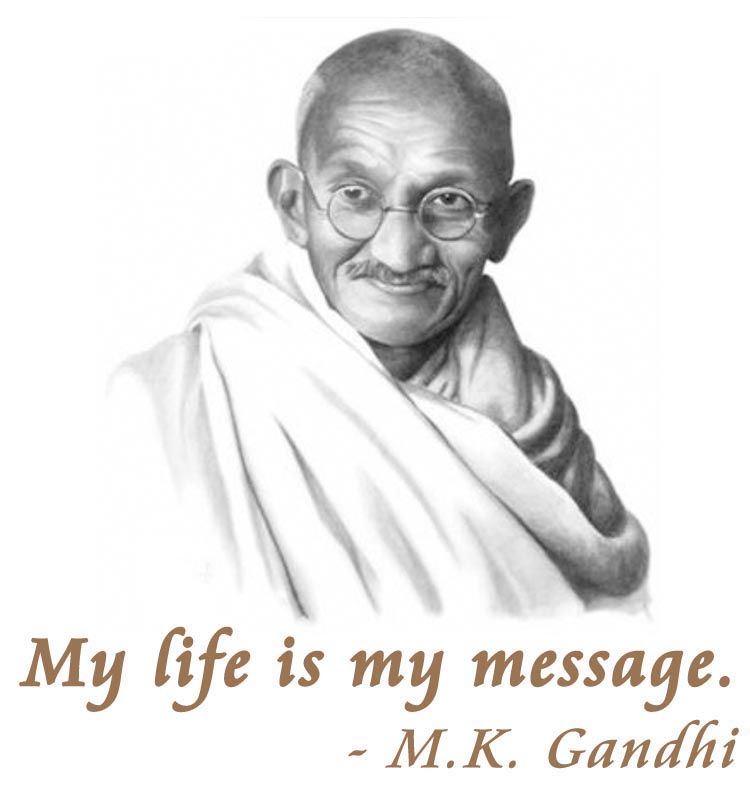
Global Peace Movement and Relevance of Gandhian view |
- By Dr. Ravindra Kumar* "Mahatma Gandhi embodied in his life certain universal principles that are inherent in the moral structure of the universe, and these principles are as inescapable as the law of gravitation." - Martin Luther King Junior Martin Luther King Junior in his above-mentioned statement clearly emphasizes the following about Mahatma Gandhi: One, Gandhi's life was brimming with certain universal principles or values; secondly, the impossibility to escape from the reality of universal principles or values. In other words, acceptance of these important universal principles or values cannot be denied. King Junior also highlighted that there is a moral structure for the human world and universal values identify the human world, and they are the conditions of a civilized life. In this regard my own view is that morality itself is one of the three1 fundamentals of civilization. I have explained this in length in my book entitled, The Fundamentals of Civilization. But, without deviating from the topic in hand it suffices to say that without morality there is no possibility of a civilized life. In the absence of morality, civilization is completely meaningless. Finally, morality is the true ornament of human life and as Mahatma Gandhi himself pointed out, it helps "in finding out the true path for us and in fearlessly following it." Further, placing the Mahatma in the centre of the statement by King, we may arrive at the conclusion that morality, one of the chief universal values that conditions civilized life, was among those universal principles that characterised Gandhi' life. And, it is true. Gandhi's life was imbued with morality. It was the basis of his ideas, activities and works. He stressed on this aspect urging humanity to adopt it "consciously and as a matter of duty."3 More particularly, the supreme human value Ahimsa [non-violence], of which morality itself is one of the supplementary values or one which absolutely stays within its domain, was the nucleus in the life and works of the Mahatma. In this context the words of Mahatma Gandhi that "I will not sacrifice Truth and Ahimsa even for the deliverance of my country or religion"4, are sufficient to exemplify this fact. Ahimsa, an essential condition of existence, development and achievement of the life's goal, was the core of all of Gandhi's activities. Perhaps for the first time in the entire human history Mahatma Gandhi applied non-violence in its refined form and as per the demand of time and space in the political sphere. He adopted Ahimsa as a means to achieve unprecedented success. He established with certainty that on the strength of non-violence, evils like exploitation, inequality and slavery could be eliminated. All kinds of estrangements, disputes, conflicts, hostilities and struggles could be settled amicably whereby conflict and disagreement could be transformed into a state of harmony and peace. That is why; a great man like Martin Luther King Junior spoke about the Mahatma the way he did. Gandhism [amalgamation of Ahimsa-based ideas and practices of Mahatma Gandhi] essentially and inevitably became in one way or the other, the centre of every movement launched by him and his colleagues for achieving equality and freedom. Many others like Martin Luther King Junior followed Ahimsa with the purpose of establishing peace and justice. IIMy emphasis on the subject could easily bring up the question why Gandhism is necessary today.To deliver a satisfactory answer I think it would be appropriate to discuss first why we need to launch movements for peace? More particularly, why peace-movements are necessary internationally in these days when the world is fast converting into a global village? In fact, peace is an active and dynamic state in which one gets the opportunity to move forward towards development without confusion, fear or worry. On the other hand conflicts, disputes, dissensions, fights or struggles are illustrative of the absence of peace. Undoubtedly, harmony, cooperation and love emerge as chief characteristics of the state of peace. Despite several negative human tendencies, efforts for progress are desired by all since advancement at all levels and in all walks of life is a prime necessity of human life. In other words, it is a part and parcel of human endeavours.Hence, through the ages man has made constant efforts to gain peace either by individual or by collective means. This state remains intact today and will be so in the times to come. Before proceeding further one more thing should be clarified. Peace is a dynamic state and not a situation of the status quo. Furthermore, it has nothing to do with inactiveness. In a state of peace, man accepting the reality of Vasudhaiv Kutumbakam5, and freeing himself from the state of confusion, fear, tension, conflict, struggle or war, through harmony and cooperation of others in society continuously work to ensure welfare of humanity. Peace is also the best means to progress.6 Hence, it can be asserted that through the ages efforts for peace have been made individually or collectively and for this the method of non-cooperation has also been adopted from time-to-time.7 Today, because of the unprecedented scale of globalization, the importance and the need for such an effort multiplies many folds, more than in the past. Now, let us talk about the subject in hand, i. e. peace and Gandhian view, in particular the adaptability, importance and significance of Gandhian view and vision of the establishment of peace globally! As we know, the Gandhian view in general pertains to the welfare of the human world. Moreover, Mahatma Gandhi carried out his practices accordingly. Whatever he preached he practiced them to clearly illustrate to the world that his life itself was his message. Therefore, it is necessary to take his ideas and practices together while discussing or analyzing his views. We can categorically say that Gandhian approach or view can be comprehended in real sense only if his ideas and practices are both put together in perspective. Firstly, the basis or the centre of Gandhian view is Ahimsa [non-violence] as the highest human value. Ahimsa is a natural and eternal value. Besides being the essential condition for the existence Ahimsa is the means of development and achieving the goal of life. All high human values, including morality, at the centre of this discussion, originate from Ahimsa. Furthermore, Ahimsa itself is also the protector of all human values and the basis of ethics. Therefore, thousands of years ago, Ahimsa was declared as the Parmodharma8 by the Vedic-Hindu philosophy and it was also accepted as the Parmabrahaman9 by Jainism. Hence, Ahimsa is interpreted as the basis of the supreme moral law. It is the foundation of universal principles and also its leading force. It is an eternal law or the rule. To repeat, Ahimsa is the essential condition for existence and continuity. This fact is emphasized by Martin Luther King Junior who underlined the non-violent philosophy of the Mahatma many a time. For example he said, "I found in the non-violent resistance philosophy of Gandhi... the only morally and practically sound method open to oppressed people in their struggle for freedom."10 Secondly, Gandhian view admits the reality of differences, disputes, conflicts and struggles, and their impact on various walks of human life.11 It accepts cooperation and struggle both as the necessities of society.12 But, at the same time it is determined to settle or resolve all states of violence by adopting Ahimsain its refined form as per the demand of time and space. Thus, admitting the reality of the law of change Gandhism calls for resolution and solution of each and every struggle and dispute through the value of Ahimsa. In comparison to other available methods of conflict resolution Gandhism has a certain distinct and striking sense of justice. That is why; for almost a century the people of the world have looked at this method with high hopes and expectations. Not only this, some of the non-violent actions launched per the Gandhian way in different parts of the world achieved unprecedented successes. The actions launched by Afro-Americans under the leadership of Martin Luther King Junior himself in the United States of America could be well counted in this very perspective. The attraction and curiosity of people all over the world towards the distinctive Gandhian view seems to increase day-by-day to revitalize high hopes in the hearts of people more than in the past. With on-going globalization, the genesis of new problems, disputes and conflicts seems inevitable. That is why; the Gandhian view in resolving these problems emerges as one of the best and noble alternatives available to the world. It can show the people the pathway to prosperity and peace opening the doors to both prosperity and peace through mass awakening, cooperation and participation of people. This is the uniqueness of the Gandhian view. For, Martin Luther King Junior [quoting him again] went to the extent of observing the personality of the Mahatma in the sixth decade of the last century: "Gandhi was probably the first person in history to lift the love ethic of Jesus above mere interaction between individuals to a powerful and effective social force..."13 IIIIn the current perspective, when globalization is on rise day-by-day, Gandhian view fully imbued by Ahimsa, has special significance for those working for peace at the global level. It is because Gandhian view accepts all the spheres of human life as the essential parts of an 'Indivisible Whole'. To quote the Mahatma himself, "You cannot divide life, social, economic, political and purely religious, into watertight compartments."14 Furthermore, Gandhi accepted the reality of interconnectedness of all spheres of life and discussed their essential and inevitable effect on one-another and, therefore, called for solution of conflicts, disputes, problems and struggles without any prejudice. He particularly inspired and encouraged the people to be ready to action to win justice, freedom and equality on the basis of high human values, particularly Ahimsa. He called for readiness to compromise always, but without surrendering self-respect, and by abiding to truth and morality. This reality could be well testified particularly in the two local-regional level Satyagrahas namely Champaran15 and Kheda16 [1917-8], which were carried out under the leadership of Gandhi himself and in Nagpur17 Flag Satyagraha [1923], Borsad18 Satyagraha [1924] the Bardoli19 Peasants' Struggle [1928], fought under the leadership of Vallabhbhai Patel, the Rajkot20 Satyagraha [1938-39], initiated under the leadership of both the Mahatma and the Sardar, Vaikom21 Satyagraha [1924-25], initiated under the leadership of T. K. Madhavan22, and at national level Civil Disobedience Movement [1930]23, launched by Gandhi by breaking the Salt Law.24 All of them were more or less successful. However, the Bardoli Peasants' Struggle was unique and unprecedented as it created history. All of them greatly inspired the people, not only Indians, but so many others in the world. They set a clear direction for non-violent struggles [Satyagrahas] to be launched in times to come in different parts of the world. Although an account of the series of events pertaining to these is available in the history books, there is still a need for their fair and comprehensive analysis. Along with this, a comprehensive and critical analysis of Afro-American struggles, particularly the ones that commenced in the sixth and seventh decades of the Twentieth Century25, in particular the initiatives of Martin Luther King Junior that acquainted the present generation of the impact of Gandhian view is also required. As we all know King accepted and adopted Gandhian way in the Afro-American struggles as he saw it fit, the best means among all the ways and methods available for depressed classes in their fight for equality and freedom in his own land. By doing so, the relevance and aptness of Gandhian view in the peace movements at national and global levels would become apparent to us to step forward on the pathway to peace in the Twenty-First century. References:
*Dr. Ravindra Kumar is a Former Vice Chancellor of CCS University, Meerut [India]; he is the Editor-in-Chief of Global Peace International Journal. |