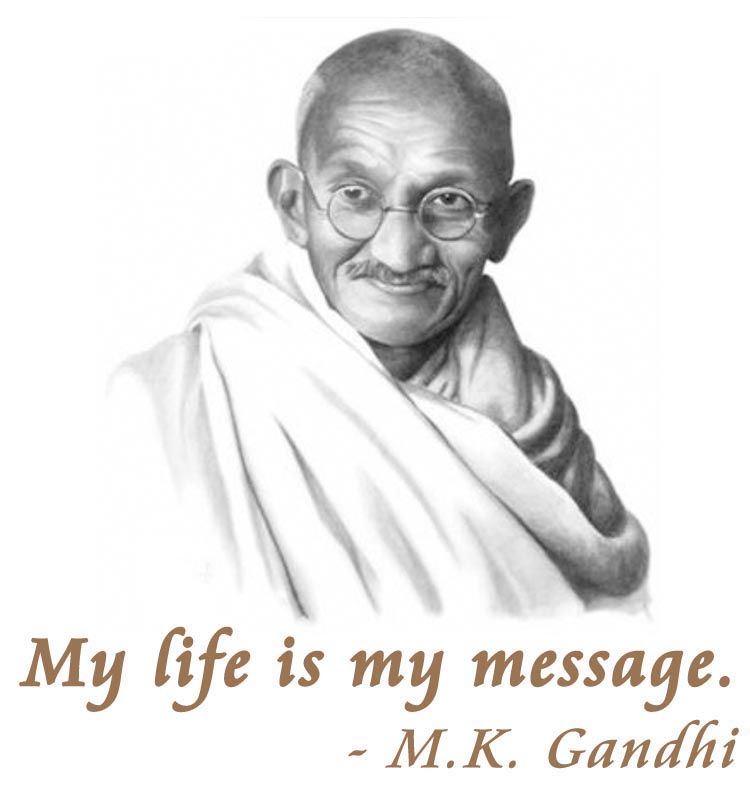
Gandhi and Contemporary Social Science |
- By Mukesh Srivastava* Who is the best interpreter? Not learned men surely. Learning there must be. But religion does not live by it. It lives in the experiences of its saints and seers, in their lives and sayings. When all the most learned commentators of the scriptures are utterly forgotten, the accumulated experience of the sages and saints will abide and be an inspiration for ages to come.1 The grim fact is that the terrorists have in absolute honesty, earnestness and with cogency used the Gita, which some of them know by heart, in defense of their doctrine and policy. Only they have no answer to my interpretation of the Gita, except to say that mine is wrong and theirs is right. Time alone will show whose is right. The Gita is not a theoretical treatise. It is a living but silent guide whose directions one has to understand by patient striving.2 Writing about Gandhi has become increasingly difficult in our times, since the sheer weight of critical scholarship on Gandhi-- some of which seeks to explore the finer and subtler aspects of his relationship with modernity, colonisation, nationalism and sexuality-- is very daunting indeed!3. In any event, however, I would venture to explore in this paper the relatively unexplored dimensions of both Gandhi the man and Gandhian discourse, through a close reading of the three key terms: Swaraj/Swadeshi/and Satyagraha which are bound together by the common and most fundamental thematic of Satya and a commitment to search for the truth. What comes out of the close reading is the realisation that both Gandhian theory and practice take us far ahead of the problematic of both modernity and nationalism, into a domain called experiential politics and/or experiential knowledge whose full range of meanings, and ethical force, we have yet to acknowledge and ascertain. Let us begin by examining two very simple statements of Gandhi made well before the political independence. He said: "We must become the change that we wish to see in the (external) world".4 This is a very loaded statement. We cannot wish it away by subjecting this statement to any kind of historicist, psychological, symbolic or discourse analysis. It remains there like a mirror before us, staring in the face of all our activist or scholarly zeal to transform the world we live in. The implications of this statement are very far reaching, but suffice it to say here that the statement exhorts us to pay attention to the primacy of the self over 'the world'; or in other words, the ethical and subjective dimension of the self over an objective and empiricist self-description, or analysis of the world. The second statement is even more startling in its cognitive and ethical depth. Gandhi wrote in The Hind Swaraj (1909) : 'The English have not taken India; we have given it to them. They are not in India because of their strength, but because we keep them.' 5 Startling indeed as it will sound to a modern and nationalist sensibility, Gandhi was absolutely sure of what he wrote in The Hind Swaraj as far back as 1909, and was unwilling to change even a single word in that very provocative historical document. Taken together, these two statements point to a very urgent need for the re-structuring of 'the self' and a radical dismantling of our cognitive, ethical and moral priorities before we may expect a meaningful transformation of the social and political world at large. The enemy, therefore, is not only lurking within us; it is indeed an intimate part of our self-definition in terms of scientific and secular progress. This 'enemy' is identified in The Hind Swaraj as 'modern Western Civilization'. It is significant to stress the qualifier 'modern' with all its affiliation and implications, suggesting thereby the initiation of a world view as well as a political process which began with the European Renaissance in the West. Gandhi's fundamental opposition and struggle, therefore, is neither with the West as such, nor with the British people and government, as was the case with several Indian Nationalists of different dispensation. Gandhi's problematic lay in fact well outside the bounds of post-enlightment apparatus of rationality and its vision of history, science, masculinity and progress which was largely internalised by cultural nationality and social reformers of the late Nineteenth century India who argued largely in favour of 'modernising' India by reviving its past glory of the Vedic ages through purification and revival of classical Sanskrit learning. 6 Gandhi emerges as a purely maverick figure on the Indian national scene who remains, quite paradoxically, outside the theoretical formulation of the modern nation-state and its vision In fact, on the contrary, he argues for the dissolution of the nation-state in favour of enlightened anarchy while still leading the national liberation movement in India to its success in 1947!. This argument can be developed further by a critical elaboration of three key terms taken from the Gandhian lexicon, namely Swadeshi, Swaraj and Satyagraha which are bound together by the common commitment to the search for truth. SwarajThe term 'Swaraj' in Gandhian lexicon straddles two different locations, the inner and the outer, beginning from the rule over oneself, to a republic of local self-government with absolutely radical form of self-regulatory and participatory democracy. For Gandhi, however, the first meaning or the inner dimension of Swaraj, that is, rule over oneself, is not only the vital component; it is a pre-requisite to the outer or institutional arrangements of Swaraj. The inner dimension lay in taking up an active and honest exploration into truth, or one's own true nature, or a mode of self-inquiry leading to the state of experiential knowledge. As Gandhi expresses it: Devotion to this truth is the sole justification for our existence. All our activities should be the very breath of our being. When once this state in the pilgrim's progress is reached all other rules of correct living will come without effort and obedience to them will be instructive... To a man who has realised this truth in its fullness, nothing else remains to be known because all knowledge is necessarily included in it ...7 Swaraj, then, can arise only with the removal of cognitive and ethical enslavement brought about by forces far deeper than mere repressive policies of the British government. In the most fundamental sense Swaraj can arise by a radical re-structuring of the constitutive elements of the self thus spontaneously and naturally leading to the restoration of a world-view as well as an epistemology founded on experiential knowledge that were not encumbered by modern western civilisation. Thus Gandhi's vision of Swaraj is pitched at a level far beyond the constitutional, social or political. He does not accept the argument that effective combinations are formed among individuals and groups sharing self-interests, and that institutions of representative democracy will ensure that the government will act in ways, which are, on the whole, in the common interest of the entire collectivity. Besides, for Gandhi, the legal fiction of equality before the law and the supposed neutrality of state institutions only have the effect of perpetuating the inequalities and divisions which already exist in society. Politics has no role in removing those inequalities or cementing the divisions. In fact, this very process of law and politics creates a 'vested interest' among politicians, state officials, and 'legal practitioners' to perpetuate social divisions, and indeed to create new ones. By contrast, it is only when politics is directly subordinated to a communal morality that the minority of exploiters in society can be isolated by the people and inequalities and divisions removed. As a political leader, therefore, 'Gandhi counterposes against the system of representative government an undivided concept of popular sovereignty, where the community is self-regulating and political power is dissolved into the collective moral will. In Gandhi's own words: 'The power to control national life through national representatives is called political power. Representatives will become unnecessary if the national life becomes so perfect as to be self-controlled. It will then be a state of enlightened anarchy in which each person will become his own ruler. He will conduct himself in such a way that his behavior will not hamper the well being of his neighbours. In an ideal state there will be no political institution and therefore no political power.'8 SwadeshiIn Gandhian deployment of the term Swadeshi we discover a deep antagonism to not only foreign goods or foreign consumer products, a phenomenon which is all too well known, but also simultaneously, a deep distrust and hence outright rejection of all foreign institutional methods of governance and politics. When Gandhi comments on modern western civilisation's violent and enslaving effect on its own people, as well as on the Indian culture, he envisions a world which is free of the inhibiting and dominating frameworks of modern governance and politics everywhere. Significantly then, Swadeshi is not a form of parochialism, or geographical landscape, as one's village. It is rather a universal state of mind and being, unencumbered by the world-view pioneered by Newtonian Science, and Lockean politics of state, where the state is neither the final arbiter between individuals or groups, nor is it the giver of any value or largesse. Seen in this light Gandhian conception of Swadeshi politics marks a radical departure from both the liberal, as well as socialist and Marxian conception of politics. More generally, we can characterise the liberal conception of politics as an activity that uses the state to advance its objectives, be it solving social problems or legislating new laws or re-designing institutions, whereas in the Gandhian conception of politics it is community based, collective and shared ethos and values that will determine the role of the state, if any. Gandhian stress on Swadeshi thus arises from a total rejection of the norms that are set up by and come through modern law, religion medicine, politics and history, all of which serve to occlude, rather than deepen, the kind of knowledge directed toward the search for Truth. Gandhi seems to have achieved this insight from a variety of traditional sources, including traditional Christianity, Syncretistic Hinduism, Jainism, popular Islam and the thought of Tolstoy and Thoreau, all of which he fused into his unique style and symbolism that deserves special attention and understanding. It is the uniquely symbolic style of Gandhian 'Swadeshi' as a form of 'cultural power' which has largely escaped attention from contemporary social sciences, based as they are on tools of analysis that are themselves derived, in one way or another, from the classical natural sciences and their accompanying varieties of logic. Indeed one might as well submit that a stubbornly 'rational inquiry' which tends often to reduce culture to a set of objective linguistic propositions or worse still, to different ideological forms of politics, has all too often missed the point about 'Swadeshi' and its ability to fashion weapons of political struggle out of unorthodox material. Gandhi's politics were formed out of an irreducible combination of cultural and political components of his philosophy in which what you do and the way you do it are inextricably mixed. Resolved into its parts, it appeared laughable and simplistic, but as a totality it was after all the only form of power which not only put the British on the wrong foot, but also posed the most fundamental challenge to British rule in cultural and civilisational terms.9 The source materials out of which this symbolic machinery was drawn, and the elaborate theatre of simplicity, the Charkha , Khadi and the local herbs as medicine were , as already mentioned, belonged to popular and syncretistic elements of both Hinduism and traditional Islam in India, constituting together a culture of great inflections containing an enormous repertoire of gestures symbolizing action from insults to defiance. Seen in the light of Gandhian style of 'Swadeshi' politics was neither obscurantist, nor impotent, as most of the contemporary social science had mistakenly believed. Rather it was a subtly indigenous cultural style which does not justify itself in terms of the other but effects a breaking down of the barrier between the political interlocutor and his audience. The net result of this was that Gandhi uniquely succeeded in fashioning a pre-discursive play on symbols and gestures which already said a great deal to an audience before the actual speaking began. The elaborate theatre of simplicity was not a matter of personal idiosyncrasy; they constituted small but wholly credible everyday gesture of belonging, which formed in their totality a deeply anti-colonial political act in cognitive as well as cultural terms. It did through a personal symbolic style what a purely rationalist discourse could never aspire to achieve both cognitively and politically. Hence, the need for a much greater appreciation of 'Swadeshi' in contemporary Indian politics! SatyagrahaGandhi's relentless pursuit of Truth (Sat) implied a concrete, if unconditional, confidence in every person far surpassing the negative and suspicious thinking of several systems of thought and ideologies by violent confrontation on the turf of manliness and logic of progress. He could honestly call himself a 'sociologist' and a 'communist' though his reading of Indian culture and religion, and his uniquely fashioned style of symbolic politics, urged him to reject many of their fundamental assumptions, methods and perspectives. Towards the end of his life-odyssey, he enshrined the essence of that timeless aspiration in a single statement, as he said: I will give you a talisman. Whenever you are in doubt or when the self becomes too much with you, apply the following test. Recall the face of the poorest and weakest man whom you may have seen, and ask yourself if the step you contemplate in going to be of any use to him. Will he gain anything by it? Will it restore him to a control over his own life and destiny? In other words, will it lead to Swaraj for the hungry and spiritually starving million? Then you will find your doubts and yourself melting away.10 The term 'Satyagraha' has an interesting origin, when Gandhi began his movement in South Africa; he first used the term 'passive resistance'. As the struggle advanced Gandhi found 'passive resistance' to be inadequate to express the substance of his movement. It also appeared to him 'shameful' that the Indian struggle should be known by an English name. A small prize was announced, therefore, in the journal Indian Opinion to be awarded to the reader who invented the best designation for the new struggle. Maganlal Gandhi suggested the word Sadagraha meaning 'firmness in a good cause'. Gandhi liked the world but as it did not carry the full import of his idea, he changed it to Satyagraha, 'the force which is born of truth and love with total non-violence' 11 Etymologically the Sanskrit word Satyagraha is made up of root word Sat and Agraha combining to form an expression implying Active Resistance to Injustice, where the power of resistance is derived from the relentless pursuit of Sat while engaged in a state of mind which is absolutely fearless, and is willing to stake one's all including one's job, family, reputation, security, and life itself, for the sake of truth. Therefore, it would be a gross error to interpret Satyagraha as a self-indulgent political tactic or strategy to achieve a narrow or selfish goal. After the death of Gandhi, or even during his lifetime some groups of people might have used the term 'Satyagraha' in order to achieve a short term goal; but this degeneration into a strategy or tactic can by no means be equated with the Gandhian weapon of struggle, as he had conceived of it. Similarly, the phrase non-cooperation, or civil disobedience, though often in use in modern political and social theory, also falls short of the hermeneutic load carried by the original Sanskrit Satyagraha. That is because the experiential domain of Satyagraha which truly belongs to the realm of spirituality, as a way of self-inquiry, or as in Gandhian parlance, an experiment with experiential truth, can not be adequately translated into the lexicon of a secularized world-view. The intranslatability arises from the direct incompatibility of two opposite worlds: the spiritual and the secular. Little wonder that the chief architect of modern Indian nation-state, Jawaharlal Nehru, found it so exasperating to see Gandhian philosophy of life in action; particularly the application and withdrawal of Satyagraha at will on many occasions! For Nehru, as for several others like him in the Indian National Congress, the re-enchantment of the secular world was as obscurantist as was indeed the fundamental and necessary experiential condition of Satyagraha for the emergence of true meaning of Swaraj Gandhi explicitly said that for him Bhagavad Gita was the most inspirational text in his fashioning of Satyagraha as a weapon of political struggle against the injustice of the British Raj12. Here he found a perfect theory of action which is intention less and therefore beyond good and evil in the ordinary sense of the term. Action of a true Satyagrahi, therefore, is action without mental conception of good and evil, reward or punishment, because it arises from an experiential domain of Sat which has no objectual or informational dimension per se but can nevertheless allow or enable one to use objects for executing actions. This enables us to understand the marvelous sense of integration that Gandhi brings to a whole range of very disparate objects, events and phenomena: family, economy, politics, ethics and the natural world, which flows effortlessly from this unity of reflection and action. The social for Gandhi is then imbued with action and experience of a true Satyagrahi, the State of mind of a Sthitpragyan, as he discovered it in the Bhagwavad Gita. He could therefore declare unequivocally: It is a charge against India that her people are so uncivilised, ignorant and stolid, that it is not possible to induce them to adopt any changes. It is a charge really against our merit. What we have tested and found true on the anvil of experience, we dare not change.13 It has been fashionable in the political left for quite some time to associate Gandhi with the forces of reaction, even if he is given credit for some mysterious and magical capabilities through which he could feel and trigger the pulse of Indian masses. Discussed largely as a clever strategist and a shrewd baniya political tactician, it is alleged that Gandhi allowed himself to be appropriated by the bourgeoisie middle classes and its nationalist press who in turn took full advantage of his mysterious capabilities of launching a mass revolution against the British Raj.14 Thus the middle class "passive revolution" of India can be characterised as a nationalist moment of manoeuvre whereby the masses of Indian peasantry and artisan classes were drawn into the charmed circle of Gandhian Satyagraha mass movement, only to be disappointed and let down at the realisation of political independence 15. This accusation against the Gandhian method, or worse still, historical understanding of the phenomenon of Satyagraha, even when leveled with all seriousness and scholarly zeal, is deeply flawed and misplaced, because it arises from a lack of fundamental awareness of the constitutive elements of Satgyagraha leading to Gandhian notion of Swaraj . Satyagraha, in fact, is no politics at all in the usual sense of the term. It has no explicit political objective to be achieved. Epilogue:After a consideration of the three keywords from Gandhian lexicon, namely Swaraj, Swadeshi and Satyagraha, one is obliged to ask: what to make of Gandhi today? Is his model of Swaraj and the method to obtain it; are parts of a glorious relic or heritage we may choose to admire with awe and wonderment from a distant horizon? Perhaps, one may all too readily put on one's pragmatic hat and announce that it is not modernity or modern civilisation per se that may be rejected but the state of mind and the society that it engenders. Further, it is not technology or the civil society per se but the wrong uses of both technology and civil society that must be rejected. However, Gandhi's own position on these matters is absolutely clear. When asked twenty five years later after the writing of Hind Swaraj whether he would like to change anything in that book his reply was an emphatic no. He remained all along fully convinced that evil tendencies are inherently etched and deeply embedded in modern civilisation; its political structure, civil society, and technology. It is not as if one could separate modern civilisation from its evil effects, and use it as a neutral tool for all round growth and prosperity. The task before the cultural critic today once again, is to meditate over that Gandhian claim. Notes and References
* Mukesh Srivastava is Professor of English and Media Law at the National Law University, Bhopal, where he is also the chairperson of the centre for Law Language and Culture. His most recent work involves studies in consciousness and critical Humanities. |