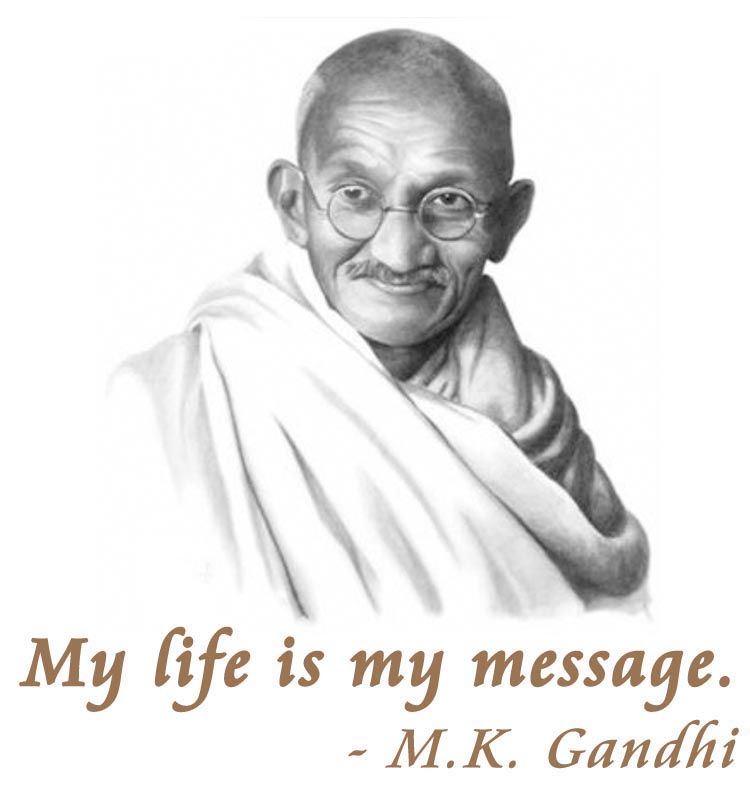
Mahatma Gandhi - A Protagonist of Peace |
- Nirendra Dev* The second day of the month of October presents yet another occasion to a grateful Nation to recall the teachings of the Father of the Nation, Mahatma Gandhi. The advent of Mohandas Karamchand Gandhi on the Indian political horizon posed enough reasons to excite as well as attract hundreds of Indians towards him and - more towards his ideology, which later came to be called the Gandhian Philosophy. It is indeed amazing that the personality of Gandhiji gripped the imagination of millions of his countrymen and in later stage an overwhelming number the world over. It was to his unique credit that in a world marred by violence and man-made hatred, Mahatma Gandhi stands firm as a man of universal goodwill and a protagonist of peace. What is more striking is that Gandhiji emerged during his life time as a torchbearer of peace, even today he continues to surprise mankind with his non-violent methods of resolving conflicts. To many, it is not merely a strange phenomenon that a Nation subjected to colonial rule put up a strong resistance against the British hegemony with non-violence as a principal tool under a frail looking leader like Gandhiji. What is stranger still is the magic spell of success his methodology continues to have. Can there be any denying the fact that 'non-violence' and the message of peace is still a familiar catchword among the world leaders to settle any international or bilateral dispute? It goes without saying that it is never possible to evaluate how much India and the world owes to Mahatma Gandhi, the holy mascot of peace. A peace - however with a difference! This is what the protagonist was himself to say: "I am a man of peace. But I do not want peace at any price. I do not want the peace that you find in grave". This is precisely an element that gives a suitable clause about Gandhi as a 'man of peace'. This is only to underline that despite being a crusader of peace, Mahatma Gandhi was not just cut out to be someone who would or could accept anything or everything in the name of a peace deal. Gandhiji's definition of peace was not without struggle. In fact, he had led brilliantly in fight against apartheid in white-ruled South Africa. Consequently on his return back home in 1915, Gandhiji took on the mantle as a social reformer with campaign against untouchability and other social vices. Later he extended this yardstick to political sphere and in the long run took his message of love, peace and mutual adjustment to the cause of Hindu-Muslim harmony. His 'Ram dhun', the popular devotion number, 'Ishwar Allah tera naam' is still the nation's best hymn for Hindu-Muslim peace. This brings us into debate what was then 'peace' to Gandhiji. Well, one can say that the highly upheld 'Peace' was not an end by itself to him. Rather it was only a sort of a means to ensure better welfare for the mankind. Mahatma Gandhi in real sense was a harbinger of truth. In fact, he even had said that 'Truthfulness is more important than peacefulness'. In this context, the following words of the Mahatma, as quoted from 'Young India' newspaper are quite relevant. Mahatma Gandhi wrote, "Though we sing - all glory to God on high and on the earth be peace - there seems to be today neither glory to God nor Peace on earth". Mahatma Gandhi wrote these words in December 1931. He died 17 years later in January 1948 to an assassin's bullets. It indeed was tragic that a saint of universal peace and non-violence fell a victim to violence and hatred. But even today in the circa 2010, Mahatma Gandhi's words of 1931 holds true. The world is today faced with plethora of conflicts - of all types. Therefore, we see Gandhi's emphasis on universal brotherhood and peaceful co-existence has all time relevance. His teachings are therefore the most upheld principles of patriotism as also on ways and means to end various global conflicts. In fact, a true testimony of Gandhij's teaching lies in the fact that mere "good ends" do not justify 'bad' means. The world over therefore, today the emphasis is on human dignity and upholding the values of natural justice. It is obvious that in today's world, nothing seems to be permanent except the 'crisis of peace' - and nothing would be a better tribute to this man than to re-dedicate ourselves towards the cause of 'peace' and mutual tolerance. Here lies the relevance of Gandhism. Source: http://www.pib.nic.in/newsite/efeatures.aspx?relid=66068 *Special Representative with 'The Statesman' in New Delhi. |