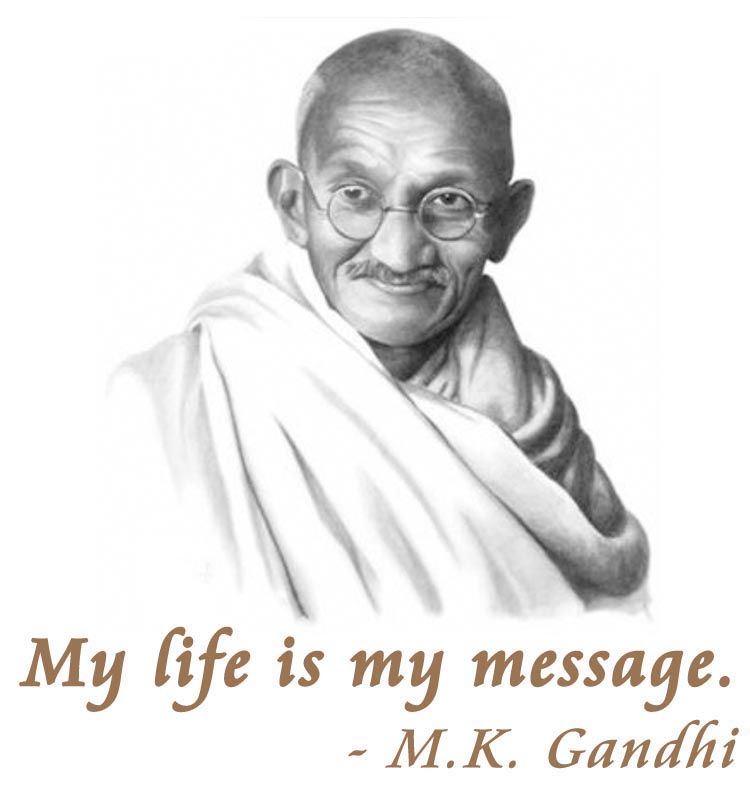
The Way Forward |
Is Gandhi's Doctrine Possible?Gandhi's doctrine of nonviolence has been shown to be very relevant and timely in many situations. He professed a philosophy, which he himself experimented in many situations, especially in gaining independence for India. One begins to imagine the number of lives Gandhi has touched. However, it is not a bed of roses for Gandhi and his followers. Gandhi faced heated criticisms right from the time he was still alive. Those who could not contain his innovations had him assassinated. Jinnah Mohammed Ali disagreed most of the times with Gandhi and was instrumental for the formation of what we have today as Pakistan. Can Gandhi's philosophy of nonviolence be understood is Iraq? Can it solve the current problems in the Middle East? Mandela found himself unable to continue with the application of Gandhian nonviolence and ended up making use of sabotage. Steger accuses Gandhi of sometimes condoning with what he called "conceptual violence."1 That is the construction of an "other" who is spiritually inferior or lacks truth. This lapse into conceptual violence theoretically delimitates his theory of nonviolence. Earlier on in 1920, Gandhi claimed that his nonviolence was a universal philosophy. He claimed that "my religion (nonviolence) has no geographical limits. If I have a living faith in it, it will transcend India herself."2 Gandhi however sacrificed at times his nonviolence principles in favour of nationalist power. Any Universalist theory must be accessible to all without exception. It shuns inequality. Gandhi's concerns for his nationalist principles have plunged him into so many criticisms and have many moral implications. His critics claim that he tended to represent a theory of community based on the exclusion of others. Steger further notes that Gandhi made political choices in the interests of nationalist power and tainted his universal moral philosophy of nonviolence. He further claims, "By participating in the instrumental process of seizing political power from the British, he (Gandhi) risked the dilution of his nonviolent principles."3 Furthermore, Gandhi though claiming a Universalistic philosophy, invited a particular Indian history tied to a particular group of people. Even within the Indian context, Gandhi tended to speak with a predominantly Hindu context. Nobody speaks from nowhere. On surface view, Gandhi's interpretation appeared as a "Manichaean world of good and evil with both violence and nonviolence serving as the main players."4 However, though Gandhi viewed violence as evil and nonviolence as good, it is difficult to reconcile his nonviolence with the way he took part in wars. Four times during his life, Gandhi offered his services to the army. Despite efforts to defend this attitude of, it still remains controversial to many people. However, the war service was something Gandhi outgrew. On another note, some moralist find problem with Gandhi's view of mercy killing. In the ashram, there was an ailing calf, which lay in agony beyond treatment. Gandhi decided to kill it by slow injection. When challenged if this would be done in the case of man, Gandhi's response seems to support Euthanasia. He said: In practice however, we do not cut short the sufferings of our ailing ones by death, because as a rule, we have always means at our disposal to help them, and they have the capacity to think and decide for themselves. But supposing that in the case of an ailing friend, I am unable to render aid, and recovery is out of the question, and the patient is lying in an unconscious state in the throes of agony then I would not see any himsa in putting an end to his suffering by death.5 In another case Gandhi was very absolute by saying, "should my child be attacked with rabies and there was no helpful remedy to receive his agony, I should consider it my duty to take his life."6 Such views portray mercy killing and are negative because it is a usurpation of God's lordship over human life. I. M. Onyeocha attests that "The initial intention is to put the person to death, while the ostensible reason is to make death easier and less painful and agonizing when it is considered that continued life would be burdensome."7 Gandhi cannot go away un-punctured for his "hate" for Christians treated in the sixth chapter of this book. He seemed to have understood the Sermon on the Mount in a literary way. He tried judging Christianity with the standards of Hinduism. He read only the portions of the Bible which moved in line with his frame of thoughts, and without reading all, he tried universalising the particular. The Sermon on the Mount literally understood is NOT the whole of the Bible with 73 books! Even the Ethiopian Eunuch when reading the Old Testament Scriptures asked for the help of Philip because the former could not understand (Ac 8:26-40). One can quickly conclude in Gandhi's case that the latter did not understand the Old Testament, so he kept it off from his doctrine. He could have asked for explanations from some biblical scholars. We should not rely much on these criticisms lest after bathing a child thoroughly, we throw away the washbowl and the child! We can learn from Gandhi's mistakes and sieve his thinking to take what is necessary. After reading the Gandhian affirmation which has been our bone of contention all this while, we insist that the contemporary Christian needs to put into practice what he hears and believes. It is interesting to note that Gandhi, according to Vinay Lal is someone everyone loves to hate. Lal insists: Gandhi has legions of admirers, but he has also been the target of severe, even virulent, criticism from numerous perspectives. Though Gandhi still commands veneration from many, he is also someone everyone loves to hate. Some critics fault him for particular positions, such as his support of the Khilafat movement, his inexplicable views on the Bihar earthquake, his deployment of Hindu imagery or idioms of speech such as 'Ram Rajya', and so on. Other critics, arguing from specific ideological positions, are inclined to find systemic shortcomings in Gandhi's views8. Many scholars like Vinay Lal ask so many interesting questions about Gandhi that one cannot fail to mention in these criticisms: why did Gandhi's legacy have no impact in countries such as Uganda and Kenya, where there were substantial Indian populations and yet the Indians faced eviction and discrimination? If even the Indian populations in Africa could not sustain Gandhi's teachings, should we expect that African people should have done so? The Way Forward for AfricaAfter such a flamboyant expose on the relevance of Gandhi's Doctrine of Nonviolence to Africa, the chief question remains: What is the way forward for Africa to adopt nonviolence? How can Africa, move step by step towards adopting an African Voice of Nonviolence? This involves adopting Peace in African Societies in the religious, political, developmental and educational hemisphere. Many African thinkers and theologians like Jean Blaise Kenmonge, Ká Mana in the book "Pour la voie africaine de la non-violence" (Towards an African voice of Nonviolence) have recently asked this question: "Is it possible to imagine today an African voice of nonviolence and propose it to the world for a new project of civilisation and of culture?"9 The expected answer is obviously YES. A yes which does not end in imaginations but of course, a YES which will encourage Africa to incarnate and invent a nonviolent doctrine to fight the chaos that the world order has placed Africa into, as reflected in all the African calamities. In the preface to this book, Mgr Jean-Bosco Ntep, of the diocese of Edea in Cameroon observed that, in terms of philosophy and practice of nonviolence as a necessity for education towards peace, having as its base the construction of a society based on Justice, Prosperity and Respect of Human Rights, Africa has not yet vigorously and decisively imposed her voice to reflect. Despite the presence of so many associations and movements in the society which are apt to implement the methods of nonviolent action in many African countries, it is a pity that our continent has not yet clearly shown clearly and with determination this moving force10. Nkrumah dreamt of having a united Africa. It is our thinking that nonviolence goes with unity. Gandhi fought vigorously to unite people. The best way forward for Africa is to be united. What happens in some African countries is quite appalling. Many who travel complain of the maltreatments received at the embassies in trying to get visas and also of the way they are badly treated in the receiving countries in Africa. We insist with Nkrumah that"Africa Must Unite!" Most African nationssince the year 2010 have been celebrating 50 years of independence. One is tempted to ask if it is really fifty years of independence or fifty years of neo-colonialism. Many think that Africa must adopt a New Independence which involves healing our selves from this sickeness of neo-colonialism and creating a new destiny built on African values. Africans need to feel free in the African continent and affirm themselves in the world. Africans will need to quit the consumer stage and take their right place in producing in all domains of life. After about fifty years of African independence which in my own humble opinion have failed, it is necessary to adopt the clarion call of professor Ka Mana: THERE IS URGENCY! There is urgency in thinking of the New independence of Africa in terms of grandeur, liberty and creative power. There is urgency to reconstruct the future of Africa. There is urgency in thinking of the leadership of Africa in terms of the welfare of the people. There is urgency in putting in place political, economic and cultural institutions capable of bringing up the capacity of Africans inventing and organising themselves. There is urgent need of intergrating the life of each African in a regional dynamic of cooperation and political solidarity in order to build a sound political system. Since there is urgency, we need to hasten up and organise our countries so that Africa should succeed. We need to crave the path even if it means carving roads through solid rocks. In effect the time has come to make our countries shine with the light of the new independence. There is urgency!11 Africa is aware of the light great people like Gandhi, Martin Luther King Jr, and a host of others mentioned above have brought forward to show that nonviolence is an indispensable necessity and an imperative to bring concordance and authentic harmony among humans. The bishop observes also that Africa so far has not taken time to reflect on her religious treasures, social norms and cultural values to offer proposals to the great barbarity ravaging our continent. Africa finds herself in a modernity in which, politics, economy international relations among religions are confronted by multiform absurdities. Despite this, Africa has not taken enough time to discover these modern forms of exploitation and domination, Africa has not proposed any new project of civilisation grounded on nonviolence. 7.2. ConclusionIn spite of all the heated criticisms on Gandhi, it is worth noting that he remains a fallible human being. In effect, "Gandhi may not have been his own best critic, his critics have also not done him the justice of attempting to understand how he negotiated the various critical worldviews that he encountered"12. It was not by chance that he was given the "Mahatma" and "Bapu" titles. Anyone who critically examines his theories will hurriedly conclude that he was saint like. While recognizing his shortcomings, his philosophy of nonviolence remains a masterpiece. He is the emancipator of the oppressed, the freedom and the empowerment of the people vis-a-vis a totalitarian and centralized state which has usurped all such freedom and power. With his philosophy, politicians will be persuaded to understand the dangers of violence. Gandhi faced heated criticisms from feminists, Marxists etc. Nevertheless, he opened up himself to criticisms by his frankness in his autobiography as Vinay Lal beautifully puts it: Since Gandhi himself never much abided by the distinction between the private and the public, he also opened himself up to criticism. It is doubtful, for example, that anyone would have known anything of that very small heap of indiscretions which he describes in his autobiography and later writings - the theft of a few gold coins from the family home; the visit to a brothel from where he emerged, predictably, with his virginity intact; the wretched encounter, which commenced and ended in his mind via the belly, with a dead goat; the lust that drove him to Kasturba's bed while his father lay dying; and the immense disappointment he experienced in his 60s when he was painfully brought to the awareness that he had not yet mastered the sexual instinct - had Gandhi not himself rendered his life, in his words, into an open book13. On this note, rather than spending countless hours criticising someone whose life remains an open book, well disposed to criticism, it is better to learn from his many virtues. Gandhi's intellectual influence on his countrymen was considerable. Some were attracted by his emphasis on political and economic decentralization; others by his insistence on individual freedom, moral integrity, the unity of means and ends, and social service; still others by his Satyagraha and political activism. For some students of India, Gandhi's influence is responsible for its failure to throw up any genuinely radical political movement. For others it cultivated a spirit of nonviolence, encouraged the habits of collective self-help, and helped lay the foundations of a stable, morally committed, and democratic government. Gandhi's ideas have also had a profound influence outside India, where they inspired nonviolent activism and movements in favour of small-scale, self-sufficient communities living closer to nature and with greater sensitivity to their environment. Gandhi's moral and political thought was based on a relatively simple metaphysic. For him the universe was regulated by a Supreme Intelligence or Principle, which he preferred to call satya (Truth) and, as a concession to convention, God. It was embodied in all living things, above all in human beings, in the form of self-conscious soul or spirit. Since all human beings partook of the divine essence, they were "ultimately one". They were not merely equal but "identical". As such, love was the only proper form of relation between them; it was "the law of our being", of "our species". Positively, love implied care and concern for others and total dedication to the cause of "wiping away every tear from every eye". Negatively, it implied ahimsa, or "nonviolence". Gandhi's entire social and political thought, including his theory of Satyagraha, was an attempt to work out the implications of the principle of love in all areas of life. For Gandhi, the state "represented violence in a concentrated form". It spoke in the language of compulsion and uniformity, sapped its subjects' spirit of initiative and self-help, and "unmanned" them. Since human beings were not fully developed and capable of acting in a socially responsible manner, the state was necessary. However, if it was not to hinder their growth, it had to be so organized that it used as little coercion as possible and left as large an area of human life as possible to voluntary efforts. As Gandhi imagined it, a truly nonviolent society was federally constituted and composed of small, self-governing, and relatively self-sufficient village communities relying largely on moral and social pressure. The police were basically social workers, enjoying the confidence and support of the local community and relying on moral persuasion and public opinion to enforce the law. Crime was treated as a disease, requiring not punishment but understanding and help. The standing army was not necessary either, for a determined people could be relied upon to mount nonviolent resistance against an invader. In Gandhi's view it was a "sin against humanity" to possess superfluous wealth. A nonviolent society was committed to Sarvodaya, the growth or uplift of all its citizens. Private property denied the "identity" or "oneness" of all men, and was immoral. In Gandhi's view it was a "sin against humanity" to possess superfluous wealth when others could not even meet their basic needs. Since the institution of private property already existed, and men were attached to it, he suggested that the rich should take only what they needed and hold the rest in trust for the community. Increasingly he came to appreciate that the idea of trusteeship was too important to be left to the precarious goodwill of the rich, and suggested that it could be enforced by organized social pressure and even by law. Gandhi advocated heavy taxes, limited rights of inheritance, state ownership of land and heavy industry, and nationalization without compensation as a way of creating a just and equal society. Gandhi touches the lives of everyone both young and Old. Michael Nagler recounts how Gandhi touched him since from the age of 10: By the time I came to Berkeley, already a "peacenik" with the rhetoric of the civil rights movement echoing in my ears, I had of course heard of Gandhi-but like most Americans, I knew little enough about him. A few days after my eleventh birthday I saw a picture of the Mahatma's cremation and the wild grief of the mourners on the cover of Life magazine, which left a distinct impression of otherness, even weirdness, about the man and his culture, and the little I later heard-about his fasts, his asceticism-did little to dispel this first impression. I admired his achievements, but they seemed almost more than human. I felt that he was probably a great man, and I was not, and that was that. But when Sri Easwaran began to weave his own reminiscences of Gandhi into his inspiring talks, slowly and from many angles shedding light on who Gandhi really was, an entirely new picture emerged. I began to see that Gandhi was at once much greater and yet more relevant-even to my own little life-than I had imagined 14. We still insist that If humanity is to progress, Gandhi is inescapable. He lived, thought and acted, inspired by the vision of humanity evolving toward a world of peace and harmony. Who is this great man that environmentalists, pacifists, conscientious objectors, non-violent activists, nudists, naturopaths, vegetarians, prohibitionists, social reformers, internationalists, moralists, trade union leaders, political dissidents, hunger strikers, anarchists, luddites, celibates, anti-globalisation activists, pluralists, ecumenists, walkers, and many others have at one time or another claimed as their patron saint, or at least drawn inspiration from him? We may ignore Gandhi at our own risk. The world needs Gandhi, Africa needs Gandhi. End Notes
|