Preface |
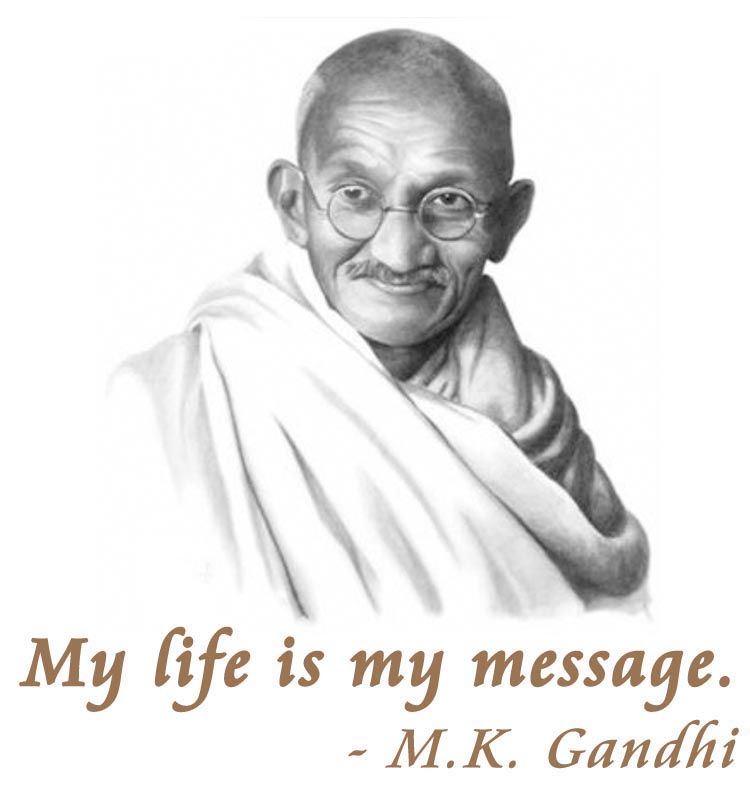
GANDHI or the future of humankindIn a world where the violence of men and nations has reached levels that make us fear the loss of life on earth and the annihilation of all that mankind has created beautiful, big, magnificent and wonderful over the centuries, a book on non-violence is always good news to receive. The one you are going to read meets these criteria in more than one title and in several angles. It is, first because it takes us back to the thought of the man who, in modern times, made of non-violence not only a fundamental theory to promote but a decisive practice of profound transformation of minds and social structures: the Mahatma Gandhi. This remarkable man, the author of this book presents forcefully his spiritual insights and guidance of thought and action. He shows at what point the idea of non-violence and its orientations of life such as Gandhi has developed form a base to build the only world worth being built today: the world of love in all its possibilities of humanisation of men and peoples. This book is also good news because it is written by a young Catholic priest who interprets Gandhi on the basis of what the message of Jesus Christ was radical in its understanding of love and in its valorisation of force to love, in the words of Martin Luther King. When we put non-violence in the global dynamics of love in the deepest sense that Christ gives, we understand that Gandhi did not only address to his own people in a context of political liberation of India but to all nations in which non-violence is a form of very fertile shortcut of what history has as the seeds of spirituality to make of each person a true human being and of society a place of true humanity. When a Christian reads and understands Gandhi from this perspective, as the Reverend Father by Jude Thaddeus Langeh Basebang, he offers a valuable contribution to our contemporary world dominated by the most barbarous and wild violence, a world where it is important and indispensable to place non-violence as a new basis of civilisation. His book is also good news for the African continent. For half a millennium already, this continent is dominated by violence. Her story is a story of tears and blood, of sweat and trauma from the horrors of slavery to the present globalization which does not augur something else for the future other than exponential intensification of violence. Even today, African news is woven by violence: the violence of weapons, the violence of murderous tribal identities, the violence of despotic powers, the violence of unending miseries, the violence of desperation due to injustice, inequality and denials of human rights everywhere in our countries. In this context, the good news of non-violence is not only a necessity; it is a life-threatening emergency. The Reverend Father Basebang understood this urgency and his book spreads the breath with a real happiness. By publishing such a book, it is clear that Africa's future cannot be built on another foundation than that of non-violence as that of Gandhi and that built on the fertility of the Gospel of Jesus Christ. Insofar as the book of Father Basebang feeds on all the juice of any politics of non-violence, it is good news for the education of future generations, those who have to build their future and who should not allow themselves to be dominated by the present civilisation of violence and destruction. Today more than ever, in Africa and around the world, the ethics of non-violence has to be devoted primarily to the education of youths. The future depends on it and there is urgency. With such an ethic, one can imagine that another type of politics will be possible: the politics of humans. Another type of economy will be possible: The economy of shared happiness. Another type of culture will be possible: the culture of responsible solidarity at the level of individuals, peoples, cultures and civilizations. We must express deep gratitude to Reverend Father Basebang for highlighting these basic requirements of humanity from the mind of Gandhi. Kä Mana University Professor |